27.1.14

A Fanta to End the Mourning

(by Eric)

Last week I received a text.  It was from our friend Pastor Luc, who is the assistant administrator at our hospital.  It said that he unexpectedly lost his mother that morning.  I was saddened for him, and touched that he would think to text me at a time like that.  Luc is a very solid guy.  When we first arrived, he drove us around to introduce us to the local administrators and the chief of police.  In light of our coming, he convinced them to add two new police officers to the Kibuye campus.  During a rain storm a few weeks ago, I was trying to get an urgent message to him, but the cell connection was cutting out.  Next thing I knew, he was at my door with a big umbrella and some rainboots.

Sunday marked the seventh day since her passing, and we were invited to a traditional gathering to mark the end of the initial mourning period.

An aside:  As I share impressions of Burundian culture, I'm sure that I'm getting things wrong sometimes.  I'm sure I will be able to re-read this in years to come and think "Wow, I really didn't understand that at all."  In a sense, I hope I will, since that will mean that I've grown in my understanding of this world around us.  But I will share it as I understand it, nevertheless.

We drove out in a little caravan of about 5 vehicles at 1pm.  Everyone was in a suit.  We left the tarmac after a few minutes, but the dirt road remained good.  Luc was in the car in front of us, and was frequently stopping to pick up more passengers.  It was obviously getting full up there, so we signaled that we could take some as well.  We arrived at the parish church, which has a gathering area.  A young mentally-handicapped guy came out and immediately hugged the three white guys in suits, and insisted on introducing us to various even-now-unidentified people.  There were a lot of hospital acquaintances there, and so we chatted a bit.  After a while, they showed us to a shaded area, and gave us the benches of honor, to the side of the head table where the family sat.

They passed out your choice of soda: Fanta Lemon, Fanta Orange, Coca Cola, or Schweppes Tonic Water.  We all enjoyed a beverage, and sang a few hymns.  Then Luc made a short speech, as did another guy from the crowd.  Then they passed out the envelopes.

The envelopes are for donations.  The donations, as I understand it, are for the payments of the debts of the person who has passed away.  In a sense that seems harsh, to come knocking for a debt after a death, but in a land of a lot of debt, and no small amount of death, it's probably necessary to have some security in the lending process.  We were told that, for older people, there is usually a second such ceremony during the dry season, since other people will then come from further away to collect further debts.

This is still uncomfortable territory for us, and probably will be for a long time.  As Americans, the purest friendships are void of financial matters.  We just like "being together".  Africans tend to value interdependence and solidarity in lieu of independence and "freedom".  So, being a part of this process assures them that they are integrally linked into the broader community.  That being said, we're still Americans, and so we feel the discomfort.  However, we took an envelope and tried to guess what would be appropriate for our friend, comforted by the fact that his character assures us that he will steward whatever gift well.

People came and brought them up to a little conical basket which is typical of Burundian style.  Then, before we knew it, they were closing the basket, and we three had to rush up and put in our donations before it was too late.  Thus ended our dream of inconspicuously participating in community life.  There was gentle laughter, and we sat down, chatted some more, shook a bunch of hands, and made our way home.

22.1.14

Case of the Week: Acute Flaccid Paralysis

(By Alyssa)

I met Claudine on one of the first days I rounded on pediatrics. She was 4 years old and I was immediately struck by how sick she was. She had been admitted severely anemic (Hemoglobin of 3) with a diagnosis of malaria. As she was comatose and had had several seizures, she was also treated for meningitis. She had already received a blood transfusion and a couple days of IV medications by the time I saw her but she was still completely unresponsive. She required intubation and mechanical ventilation but that’s not possible here. I spoke with the family explaining the gravity of her condition and we prayed with them together as a team. I alerted the on-call doctor and asked him to keep a close eye on her - he was called to evaluate her several times due to high fever, difficulty breathing, and seizures. I really didn’t expect Claudine to survive. But each morning I came back to pediatrics and found her still there. She began to open her eyes and look around the room. But she still didn’t speak or move. We discovered one day that she actually could follow commands with her eyes. But she was completely paralyzed to the point of being unable to swallow or speak. Possibly a post-infectious Guillian-BarrĂ© syndrome, possibly something else. We needed to give her nutrition somehow as it had now been over a week since she had been able to eat or drink anything. I discovered some pediatric nasogastric tubes in the back supply room. The nurses had never placed or used an NG tube before, so I inserted it and explained it to them. But then I realized we didn’t have any formula to put in it nor was there any milk available (cows produce very little milk here) and the family couldn’t afford to buy milk. So I talked with my teammates and the families agreed to donate milk each day for this little girl. Anna even helped me deliver it to her one day. And we taught the mother how to put the milk in the NG tube. After a few days, Claudine regained the ability to swallow, so we removed the tube and she was able to eat. The last day of her hospitalization she could speak very softly and barely move one hand. 


She came back today for a follow up visit and I feared she would be emaciated and still extremely weak. But, amazingly, miraculously, she looked like a completely normal 4 year old girl! Walking, talking, active - I wouldn’t have even known it was her if I hadn’t recognized her mother. I loved sharing this excitement over her healing with the pediatric team as the medical students and nurses rejoiced with us. We praise God for bringing healing to her and for reminding us in this way of His love for these precious children. 


17.1.14

On a Thursday Afternoon

Today the kids and I (Heather) were wondering what goes on up at the hospital on a Thursday afternoon.  We walked up with a camera in case any of you faithful readers were curious as well.
Thursdays at 4:00, Alyssa teaches the medical students how to do pediatric physical exams.  Abigail happily sat in today so that the medical students could practice checking her ears and eyes.

Then we found Carlan as he was walking between buildings on his way to examine a patient.

John was building walls for the eye ward operating room.

And Jason was scrubbing for surgery.  In this operation he actually drained 2 liters of pus from the leg of a 10-year-old girl with pyomyositis.

So that's what we found happening at the hospital at 4:30 on a Thursday afternoon.

9.1.14

First Impressions: Poverty

The blog silence for the last few days is largely a result of us not being sure what to say about beginning work.  Our own processing is so much still in process that it's hard to articulate anything to share.  It's a lot to take in, and one could slice it on any plane.  So I'll pick one aspect, not because it gives a comprehensive perspective, but because it might be adequately bite-size.  The good news is that we're not going anywhere, so if you keep reading the blog long enough, a holistic picture of life at the hospital ought to emerge sooner or later.

Taking care of patients here is hard.  We understand limitations, but we are all hit by a whole new level of limitations.  One of the largest of these is poverty.  This is not new, but it is at a whole new level.  According to GDP, Burundians on average make about 1/3 of what Kenyans take home.

Example:  Rounding on the medical service yesterday, and we see a man in his 50's with urinary obstruction.  We can determine that it's due to his large prostate.  That part doesn't cost anything (ask your neighborhood urologist why).  Jason can take his prostate out.  Great!  We can help this one.  Let's do it!

Problem.  There's a decent chance his urinary obstruction has made his kidneys function poorly enough to be dangerous for his surgery.  And actually hospital policy means he needs a few labs before going to the OR.  OK.  Our lab can check those!  Let's do it!

Problem.  It's too expensive.  It's probably at least $8 to get all those lab tests and he doesn't have the money.  His family is coming tomorrow.  Maybe they will have something…

This is an illustration.  In most other cases, the problem of the grinding poverty here comes into play right at the beginning, so they wouldn't make a very interesting illustration.

Poverty calls everything into question.  "Standards of Care" are almost always income-dependent.  Everything we know of such standards is therefore subject to drastic reevaluation.  This test for this problem.  This medicine for this benefit.  Is it worth it?  Well, what does this cost mean to you?  There is often no straight answer to this question, so it gives us a great sense of "shooting in the dark".  Was that the right decision?  I think so, but how can I know?

And this, of course, is humbling.  Or maybe humiliating.  Sometimes the difference is hard to tell.  And maybe not all that important in the end.  Humility (or maybe humiliation) seems to be one of the hallmarks of our clinical beginning here in Burundi, as it has been throughout our time of language learning.

It's not a new thing.  It's certainly not a bad thing.  But it's hard.  Pray for us as we go.

2.1.14

McCropder Docs Invade the Hospital


(by Eric)
 
Today, January 2nd, 2014, is the official start of the hospital work of the six McCropder doctors.  We have been involved in various ways in the past couple months, even with some clinical work, operating, and consults, but our Burundian doctor colleagues (and 1 American visiting doc) have continued to work in the hospital, thus allowing us for the most part space to work on homes, community relationships, and language study.
 
My impression of the community anticipation of this is that it is high.  People are excited to see the white coats, and the influx of more advanced care into this community.  24 medical students are slated to arrive on Saturday, to begin on Monday, this group for 4 months.  There are five Burundian general doctors (no residency training) at the hospital, and for the most part, we have been teamed up with them, to learn the ropes.
 
We got together to pray last night and talk about excitements and anxieties.  Some thoughts:
 
-It's been a long break from clinical medicine.
-Are we really going to do this in a foreign language (or two?)
-There is so much that needs to change.  How do we balance being leaders with respecting what has been going on, and not changing too much too fast?
-John is opening a new department today, and will be training his small staff on a brand new type of care.
-McLaughlins' kids will be having some time alone with a Kirundi-speaking nanny each week from now on.
-O God, help us to love.  Whatever we do, let us do it with your love.
-We are so thankful to have come this far, having been shown so much faithfulness by so many friends and strangers, and most of all by a Savior who has loved us and called us to a good work.

26.12.13

Ziplocks, Laughter, and Locking the Door

by Heather

Well, I learned three lessons this week.  Lessons about Ziplocks, laughter, and locking the door. 

On Sunday, six McCropders visited a church in a nearby village.  We arrived and were shown to our seats.  Guests like us sit on the stage in the front, facing the audience.  The service included baptisms, introducing the new district leader, and presenting gifts like chickens and bananas.  It was a lovely service until... right after the part where we greeted the church (that is, entertained the church with our rudimentary Kirundi)... Abigail, who had been unusually quiet for a five-year-old, murmured something about a stomach ache.  I whipped out a Ziplock bag, not a moment too soon.  The Ziplock caught MOST of the disaster, and I found some more on Jason’s sport coat when he stood up later in the service.  Our seats up there on the stage made it tough to be discreet.  Lesson one:  always travel with a Ziplock bag.

The service was several hours from completion, so I took the kids outside for a little fresh air.  Next door in a classroom building, some chickens were awaiting distribution in the church service.  Anna gave each chicken a name, set them up on the school benches, and began to teach them French.  This seemed pretty normal to me, or at least normal for Anna.  The others in the room, however, found the whole scene entertaining.  Laughter lifted the stress of the vomit fiasco, and lesson two became clear:  laughter helps to put mishaps into perspective.
When the chickens entered the church service, we accompanied them and stayed for the duration of the service, which ended at about 2:30pm.  We stayed for lunch and arrived home by about 4:30.  Upon entering the apartment, we discovered a mishap which challenged me to put lesson two into practice.

Somehow, evidently, unfortunately, Abi’s chicken, Ebony, was inadvertently locked in the house.  Ebony ate everything edible, and she made a VERY VERY BIG MESS.  Worst of all, she discovered one of Anna’s pet chameleons… and killed it.  : (   She also laid an egg on Abi’s bed.  We were hoping that Ebony was so miserable while trapped in the house for an entire day that she would never want to come in the house again, but alas, she seems to have decided that Abi’s bed is the only place she wants to lay her daily eggs.  Lesson three:  always make sure all your pet chickens are outside before locking the door.

We certainly will continue to learn many lessons in the year ahead, but I'm glad to have these three down now.

21.12.13

Christmas Container

 By Alyssa

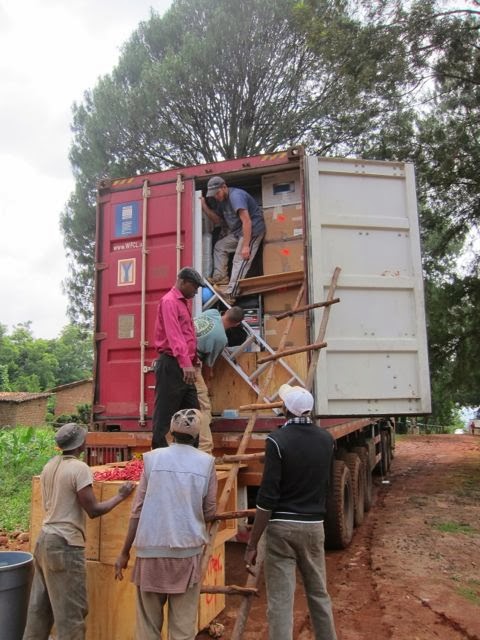
Christmas has arrived at Kibuye for the McCropders in the form of an enormous 20 ton red box! Our container is here! The container has been in Burundi for about 6 weeks but has been held up in customs and it finally was given clearance to come to us this week. Amazingly, the ministry of health requested that customs not charge duty on the container due to our service to Burundi - the customs officials initially said no to that - and then, inexplicably, changed their minds and didn’t charge us duty. Incredible! After the container was cleared, it took another couple days to identify a truck and driver - days full of rain and mud up here - and then the container made the final trek on Wednesday morning. After traveling from Michigan across the Atlantic and the Mediterranean, through the Suez canal, missing the boat in Oman, avoiding Somali pirates to arrive in Tanzania, and then traveling overland from Tanzania to Burundi, I think the last 3km were actually the most difficult part of its journey. We’re thankful that the 2 1/2 hour drive from Bujumbura to Kibuye is well paved until the very end. But the last few kilometers of dirt/mud created certain challenges for our container as you can see below. 

 First view of our container coming down the road

 Tight squeeze
 Stuck in the mud - Jason on his way up to the hospital
 OB consultation on the road
 Many attempts were made to get the truck out before the Busoma truck came to the rescue
 Lots of curious onlookers

Can you find John Cropsey?

But, the small hospital-owned truck came to the rescue and pulled the large semi out of the mud. And then the unloading process began. Thanks to John & Jason’s hard work, there was no wasted space in that container. It took them months to get everything fit in there perfectly and we weren’t quite sure how long it would take to get it unloaded. But the truck needed to get back to Bujumbura and the container had to be unloaded before it could be tipped off the truck and placed on the concrete slab. A team of strong men worked tirelessly all day taking ~300lb crates from our container to our houses.  And there was much rejoicing as everything seemed to be intact and undamaged! It didn’t even rain to speak of - remarkable during the rainy season. Ropes were placed to keep the curious onlookers at a distance. The workers at one point asked what the washing machine was - they couldn’t imagine a machine to wash the clothes. Everyone on our team had a role to play in the unloading process. But we weren’t absent from the hospital completely. In the midst of the craziness, Jason operated on a post partum lady (after discussing the case with Rachel), Carlan met with the medical director concerning administering narcotics at Kibuye, and I lectured midwife students on examining a newborn. This really is perfect timing for the container’s arrival as hospital work ramps up to full time for us January 2. God has indeed heard and answered our prayers and our hopes in His timing! 


 We all enjoyed watching for the container's arrival! 
 The kids were praying for the container's arrival just at the moment that they heard it going by their school window! 
 Even Toby watched the events of the day

 Very tightly packed container! 
 The most exciting event of the unloading for many
 Very heavy crates!
 The kids are very excited about their bikes, too! 
 Preparing to tip the container off the truck

 Sorry to the corn
 10 men with sticks/logs for levers moved an 8500lb container into place on the blocks. Incredible ingenuity of practical physics! 
 An empty container
Container in its new home

As we unpack picture frames and familiar belongings - many of which we haven’t seen for years - it feels like we’re really settling in. We have officially moved to Kibuye now that the moving van has arrived. I realized in seeing teammates’ things that, while we’ve been close friends and teammates for 4 years now, I’ve actually never known them in a stable settled place. I’ve never seen the many McLaughlin musical instruments, Carlan’s homemade bookshelves, Cropsey’s furniture, Anna’s bike, or Jason’s tools. We’ve traveled for four years to Kenya, the US, France, Burundi with only what could fit in 50lb suitcases. What a joy it is to make this our home hopefully for many years to come! I also think of the many people making this event possible for us - our parents who stored our things for us and cheerfully helped us pack and move them to the container, my sister’s high school friend who has been praying nightly for our container to arrive as she feeds her newborn, the ladies in my church who threw a container shower for me before I left Birmingham, many friends at Knox Presbyterian church who have gifted us with games and folding chairs and so much else, and myriads of friends and family and supporters praying for this event and caring about these details. Urakoze cane (thanks very much)!

19.12.13

Advent, Promises, and Their Fulfillments


(from Eric)

"Now there was a man in Jerusalem, whose name was Simeon, and this man was righteous and devout, waiting for the consolation of Israel." - Luke 2:25

Long ago, the wisdom of the Christian church decided that every year they would reenact the waiting of the coming of the Messiah, that it would remind us how to wait for his coming again.  And here we sit, at the end of that advent season.

Advent.  "Coming".  Coming of what?  The coming of that which was promised to us.  In the case of Christmas, it is the coming of a person, Jesus, but the fulfillment of every promise would flow in his wake.  God bringing his kingdom.

In a very true sense, our team has been celebrating the fulfillment of a promise since our arrival at Kibuye six weeks ago.  There was waiting.  There was unsettledness.  There were difficulties.  There was yearning.  There was a sense of God's calling, of his destination, but it was not yet manifest.  So we waited.  And it felt sometimes like it would never come.  It felt like maybe we should stop waiting, and start getting on with something more "useful".

And now we're here.   And we're celebrating.

Andrew Peterson sings: "It was harder than we dreamed, but I believe that's what the promise is for."  To sustain us in the difficult times.  And the more faithful the promiser, the more weight his promise carries.

And it's because it's hard to wait that we have to celebrate.  We have to celebrate and remember the fulfillment of the long waits, of the great promises, that we would learn to wait patiently and faithfully for the other promises that have yet to be fulfilled.

Simeon waited long for "the consolation of Israel", which seems pretty vague to me.  But even if he was specifically waiting for a Messiah, the misconceptions about Messiah-hood that abounded in Jesus' time would lead us to believe that Simeon wasn't expecting a newborn baby.

But then he saw him.

And the joy of a promise fulfilled was his.  It was joy enough.  For he knew that he could now die in peace, just having seen God's great promise fulfilled.  There is a satisfaction there that I rarely, if ever, can call my own.  Which is odd, given that I too believe that Jesus' birth was the coming of God's great salvation.

The yearning remains.  Why?  Because there are promises yet to be fulfilled.  Here at Kibuye, we celebrate, but the yearning remains.  Our arrival is far from an end in itself.  It is much more of a beginning, and we await what will be.  All of creation is still waiting for what will be.

Consider, along with us, the places in your life and in the world where the final fulfillment of the promise has not yet come to pass.  Then, consider Simeon.  Consider Israel waiting thousands of years.  Consider us now at Kibuye.  Consider all the thousands of tiny advents that indeed have already come to pass.

And let us wait.  Let us wait in expectation.  Let us wait well, for the One who promises is faithful.

"But when the fullness of time had come, God sent forth his Son, born of woman, born under the law, to redeem those who were under the law, so that we might receive adoption as sons." - Galatians 4:4 

14.12.13

Team Time

This weekend we have set aside two days for dedicated team time.  Yesterday we headed out together in the van to see some beautiful Burundian waterfalls.


After a picnic lunch, we returned home for reflection time focused on themes from the book we are studying together, Paul Miller's "A Praying Life."

This morning, in true Burundian fashion, we hoed in the garden.  “Kurima," one of the first Kirundi verbs we learned, means “to hoe."  Below, “Alyssa ararima.”


At the moment we are in Gitega, a nearby city, for lunch (and fast internet, hence the blog pictures).  We are thankful for the community of the team.  It's fun to spend designated team time together, and even better, it is a gift from God that we can enjoy daily life together on normal days as well.

We are all hoping that the next blog post might announce the arrival of our shipping container.  It is scheduled to make its way to Kibuye on Monday!  

6.12.13

Merry Christmas from Burundi


For more information on what we're up to and for alternative Christmas gift or year-end giving ideas,
visit our new website at www.kibuyehope.com.