15.1.21

Still Learning

by Rachel

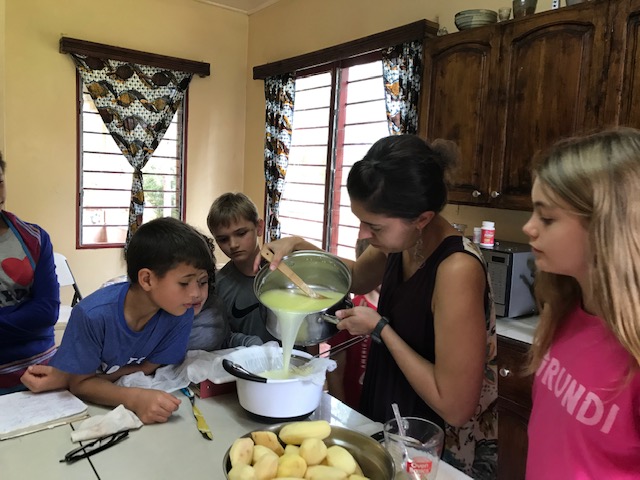
As for many people this year, we've had to be quite flexible to figure out a way forward with school in the Covid era.  We are very thankful that we've had the capacity to continue with in-classroom schooling!  And as most of you know, our teachers arrived, safe and sound, in early December so since Christmas Break we've been "back to normal" around here.  One thing that we've done in previous years that we've been able to continue this year is one of the kids' favorites, Learning Experience Day.  Once a month we take a break from regular school in order to focus on one specific subject, learning through nature walks, videos, games, and projects.  In past years we've explored everything from construction and solar panels to chickens and germs.  I thought I'd give everyone a brief recap of our themes from this year so far.  Enjoy...we sure did!

September: Owls and Raptors.  A throwback to a similar day from 2017, we were able to observe both a barn owl and several local hawks, in addition to learning about bird beak adaptations, dissect owl pellets, and sew cute baby owls from socks!

can you spot the hawk?

owl pellets

Bird "beaks"


October: Rocks.  While unable to actually tour our local quarry due to safety restrictions, we hiked to an overlook to observe heavy machinery mining and making gravel for the road.  We also had fun categorizing and observing rocks and minerals, and wrapped up by creating artwork and stories from rocks.

the quarry is behind us in this picture...dust from the gravel creation
 
A little mascot we picked up on our rock walk


Some story/rock art

November: Cows (and Cheese/Dairy): We spent some time learning about cows, dairy farms, and properties of milk before trying our hand at cheese making! (moderately successful, at least) In the afternoon, we got a tour of our friend Fidele's farm across the street from the hospital, where the kids got to see pigs, guinea fowl, chickens, and cows.  A worker even showed them how the cows get milked.


cow getting milked

January: Kingdom Fungi: With the arrival of new teachers, we didn't know we were also getting mushroom experts!  Steve and Mary took us on a mushroom hunt where we found a TON of different varieties growing around Kibuye.  We learned about fungus, yeasts, and molds (plenty of that in our wet and warm environment here), did some science experiments and observations, and made some spore print artwork.


look at the variety of specimens collected!!


spore prints

mushroom art!


28.12.20

2020 in Kibuye: A journey towards flourishing?

(by Matt)

If you have ever been to Kibuye and attended family worship on Saturday evening, you have probably said the following words as part of the liturgy: “Thank you (Lord) for leading our steps even when we do not understand.” Lately, every time I read and speak these words they resonate with me a lot. I guess it is because there is a lot I do not understand about life in Burundi, the world, 2020 and its series of crises.

The year 2020 has been a very challenging year. It has showcased the vulnerability of mankind, our exposure to risks and the possibility to lose the things that give us a sense of security and safety such as democracy, economic stability, health, freedom, and fellowship with others…

While the impact of these challenges has been gentle in Burundi this year, I am still struggling with the sense of vulnerability that this uncertainty has revealed. I would like to shield myself against the possibility of losing anything I possess.

My work in Kibuye as the construction manager generally puts me in a position of authority. By default I am called to take actions and to make decisions that are executed immediately by those who are under my authority. My natural tendency in this position is to suppress any kind of vulnerability. But as Andy Crouch puts it in his book Strong and Weak, whenever authority and vulnerability are not held together, the result is withdrawal (no authority and no vulnerability), exploitation (authority without vulnerability) and suffering (vulnerability without authority).

I do not understand everything about 2020, but in my role as construction manager I have been learning that it is good to embrace both authority and vulnerability, because that is the way to flourishing. Here are some examples of how this principle has played out in my work:
  1. When the temptation is to withdraw, remember you are part of the body. I have been learning that I am not a mercenary or expert sent to save/help Kibuye but rather part of the body of Christ sent to be with my brothers and sisters in Burundi so that together we can serve and take care of the part of the body that is hurting or needs my gifts. Being then doing. Being for me has come with personal and emotional involvement; I have been trying to be more deeply embedded in relationship and mutual dependence with the construction crew which makes me vulnerable in a way. For this reason the team has welcomed me as one of them but also as their leader. They started trusting me more than they did before.
    When we were finishing the kindergarten building, the director of the school approached me and told me that the school had decided to paint all exterior beams and columns of the kindergarten in a cream color. He did not expect any pushback from me but compliance. It was a simple request from the director who runs the school, a request that had no structural implication I needed to be worried about. It would have been easy to just paint the building and move on. But that would have been withdrawal. As a member of the community I was aware of the challenges we had with maintenance because of the lack of training, human resources and funds. It was my responsibility as an architect and a member of the community with authority to deliver a building that will serve the school and the community for years to come. I told the director that we were not going to paint exterior beams and columns because it would require regular maintenance, which the school could not afford. Instead I had designed it to be aesthetically pleasing and low maintenance. He was very disappointed in me but I thought it was worth pushing for. Now after two months of rain and mud the building still looks clean


    Kindergarten building

    View from the access road

  2. When the temptation is to act without vulnerability (exploit), find ways to stay in relationships. Dependence on my team exposes me to the risk of failure and disappointment but it also empowers my team with the authority to take actions that could affect me directly. At times the authority given is misused, but most of the time it is used in a meaningful way. If my team or the project fails, I fail; if they succeed, their success is also mine. I do not always like this kind of vulnerability but God has been teaching me to embrace it.
    A few weeks ago, I had to get 4 self-contained rooms at the Octaplex ready for 4 new doctors to move in. I relied on and trusted a local contractor to make all the furniture for the rooms but in the end, they let me down because they couldn’t meet our deadline. I felt vulnerable and suffered because of their actions. If I had not trusted them in the first place maybe I would not have felt disappointed and hurt, but I would have reinforced a negative bias about Burundian culture and contractors. Maybe I trusted them because I started to learn the meaning of being, accepting the other who is different as my brother or sister; or maybe I was learning that change, transformation and healing come when we are together in a relationship. We trust and get hurt but we also use the authority we do have (authority is our “capacity for meaningful action” according to Crouch) to try again; and we hope that the power of love that comes from being together will change the other and us. Although I ended up doing the work with my team to meet the deadline, we kept the relationship with the local contractor and contracted him for other work hoping that they will be more reliable in the future.


    The Octaplex

  3. When the temptation is to suffer out of fear of shame, take action together. I am learning that to be culturally appropriate does not mean to withdraw from taking meaningful action in order to avoid the possibility of loss or hurt. Instead, I think it means to communicate clearly in a respectful manner about the action that needs to be taken, while acknowledging that something valuable might be lost in the process.
    Last year, concrete test results for the paediatric building ramp were very bad. As a consequence, part of the ramp had to be demolished and recast. This was a very sensitive matter for leaders and members of the construction team. In this context, to demolish part of the ramp meant to accuse someone publicly of being incompetent at his or her work, a shameful rebuke in a shame-honour culture. I remember being asked several times if there was another course of action that would not require any demolition, but there was none. We had to demolish the ramp but we also were exposed to the possibility of hurt and a broken relationship with some leaders and members of the construction team. We decided to wait and demolish at a later date when everyone had come to peace with the decision. It was clear that no one wanted the ramp to endanger people’s lives by not taking care of the issue. Instead of using culture as an obstacle to good decision making and an excuse for inaction, we took action together and overcame shame and potential suffering.

    Paediatric Ward with the whole team

    View of the ramp

Now that I am at the end of my time in Kibuye as construction manager I can say thank you Lord for leading my steps to places of vulnerability where your spirit empowers me to take action in community and flourish.

I hope that in my journey I will gain more understanding of these words “I take pleasure in my weaknesses, and in the insults, hardships, persecutions, and troubles that I suffer for (the body of) Christ. For when I am vulnerable, then I am strong,” 2 Corinthians 12:10

25.12.20

Ordinary Miracles (and more on snacks)

 (from Eric)

THE LIVING PARABLE OF THE CHRISTMAS EVE SNACKS

And it came to pass, in the year of our Lord 2020, that, due to sundry obstacles, most notably the extended closure of national borders, that the venerated traditional Christmas Eve snacks of Triscuits, cheddar, and summer sausage were naught to be found.  Through months of advanced planning, such adversity had been averted in years past, but in 2020, December loomed with no prospects.

Then behold! As the Watts family prepared to return to Kibuye, a small offering of luggage space made it possible for the provision of a box of Triscuits.  Weeks later, as Rachel and I gazed at this precious box of rosemary and olive oil flavored woven wheat crackers, we smiled.  We could make do with local cheese and some leftover ham from Thanksgiving.

One week before Christmas, Erica surprised us with three (!) blocks of cheddar that she had brought from the United States as a Christmas gift for our family.  And then, the very day before this traditional Christmas triumvirate were slated to take center stage, our team gathered for another holiday tradition, the White Elephant gift exchange.  Skipping to the end, Rachel pried from the tragic hands of John Cropsey a solid log of Italian salami.

And so it was that the festal table in the McLaughlin household of Christmas Eve 2020 contained not only the unanticipated traditional family foods, but with a significant upgrade on the sausage front.


***

The italics and mildly absurdly elegant language above actually has a point.  We are in desperate need (always, but perhaps especially in 2020) to believe that God is at work in the world around us.  We are disheartened by the brokenness of things, and we ask God what could he possibly be doing.  Then something goes well, as we immediately attribute it to coincidence, or worse, to our own brilliance and diligence.  What we need is gratitude, but we find that it is a trait that does not come easily to our hearts.

"But the snacks?  Really?  I mean, I'm thrilled that you got some comfort foods, but this is no miracle."

Maybe not.  But who I am to say that so definitively?  It seems that, in the end, the degree of wonder that we see in the world around us has some irreducible degree of choice to it.  I can choose to minimize the wonder of everything I see, or I can choose to believe in it.  Either way, I have to choose.  I'm not talking about blind faith, or something uninformed, but rather a choice that is intrinsic to the patent fact that we are just not 100% sure what is really going on.  So I want to choose gratitude.  Out of the desperate need in my heart, I will look for God at work in the world around us.

As to the ordinariness of the snacks, I will plead Christmas.  I will plead the God of the universe as a baby.  I will plead a government census that brings a carpenter to his ancestral town.  I will plead the shepherds and whatever animals ate the hay in that manger.  I will plead "God with Us."  If a miracle is defined simply as "God at work", then it seems that "ordinary miracles" would be the norm.

***

Three weeks ago, Erica Ause and Steve and Mary Wiland arrived in Burundi.  They had been trying to get here since August.  They are now working in our kids' school and in other domains of Kibuye life.  A week later, the Watts arrived, finishing their quarantine with just enough time to take up their annual roles as hosts of the White Elephant exchange prior to Christmas.

Their arrivals seem like Christmas miracles.  We could still be waiting for them, but we're not.  They have come.  The long string of obstacles seemed like it might never ease up, but here they are.  Their arrivals were due to mammoth efforts by many people, but those efforts were bearing no fruit - until they did.

I'm thankful that they are here.  I'm thankful that they and we are well.  I'm thankful that, for reasons unknown, the Covid pandemic continues to largely spare Burundi.  I'm thankful for my children's growth and for being married to Rachel for 15 years.  I'm thankful for the hundreds of doctors that Hope Africa University has graduated.  I'm thankful for salami and cheddar on a Triscuit for Christmas Eve.  I'm thankful that God is with us.

Merry Christmas.

19.12.20

Snacking, Kibuye Style

by Jess Cropsey 

After living a certain way for a while, you get used to how things are, but sometimes you stop to think about something long enough to realize, Oh yeah, that’s actually pretty weird. A few weeks ago, I walked into our office to see how Elise was doing with her online school work. I found her calmly nibbling on some rose petals from a vase on my desk. Although she assured me it was perfectly safe to eat them, I quickly googled it to make sure.
That same night, I watched Micah climb into his top bunk and noticed some clover hanging out of his pocket. When asked about them, he replied they were for a late night snack while he was reading his book. These back-to-back events made me laugh and realize how weird my kids’ snacking habits really are, thus inspiring me to write this blog about snacking, Kibuye-style. 

First, it brought to mind an English class that I taught to some local teachers not long after we arrived in Burundi. One of our first lessons was about time of day which led to a discussion on meals. I taught them breakfast, lunch, and dinner. Then I attempted to teach the word snack, but was met with some very confused looks and questions like, “Wait, you eat again after your dinner?” Sheepishly, I tried to explain this away by telling them that Americans eat dinner much earlier than they do. Now that I better understand the food scarcity in Burundi and know that many Burundians live on 1-2 meals a day, I cringe to think about our discussion that day. Three full meals a day is a privilege while snacks are for young children and the wealthy. 

Since snacking doesn't happen much here, especially in our rural location, many typical snack foods in the US aren't available here. Oh, how we miss Goldfish, graham crackers, Welch's fruit snacks, grapes and cheese sticks! 

Sammy pounding the grapes during one of our final days on our last summer visit to the USA

Peanuts, boiled eggs, and homemade yogurt are some of our common snacks here in addition to bananas, passion fruit, mangoes (seasonally), carrots, cucumbers, and green peppers.
Sam with a mango about the size of his head

And there’s always a variety of homemade bread products available too — banana, pumpkin or zucchini bread; English muffins; tortillas; or bagels. Micah even enjoys onions raw or sometimes sprinkled over cinnamon bread. 

Micah in 2015 combining two of his favorite foods at the time

Apples, strawberries, and Pringles are some of our special snacking treats, but honestly I think my kids really prefer grazing outside.
Susan does a great job managing our community garden and the kids love munching on mint, chives, basil, broccoli leaves, and lettuce. Venturing out of the garden, there are even more choices available like limes, guavas, loquats, gooseberries, passion fruit, blackberries and mulberries from a neighbor’s tree, bush, or vine. There are even certain types of grass that they eat! The kids have been instructed to avoid all mushrooms just in case, but some of the workers enjoy picking the right ones (not the one below!).
But the kids’ all-time favorite go-to outdoor snack is “yum-yums” (or clover). Apparently there is a whole science behind finding just the right ones — bigger leaves are good and avoid ones with holes or yellow spots on the leaves.

Normally we don't allow food in school, but one stem didn't seem worth the battle

Journeying outside the residential area to nearby downtown Kibuye, the kids like to buy sugar cane or goat kebabs.  

A whole stick of sugar cane for about 20 cents

For the really adventurous, you can buy fried termites when the season’s right. 

Fried termites

Or if you're on the go, you can always eat them fresh!

Looking for a fresh termite snack (my kids are only observers here)

Update: Just this morning (Sunday), one of the guards was collecting the pile of flying termites that landed on our porch last night. Mary Wiland, one of our newly arrived teachers, gathered some too and fried them up (that's her picture above)! Taste test below...

10.12.20

Kibuye Music: Silent Night in 4 languages

(from Eric)

With the arrival of Mathieu Lembelembe a little over a year ago, I looked around and said to myself, "We have quite a bit of musical talent here at Kibuye now."  What followed was an idea to record a few Christmas songs amongst our team and several of our musical friends here.

Life being busy and 2020 being 2020, by the time I got around to finalizing any of the songs, many people had changed locales.  But we did manage to complete two songs.

The first is Silent Night, sung in English, French, Swahili, and Kirundi, the four main languages of Burundi.  Kayla, our American teacher, sings in English.  One of Kibuye's Burundian doctors, Ladislas, and his wife Annick, sing in French.  Mathieu, our Congolese architect, sings in Swahili, and the worship team at our local church welcomed me one dark evening to record them singing in Kirundi.  Michelle, Greg, and I came together for the music.

The second song was "Far as the Curse is Found" which I actually posted on this blog nine years ago.  For this one, I browsed my favorite carols for a bunch of lines that I thought were so good that they needed increased visibility and so pulled them altogether and made a new song.  They are 9 carols total, if you want to hunt for them.

Music sharing on Blogger not being any better than when I originally posted this in 2011, I'll just link the old video.  Suffice to say that Kayla did a great job singing background on the recording, and that the accordion made an unexpected appearance.  Email me if you want me to send it to you.  =)

6.12.20

Thanksgiving Roast

by John Cropsey

One memorable moment growing up in Togo was when my dad, the son of hog farmers, decided to roast a whole pig on a spit for one of the holidays.  I was pretty young, so I can't remember if it was Thanksgiving or Christmas or some other shindig, but I do remember that it was an all day affair that none of us boys ever forgot.  It was a special memory. 

At one point as I walked around the edge of the fire pit as us four Cropsey boys tended to the fire, I slipped off the log and my foot briefly entered the coals.  Fortunately, it was one of those rare moments this MK (missionary kid) was actually wearing shoes.  Unfortunately, these were "holy" shoes, and I don't mean spiritually.  A coal weaseled its way into one of the holes and lodged itself nicely onto my little pig toe.  That little piggy got roasted.  I yelped and ran like a banshee as apparently I hadn't yet learned the American mantra of "Stop, Drop and Roll".  My older brothers had to tackle me and rip my shoe off.   

Thankfully, the next time I was involved in a holiday freak fire accident, I had learned my lesson.  It was at Tenwek Hospital in Kenya 2010 when one of our Kenyan colleagues had her dress catch fire while lighting a sterno chafing dish heater that then exploded.  She pulled a classic "Cropsey" maneuver and took off running, her dress in flames. I full-out tackled this dainty Kenyan woman on the spot like a Michigan linebacker and beat the flames out with my hand while another doc ripped a tablecloth off of a fully set table like a magician and smothered her. Her dress was a bit worse for the wear, but she suffered only minor burns. She can thank my big brothers for teaching me "Stop, Drop and Roll" so well.

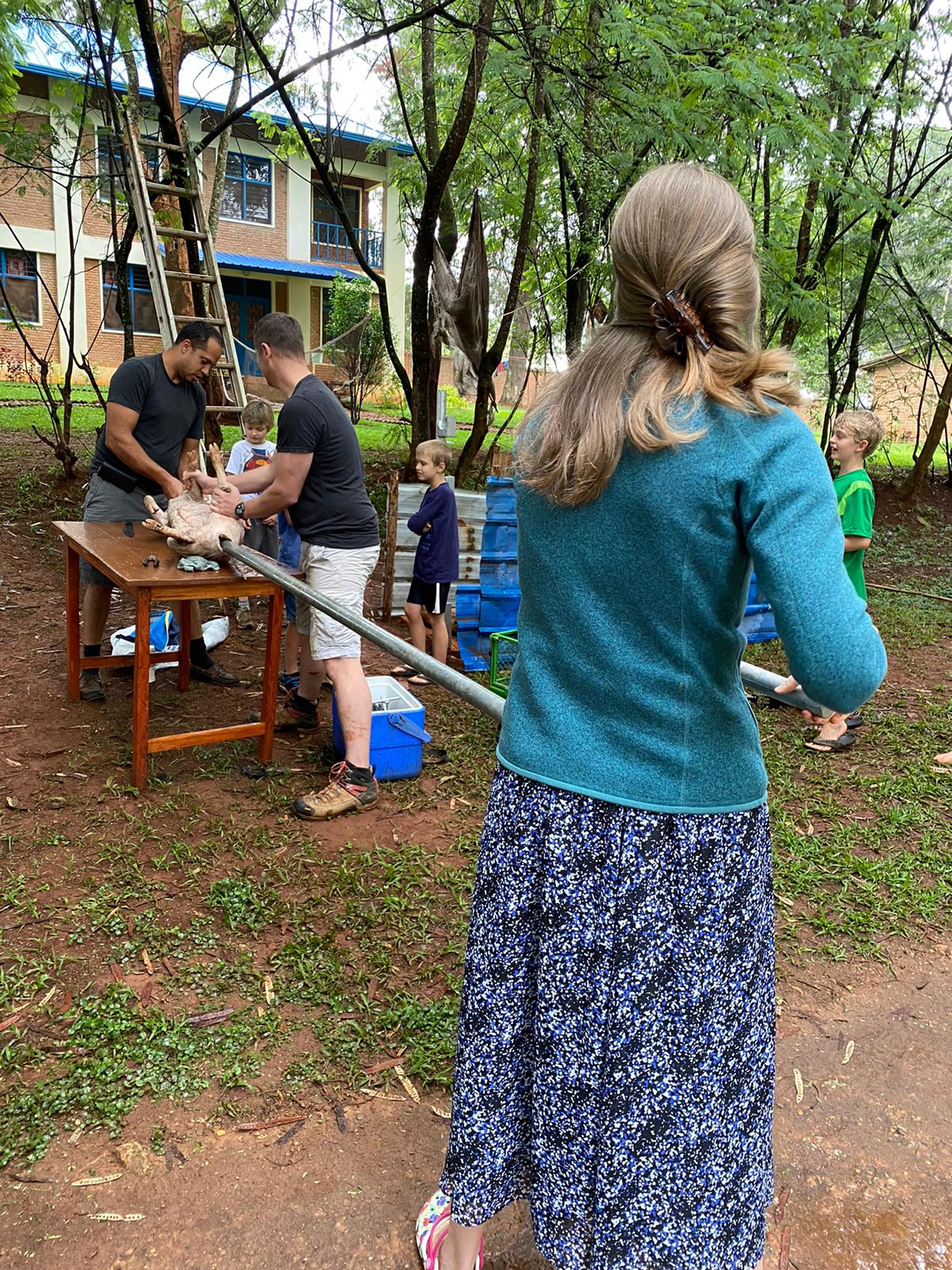
So, fast-foward 10 years, and you better believe I jumped at the chance when a fellow missionary here in Burundi, Isai Torres, offered to slaughter one of his pigs and have a pig roast at Kibuye for Thanksgiving.  What follows is a photo journal of the event.

The good "Dr" Isai Torres prepping the subject

Pre-salting, subject resting quietly

Transfer to the operating table

"Dr" Torres opening the belly for insertion of the secret herbs

"Dr" Torres closing the belly with a perfect, running suture. 
Someone may have missed their calling in life as a surgeon!

Preparing for the rigid sigmoidoscopy

Dr Jenn at work as several Kibuye children simultaneously vow to become
life-long vegetarians (until they tasted the final product)!

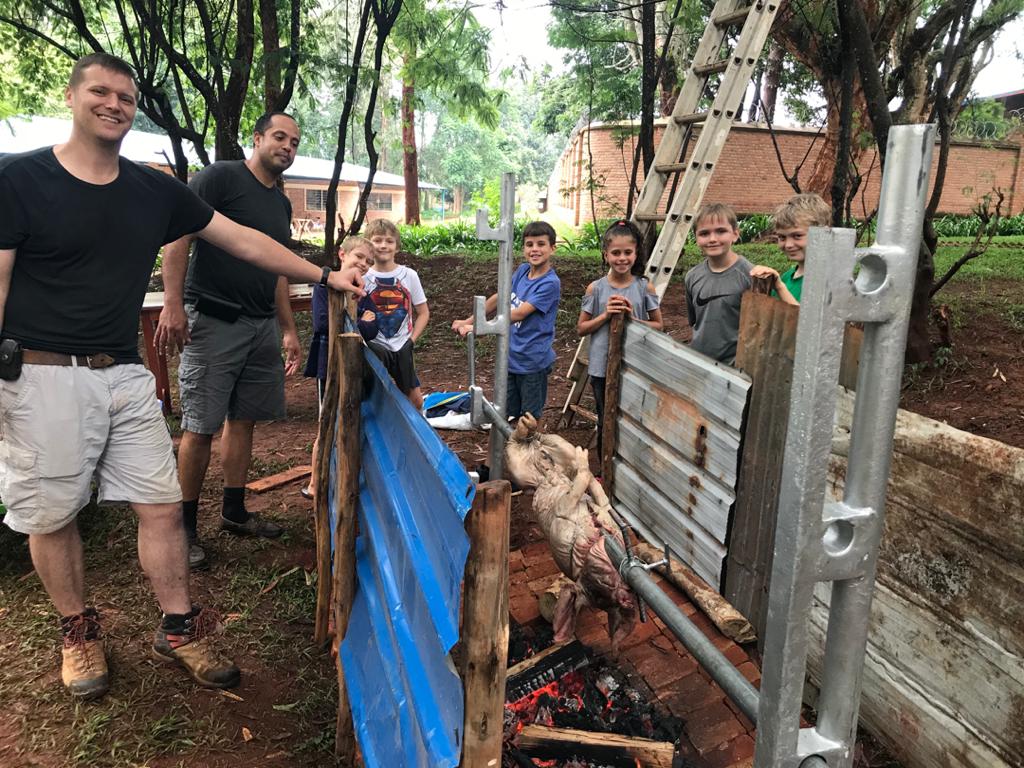
Let the roasting begin... Note, the childproof pit sides so no one gets hurt this year;)

Pop, sizzle x 3.5 hours . . . the skin was the most amazing part!

A happy Thanksgiving crew...

We have much to be thankful for at Kibuye. But our biggest Thanksgiving blessing was hearing the news that our much awaited teachers who had been delayed 3 months in the USA due to airport closure and visa issues could finally make the trip to Burundi! They just arrived yesterday after finishing their quarantine in Bujumbura. Now they will finish another 10 days of quarantine here in Kibuye. Welcome Wilands and Erica!!!

During hotel quarantine

On release to the wild!


25.11.20

Global Missions Health Conference 2020

 by Logan


Last weekend was the 25th anniversary of the Global Missions Health Conference, normally held in Louisville, KY.  This year, however, the conference was completely virtual due to COVID-19. I was really impressed with the virtual format, especially since this was the first time they did it completely virtually. Over 2000 attendees logged on to a newly redesigned website to worship together, learn from each other, and get inspired about medical missions and God’s call for their lives. 

There were some incredible plenary speakers, sharing about topics such as hearing God’s call to go to difficult places, the Christian response to the coronavirus pandemic, and dealing with mental health issues overseas.  There were some great times of worship, as well as a variety of different breakout sessions.  I led a breakout session about healthcare education as mission. 

My hope was to inspire people who are interested in missions and global health to consider healthcare education as a primary way to answer God’s call to missions.  I shared about what we are doing at Kibuye Hope Hospital, with medical student education, the current stage professionnel (“internship”) program, as well as our desire to see FM and surgical residencies start in Burundi. I talked about how medical education multiplies the effect one person might have, because they are playing a role in treating all the patients that their learners will see in the future. I also discussed the value of discipleship and mentoring relationships that develop naturally as a result of education.  

I used Moses’ interaction with God at the burning bush (from Exodus chapters 3 & 4) as an illustration of a way to respond to potential resistance to medical mission work in general, and specifically medical education missions. I don’t think the talk is currently available, but I believe all of the sessions will be uploaded soon at medicalmissions.com.

In recent years, our team has been well represented at this conference. In 2019, Alyssa Pfister was on a panel discussion about medical education, and led a breakout session about rural medical education. In 2018, Eric and Rachel McLaughlin moderated a panel discussion about missions and marriage, and Eric also spoke about resiliency in missions, using chapters from his book, Promises in the Dark, as illustrations.  

The GMHC is intricately linked to the story of our team in a number of ways. For example, Eric and Rachel actually met at the GMHC in 2003, so the conference serves as an anniversary of sorts for their relationship. The original “McCropder” team was officially formed at the GMHC in 2007, and it was through connections that were made there that they landed at Tenwek Hospital for the Samaritan’s Purse Post-Residency Program. I would be willing to wager that this connection to the GMHC is probably true for so many other medical missionaries.  

Personally, I first attended the GMHC in 2008, when I was a third-year resident at Cox Family Medicine Residency in Springfield, MO. It served as an informal interview weekend as I was applying to the Via Christi International Family Medicine Fellowship. This fellowship led me to Tenwek Hospital and is where I first connected with the McCropders.  

In fact, I remember that a strange thing happened at that conference.  I was listening to the plenary speaker talk about how important it is for God’s word to spread all over the world and how we need to be willing to take it there, even if it’s difficult, when I heard a word from the Holy Spirit say, “Learn French.”  I even wrote it in my notes.  But I had no idea what it meant.  I had studied Spanish, and had been on medical missions trips to Bolivia, and had always assumed that learning Spanish would serve me on the mission field someday. Little did I know! It was also at the GMHC in 2013 when Julie and I felt God stirring our heart towards long-term medical missions, and eventually led us to Burundi to rejoin the same team we had first met in Kenya. 

God has a way of using this conference to speak in a unique way and guide His followers on the path that He is leading them. If you didn't get a chance to attend this year, I hope you will have the opportunity someday in the future. 

15.11.20

COTW (x2) : PSGN and diaphragmatic hernia

(from Jenn)

I've seen such a variety of diagnoses during my short period of time here at Kibuye.  I find myself reading more articles and textbooks now than I did even during residency.  I love learning and I love this job. Some diseases are impossible to diagnose  (ones where you need renal biopsies, or specific antibody or serologic testing for... which we don't have available here) while some, if you know what to order, are a joy to work through.  

For example, we had child present with edema, hypertension, and cola-colored urine.  We (the students and interns and I) worked through the differential diagnosis. On admission the doctor had asked for a study of the urine, but the lab stated the urine was to discolored and wouldn't work.  So we worked through the differential - they considered nephrotic syndrome and congenital heart disease, renal insufficiency.  I said that these were good ideas, but we should try again for a urine analysis.  It came back the next day positive for blood (causing the cola-colored urine), but only mildly positive for protein.  For the diagnosis of nephrOTIC syndrome, on expects to see A LOT of protein in the urine. So this diagnosis didn't quite fit. I asked the team to try to come up with another diagnosis to put on the differential. Someone suggested nephrITIC syndrome and I agreed.  I asked the team if they knew one more test we could do to try to narrow down the diagnosis, and we decided to obtain an ASO titer.  If positive, it tells you that the patient has had a recent infection with Group A Streptococcus (AKA the bug that causes strep throat and scarlet fever, which can eventually cause glomerulonephritis OR rheumatic heart disease).  It came back positive. So we had the diagnosis - Post-streptococcal glomerulonephritis.  

While most of the time it's fun to figure out a diagnoses, a class of diagnoses that are not so fun are congenital malformations concerning major organs that, here, result in rapid decline and death.  

This baby was born at term or near term and had rather significant respiratory distress right after delivery and was therefore transferred to us in the NICU.  The baby's distress did not improve, even with high amounts of oxygen so we decided to obtain an x-ray which showed this. 

This is a large diaphragmatic hernia - where the diaphragm does not develop correctly leaving the possibility for the intestines and sometimes the spleen and kidney to enter into the chest area.  This causes a problem because the lungs therefore cannot develop correctly.  With many disease, there is a range of severity. Sadly for this baby, the lungs seemed to be quite underdeveloped which could not be fixed by a surgery.  

Fortunately this is not the norm. More times than not, the NICU is full of babies born too early who need a little bit more time to grow and develop, who need to be closely monitored for infection and who need to live in a controlled setting before being able to go home.  

7.11.20

"Let the little children come to me"

(by Jess)

It is a short Bible story that appears in three Gospels, and here is my summary: Adults think that Jesus shouldn't be bothered with kids during his tour of public ministry. But when they try to keep the kids away from him, Jesus becomes angry and says: "Let the children come to me. Don’t stop them! For the Kingdom of Heaven belongs to those who are like these children."

We read this passage during Tuesday night Bible study recently, and it was a needed reminder to me that God values me and all people, not because of how smart, good, useful, productive or mature we are. Kids are not known for leading the human race in those characteristics.

God loves kids as they are and thinks they are important enough to spend time with them and bless them. One Bible commentary says this about the end of this story in Mark 10:16, "Jesus' loving action vividly illustrated that His blessing is freely given to those who receive it trustingly. The intensive compound verb "blessed" (kateulogei, imperf., occurring only here in the New Testament) emphasizes the warmhearted fervor with which Jesus blessed each child who came to Him."

So Jesus didn't just tolerate the kids; he wholeheartedly, gladly, intentionally blessed each child.

This past year, God has given Matt and I an opportunity to see just how much he loves his kids in Burundi. Because nearly all of our work here has revolved around kids in some way (it just played out that way), we have started to notice how much He is intervening on their behalf to bless them, care for them and remind us all that they are important.

Of course the main project that brought us to Kibuye was the Pediatric Ward at the hospital. When we arrived, I was surprised to see that it was the largest building on the campus, more than twice the size of the next biggest ward. Why? Because almost half of Burundi's population is under the age of 15. And because kids are important to God.


The playground at the Peds ward was completed this week!


Another construction project that Matt immensely enjoyed was the preschool and kindergarten for the local primary school. I loved watching the design evolve to take into account the future users - very short learners! Hence the windows arranged at various heights, the benches built into windows, and the minimal use of steps. We loved seeing kids of all ages who were magnetically drawn to it and intuitively explored it. Hopefully it serves them and their teachers well! (You can see some of the new pre-school students in Jess's blogpost.) Why spend time creating such a beautiful space? Because kids are important to God.


All smiles and giggles!


My roles in Kibuye have gravitated toward serving kids, too. I've already blogged about boiling lots of eggs each week for kids who are supported by the malnutrition program at the hospital. But I also get to jump in on the occasional sickle cell clinic to color with kids. Because playtime is important, too.

Elise and I joined the med students and interns to color with about 50 kids last week. 


I've had fun connecting with the Serge kids, too. I start my weekdays with "read-to-self" time with elementary boys at KHA, and I look forward to spending time with the older girls during our weekly crochet club. 

Our current crochet project is to create a few of these octopuses to give to preemies at the hospital. Apparently the squishy arms remind babies of the umbilical cord and comfort them.


Honestly, I'm not a exactly a "kid-person" who just can't get enough of them, and yet, God is opening my eyes to see what he sees: not just their future potential, but their present value and God's image in them that is worth celebrating, serving and just plain getting to know. I am glad that this Kibuye season turned into a reminder for us of how important these little ones are to Him.

And maybe, keeping these kids in view will make me a little more like them, more ready to notice and receive God's kingdom and the unmerited blessing Jesus offers.

4.11.20

Saving Face, Part 2, “Shame, Pain, and Beauty”

 by Carlan

The Sunday after my ladder fall, as I was feeling just good enough to get out of the house, I decided to attend the French service at our local church here in Kibuye. I took some Tylenol and headed up the dirt road to the mud brick and plaster building at the center of our campus. It was my first time out in the community with my “new” face and I got more than the usual number of stares from kids and adults as I passed them on the trail. With two black eyes, a swollen lip, and healing wounds all over my face, I know I looked like a frightful sight, but I had to go up to God’s house and give thanks for the ways He had protected and preserved me.

During the singing time, we sang a 4-line song called “My Beautifier” by a Nigerian musician named Chris Shalom. I cannot vouch for the singer-songwriter’s character or doctrine and I likely would never have heard this song were it not for the committed musicians of our local congregation. It is a simple song yet it prompted some deeper reflections that I want to share with you. The four lines are:

My Beautifier, You’ve taken away the shame // You’ve taken away the pain // You made my life so beautiful (repeat first two lines) // You’ve made me just like You.

My first thought centered around that title “Beautifier.” I smiled at the creative use of language — the term is immediately comprehensible even though I was pretty sure it is a neologism. (I checked, neither the Oxford English Dictionary nor Merriam-Webster have definitions for “beautifier”.) It also made me think of the similar term, “beatify,” which, to my understanding, is the penultimate step in the Catholic process of investing people with the title “Saint.” In a much more profound way, Christ is the One who declares us and makes us to be saints, holy ones...not on the basis of good works we have done or miracles we have performed, but on the basis of His perfect life and vicarious death and resurrection.

The removal of shame occupied me next. Having just felt the eyes of my neighbors fall on my disfigured face, that line struck a visceral chord in me. Jesus takes away my shame. It is my shame. I deserve it. And He removes it, not by snapping His fingers and causing it to disappear, but by bearing it Himself. He took it upon His person and suffered dishonor for His beloved sheep.

The same process happened for pain. Having spent the prior five days with daily pain, thinking about the effect of Christ’s work, the relief He brought through His own afflictions, humbled and encouraged my heart. This is truly a beautiful life, the one purchased by Christ.

By the time we got to that last line, I was starting to tear up. “You’ve made me just like You.” I’m aware of my lingering sinfulness and the struggle to daily love like Jesus loves...but Romans 8:30 says, “those whom He predestined He also called, and those whom He called He also justified, and those whom He justified He also glorified.” All those verbs are past tense. So in some very real but difficult to realize way, having been predestined, Christians are already glorified. And while all people are image-bearers of God, there is some special way in which the Redeemed are image-bearers of Christ. That is, after all, why we are called “Christians” (little Christs, Acts 11:26).

So my facial injuries, the source of my shame and pain, are somehow useful in making me just like Jesus. He was beaten and disfigured, like one from whom men hide their faces (Isaiah 53:3). Could my facial injuries help me to identify with Jesus Christ? Could the visible wounds and scars serve as a reminder to me and others of what the Son of God suffered for His Passion? I will then count them as a blessing and a gift, if they make me more like Jesus.

However, beyond even the cosmetic, the character development that God is working through this trauma and its sequelae conforms me more into the image of the suffering Servant, the Lamb of God, the once-for-all Sacrifice for Sin and the Great High Priest. Wow! I have a hard time wrapping my head around the genius of God that can convert something like smashing your face into the ground into a treasure of character growth and sanctification, but I that is what He did for me all in the span of singing a few lines over and over again. May Jesus Christ be praised!

Here is the Chris Shalom YouTube video — song starts around 0::45s