10.1.12

Support-Raising Update

Our (roughly) monthly support update.  As of the end of December (yes, I realize it's not really the end of December anymore), the McCropders as a team have recieved (or pledged):

  • 53% of our needed ongoing monthly support
  • 44% of our one-time start-up cost
Here is last month for comparison.  Thanks so much to all of you who have been a part of this.  Donation info link is here.

9.1.12

Being Homeless (Like Jesus?)

When you are a missionary, the question "Where are you from?" or "Where do you live?" gets very complex.  This year, it's even more difficult for us.  In 11 months in the US, we will "live" in Tennessee 3 months (but gone half the time), Arizona 2 months, Michigan 2 months, Colorado 6 weeks, and Baltimore 4 weeks.

After arriving home, we bought ourselves a sturdy little car to get ourselves around this year.  I called up the insurance company to get all my ducks in a row, and explained that we had just returned from living abroad.  The agent asked if I would be needing homeowner's insurance or renter's insurance.  My reply: "Well, you know that CR-V you just insured?  That's our home for this year."  His response: "Well, I'm sorry to hear that, sir, and I do hope that things improve quickly for you."  Serious and tactful to the point of funny.

We are functionally homeless.  We depend on the generous hospitality of others.  We have bedrooms and maybe a bathroom, but not a home.  One day (on the road), Maggie asked, "Where is our home?"  Silence ensued.  We will not have our own home this year, other than our car, pictured below, packed to the hilt.  


This can definitely be challenging.  When you lose something, it is gone.  We unpack and pack a lot.  We are always a guest.

Jesus once said that "foxes have dens, and birds have nests, but the Son of Man has no place to lay his head." (Matthew 8)  In fact, for a long time, various segments of the church have chosen to describe Jesus as "homeless".  The Franciscans in particular, for a very long time, engaged in long dialogues about whether Jesus even owned the cloak on his back (the idea of his being homeless being a foregone conclusion).  Anyone would agree that he traveled light. ("take no bag for the journey or extra shirt" he told his disciples.)

And yes, since Jesus emulated this, there is a virtue to be found in this.  I thought that is what I was feeling all of those times when I would go off with a single backpack, containing everything I needed for the next two months.  And maybe it was, sort of.  But I still had a home to go back to, at the end of the journey.

At one point in our journey, Rachel and I concluded that:
  • Yes, we are living "like Jesus" in our homelessness, BUT
  • No, Jesus did not carry all these loads of stuff around with him everywhere he went
And thus the joys of "traveling light" are not ours.  We wonder about this.  Should we just trust that, wherever we show up will have a place for Ben to sleep, and thus the pack-n-play is unnecessary?  Should we just trust that Maggie will have clothes waiting for her when we get there?  Or maybe we'll just show up under-dressed to every quasi-formal event for the next year on the grounds that we will only travel with 3 shirts, 2 pairs of pants, 1 sweater, and 1 coat?

It's funny, because our lives in Africa have led us to reduce our possessions pretty dramatically.  And it continues to do so, as we know that we are not in a position to be acquiring much of anything.  I mean, there's no room in the car.

And yet, "the stuff" still has an element of burden to it.  We still feel how it creates a gap between us and the life of Jesus.  That doesn't mean that it doesn't also serve as a benefit in other ways, but the benefit is not without burden.

And so, oddly enough, we look back to our apartment in Kenya, full of hand-me-down furniture and borrowed kitchen utensils, as well as looking forward to a student dorm apartment in France, for a sense of home.  Not in the "home culture" or "friends and family" sense.  But in the "place to rest your family in their own space" sense.  And in the meantime, we will keep moving across this beloved homeland of ours, pursuing what we believe God has called us towards, incredibly grateful for the homes of others, opened to us as we sojourn on.

(Below: Ben jumps into the sneaker-car at a McDonald's in Gallup, New Mexico, during a pit stop, showing that he can never get enough of the open road.)


6.1.12

Transitions

One of the topics that we studied at the Mission Training course last month was the subject of making major transitions between continents and cultures.

While the adult class learned all about transitioning, the children learned an age-appropriate version in their classrooms. Anna, our six-year-old, can now tell you about the five stages of transition:
The blue sticks at the beginning of Anna's bridge (transition) show the Settled stage. Leaving the solid ground of home, the bridge begins to feel a little unsteady in the Unsettled stage. The red sticks in the middle, where the sway of the bridge can feel most turbulent is called the Chaos stage. Note that during the unstable Chaos stage, we know that the love of God holds us up. Beginning to settle into new ground is the Resettling stage. And finally we should establish a New Settled in Burundi.
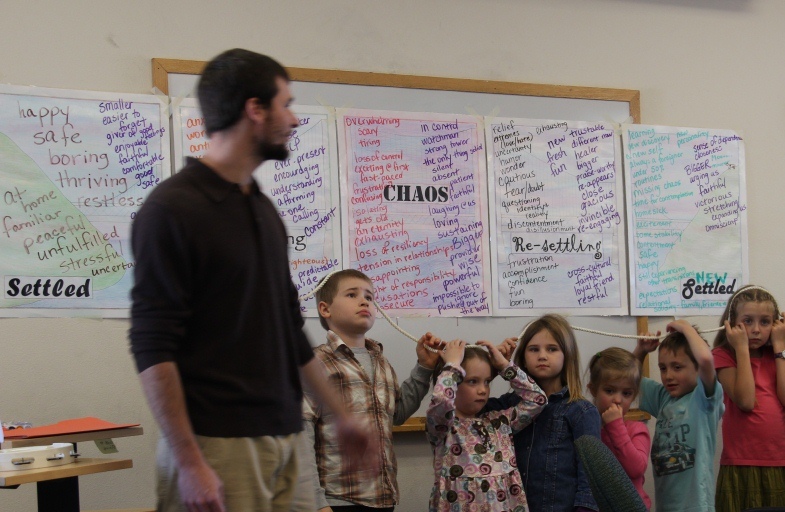
Anna got the concept. When the three week course was over, she was tearfully saying goodbye to her new best friend Cordelia (pictured next to Anna below). As Cordelia drove away after the course ended, Anna wailed with sadness. After a moment she found words to explain, "I'm in CHAOS!"

Abi also had a new good friend at the course, but these little kids do not verbally process the impact of transition as much.

Our family's current transition is underway as we are settling back into our home in Ann Arbor for the next six months. We are so excited to be here in this community again! Having gratefully received help from friends through this transition, I encourage all of you to reach out to help someone near you who is transitioning.

More transitions next week: Anna transitions from homeschooling with me to attending first grade in a local school, and Jason begins working in the USA. We appreciate prayers for these upcoming changes and also for the whole McCropder team as we continue to make preparations for transitioning to Burundi.

31.12.11

Motigo at Sunrise

On the morning of our departure from Tenwek Hospital, I managed to squeeze in something that I had wanted to experience for quite a while.  Believe it or not, it was definitively not to take a "pikipiki" (or motorcycle) ride with Jason.  Rather, it was to see the sunrise from the top of "Mount Motigo", which is the nearby hilltop, and the nearest peak around.

Right on the equator, the sun always starts to rise around 6:15 AM, and the walk is about 45 minutes.  But on the back of Jason's bike, we made the trip in under 15 minutes.  We got to the top just in time.


The lights of the Tenwek Community and Hospital down the hill.

This is what I had really wanted to see, which is the clouds settled into the valleys over the hills.


As I write this, 9 hours ahead of Mountain Standard Time, the New Year is fast approaching Motigo Hill and Tenwek Hospital.  A small village full of people we love.  An hour later, Burundi will welcome the new year.  May the Lord bless 2012.

Happy New Year.

27.12.11

State Race

I have been accused of creating competitions with others that they did not even know they were a part of. This may be a case in point. In any case, since I am winning I thought I would share it!

The McCropders have done a fair amount of travel in the past few months and we have covered well over half of the states in the US through those travels. Most of the travel is related to seeing family and friends, raising awareness about Burundi, speaking and attending conferences, and speaking in churches. As it stands, the Faders have been to the most states as seen in the graph below.


In full disclosure, I must admit that when we were visiting my cousin and her family in New Hampshire, we travelled an extra few miles off the necessary path since we were literally 1 mile from Maine and we just couldn't pass up the opportunity.

Combining all of our states shows that we have just a few more to go. The states in red below are the ones that at least one of the McCropders has been to since September.


create your own personalized map of the USA

I may or may not post an update to this blog in the future, depending on how the Faders are doing :)

21.12.11

Christmas Song Video

I love carols.  I love how some of them are really old, and connect us to generations of Christmas celebrators from years past.  And I love the great lyrics.  Many of them express the source of sustaining hope that keeps us going in our work.  And some of them are buried somewhere in the 3rd stanza, where they don't get a lot of attention.  So I wrote this song, piecing together some of my favorite Christmas lyrics.

My recording gear isn't working so well, so here's a video.  If you think of a name for the song, pass it on, since it doesn't have one yet.

Merry Christmas!

(For bonus Christmas geeky points: there are 9 carols referenced in the lyrics.  Can you name them?  The prize is knowing that you are awesome.)


O Come, O Dayspring, come and cheer
For we all are late in time
And our world lays long in darkness here
For the hope of all the earth to shine
the hope of all the earth to shine

Silently comes a wondrous gift
Mild, he lays his glory by
Deep anthems now the earth does lift
Born that man no more may die

A half-spent night, a midnight clear
Held fast, our world in darkness bound
the silent Word is pleading here
He comes to make his blessings flow
Far as the curse is found

Look for now, glad and golden hours
and swiftly, healing in his wings
He makes the nations prove his powers
of the life and light to all he brings
the life and light to all he brings.

20.12.11

Safety

Almost without a doubt, the number one question that we get asked after finishing a presentation (of which there have been many these past few months) is, How safe is Burundi?  That's a difficult question.  It's difficult on many levels--we don't really know, we maybe know but don't want to put the country in a bad light, we want to reassure family and donors, and then again, why does it matter?  People want to know because they are curious, because they care about us, because they've heard stories.  Really, Burundi was engaged in civil war until just a few years ago.  Can it possibly be a safe place to be?

The answer we give is that we think so, and the country seems to be at peace so far.  Before deciding on Burundi we spent a lot of time talking to ex-pats and Burundians about the political climate, stability, danger for citizens and residents, etc.  We are not knowingly taking our small children into a dangerous place to live, where there is guerilla warfare or drug trafficking or kidnappings happening every day.  Will war come again, and will our lives be endangered, and will we have to be emergency airlifted out of the country to safety?  I suppose these things are always a possibility.  But at this point they do not seem likely.  And we have weighed the risks and decided that there is always some danger no matter where you live, be it in a large US city with muggings, a high school where some random kid could come in with a gun and a temper, or a small town with a railroad crossing where people are occasionally killed in auto accidents.  Is there more than average danger in Burundi?  Perhaps, but not much.

We felt incredibly safe these past two years in Kenya.  It's been one of the most stable countries in Africa for the past 40 years.  And yet.  Remember the election violence that suddenly erupted just a few years ago.  Things happen.  One never knows.  But despite that, we never felt like our lives were in any danger at Tenwek.  Our kids played in the front yard.  We drove around the country with impunity.  There were cautions we took, of course--no driving after dark, avoid certain roads known to be "dangerous," don't travel by yourself.  So there is an element of, be smart as an American living abroad, and you will probably be fine.

The question remains, what if there is more than average danger in Burundi?  Would that dissuade us from going?  What about all the need in places like Afghanistan, Iraq, DRC, northern Africa?  If God called us there, would we not follow His leading?  Someone once said, the safest place to be is at the center of God's will.  We seek His will, and step out in faith.  We count the cost, but consider it a privilege to lay down our lives for Him, no matter what that looks like.  I can't say right now if our team would stay in Burundi if things became unstable.  It's something we will have to decide as doctors, as parents, and as missionaries.  We pray that things will always be safe and peaceful, that our families will be kept from all harm and sickness.  You can pray that with us, every day.  And if someday that changes, we will continue to seek God's will and follow His leading.


"In peace I will lie down and sleep, for you alone, Lord, make me dwell in safety." --Psalm 4:8

13.12.11

How much do you weigh?

Our family has spent the last 3 weeks at Mission Training International (MTI) outside Colorado Springs. We have learned a number of really helpful things about working cross-culturally. Our class topics included cross-cultural differences, conflict resolution, major transitions, stress management, grief and loss, cultural integration, healthy families, third culture kids, and resting in God, among other things.

We have also enjoyed a lot of time for introspection and retrospection. Most of the retrospection has been reflecting on experiences/interactions that we had at Tenwek these last two years. It is not unlike watching a recording of a football game that I just played in to identify what I did well and what I did not-so-well so that I can improve in the future. This whole process has been immensely helpful, and I am glad that all the McCropders will be going through this "missions boot camp" of sorts this year.

Some of what we have done here is identify our own expectations of cultural norms which may not be universal. For example, the instructor called up two young, healthy ladies the other day and in front of the whole group asked one of the women how much she weighs. No reply. He asked again. She flat out refused to give her weight. As did the other lady. Then the instructor asked those in the audience as well as their husbands to guess at their weight. Nobody dared, until one of the husbands suggested 95 lbs. as a good guess (the women probably weighed at least 135 lbs each, but don't tell them I said that).

How strange it is, really, that weight is such a taboo subject in the American culture. And yet there are certain situations where the ladies would divulge their weight (a doctor's office). And then there are situations where women would write their weight down, but the written number could easily be 10 lbs less than what they really weigh (on a driver's license). And the women were obviously flattered that someone under guessed their weight. But that would be an offense in many cultures where a certain amount of meat on one's bones indicates health and even wealth. In those cultures, the husband should have guessed 190 or 200 lbs, just to be safe and to compliment his wife. All that, and then there are some women who will readily give you their weight. Hmmm.

All this to say that if there are so many unwritten rules and potential for harm around such a small issue of asking a woman how much she weighs, how many other such stigmas are there on unpredictable issues in the cultures we are going to? And it is not that discussing one's weight is a moral or theological or political issue - it is just the way it is in this culture. The point, obviously, is that I will need to adapt to the cultural posture on any number of issues as we enter a new culture in France, and then Burundi.

By the way, is that your real hair color?


12.12.11

Missionaries Are Rich

Many Americans have the impression that missionaries are poor.  There may be a bit of truth in this if we are compared only to our North American friends.  As missionaries in the developing world, however, we are frequently confronted with the real truth that no matter how much we have "given up" to go to Africa, we have so much more than most people in the world.  I remember being very sobered when I realized that the ball of mozzarella cheese that I bought for our Friday night pizza in Kenya cost more than most Kenyans make in a day.

Someone recently brought to our attention the "Global Rich List".  On this website, you can type in your annual income and it will tell you how you stack up with the rest of the world's 7 billion.  According to the Department of Health & Human Services, the 2011 poverty guideline for a family of 5 is $26,170, putting such a family in the top 9.39% richest in the world.  Put another way, some American poor are richer than 90% of the world.  This is just a small taste of how wealthy we are as Americans.

While cruising Facebook yesterday, I came across the picture below.  The "Black Friday" harried scrambling for more stuff is a stark contrast to the poverty seen around the world.    


I've always considered our lives as missionaries rich in many ways, but I have come to realize that we are rich financially as well.  We have all we need and a whole lot more.  During this season of Advent in which we anticipate the coming of Christ as a baby, let us remember the One who left the riches of heaven and chose to live the poor and humble life of a carpenter's son.

"Do not lay up for yourselves treasures on earth, where moth and rust destroy and where thieves break in and steal, but lay up for yourselves treasures in heaven, where neither moth nor rust destroys and where thieves do not break in and steal.  For where your treasure is, there your heart will be also."
Matthew 6:19-20 (ESV)

7.12.11

McCropder Support-Raising Update

As you, O reader, likely know, all the McCropders are currently back in the US, enjoying friends and family and cream cheese, but also raising the necessary financial support for long-term work in Burundi.  We are 100% donor-supported, and these donations go through our agency World Harvest Mission.  We have two goals, an ongoing monthly support goal, as well as a one-time start-up cost goal.

Many people have been wondering how we are progressing on this, so we are going to aim to update the blog monthly as we progress.  The number posted will be the average of all five families/singles.  We are resisting the urge to have a "red-thermometer" icon on the sidebar to track our progress.

OK, so as of the end of November, the McCropders have recieved (or pledged):

  • 38% of their needed monthly support
  • 36% of their needed one-time start-up support
For more donation info, you can click here.