26.6.10

Living in a "High Context" Culture

Hours from the tarmac, surrounded by mud huts, a respectable African man travels the road, dressed in a full three-piece suit, despite the sun. A wealthy American boards a flight to an exotic international resort wearing tennis shoes and a sweatsuit.

Thanks to friend (and distant relation) David Durham for introducing me to the concept of cultural context, specifically high and low context cultures. The general idea is that cultures can be scaled according to the quantity of context. The "low context" cultures (e.g. Americans, English-speaking Canadians, and Australians) often exist in places where there has been more racial diversity with a lot of immigration. "High context" cultures (e.g. most of East Asia, the Arab world, and most "traditional" cultures like African tribal groups) have generations of relatively undisturbed homogeneity. There are a few notable areas where this concept has been useful in my understanding of my surroundings here.

Communication. This is the big one. We are often told here that being "direct" (as we understand "direct") in communication can be offensive or counterproductive. A drastic (but not uncommon) example. A patient wants to refuse medical service that you deem necessary, potentially even life-saving. In the US, a formal statement is signed, and you want to hear directly from the patient that they understand that they could suffer harm, even die, from not following this advice. Such a mode of action would be very frowned upon here. Such things are not spoken of so directly. Perhaps, "if you don't want to follow this, then anything could happen. It would be in God's hands" would be more appropriate. (Maybe, I'm still learning.) The point is, that the words used can be indirect, because the cultural context speaks for you. The communication takes places nevertheless, but those of us visiting from outside may not be able to understand it.

Formality. I was at a board meeting, composed of about six people, all of whom have likely been friends for over a decade. The chair of the board was absent at the beginning, and they nominated a new chair for the interim. From that moment on, no one addressed her as anything but "Madame Chairwoman". Even friends often call each other "Dr. so and so", even when they also are a doctor. The clothing example given above is also in this category. Being an informal person even by US standards, this has been difficult for me, and I'm sure I'm still viewed as very informal, but I'm beginning to actually enjoy this as endearing in a way. All of these formalities serve to build the high context culture in which communication takes place.

Friendships. The nature of "high context" culture usually means that friendships go deep instead of wide. Personal relationships are more defined, and when personal friendship is established, the bond (and its responsibilities) is strong. Think of the societal structures of a Jane Austen novel.

For me, this is more than mere conversational fodder or thought candy (those I take no issue with either of those ideas). This structure has been helpful for me to see aspects of Kenyan culture different from my own, and to realize that any frustrations that I have may not be related to the merits of either culture, but rather the struggles intrinsic to a "low context" person in a "high context" culture, or vice versa.

21.6.10

COTW: Postpartum Hemorrhage

The call started off badly, if by badly I mean busy. I was called by my intern at 4:30pm to see two patients in the delivery area, both of whom were bleeding. One was a woman at term, six centimeters dilated in labor, probably having a placental abruption (placenta tears away from the uterine wall before the baby is born). The second was a woman who had delivered two weeks earlier and had stayed in the hospital because her baby was in the nursery for extra care. Both has been discharged earlier, but she hadn't yet gone home.

Both of these patients could have been considered an obstetrical emergency in the US. But the postpartum mom, RC, was lying in a huge puddle of blood and blood clots. My intern informed me that her hemoglobin at discharge had only been 5.0 (normal is 12-16). I knew by this point she had already lost several units of blood, and was in danger of dying if she bled much more, so rushed her to the OR (or theatre, as it's called here) for a D&C to clean out her uterus, suspecting that perhaps there were bits of placenta left inside the uterus that was causing her to bleed. (On a side note, another OB was around and delivered the other woman bleeding, who ended up with a normal, healthy baby.)

After the D&C, a blood transfusion, and several different medications to keep her from bleeding, I took RC to the ICU for the night. Her bleeding was minimal at this time, and I left instructions for her to get 2 more units of blood. I got called back to the hospital at 5:30am to evaluate yet another bleeding pregnant patient. While I was there, the ICU called--RC had started bleeding again. Again, I found her in a giant puddle of blood and clots as she was lying in bed, nursing her baby. This time, the only option left was to do an emergency hysterectomy and remove her uterus. While the ICU staff got her ready for theatre, I carried her little baby back to the nursery. Please, God, don't let this be the last time they see each other...was all I could think.

Another OB graciously came in to assist me as we opened up her abdomen to remove her uterus. A fourth unit of blood arrived and began emptying into her veins, as we tried to minimize the loss of blood into her abdomen from our hysterectomy. Someone drew her blood to check the hemoglobin again...this time 3.4. There was no more blood of her type in the hospital. I prayed harder. We finished the surgery and waited for her to wake up from anesthesia. And waited. It took almost 30 minutes for her to open her eyes and breathe regularly on her own. The whole time I could only think of her baby, and four other children, knowing we had done as much as we could do, trusting the rest to God.

RC went home on Monday, four days after her hysterectomy. It was a remarkable recovery (in fact, she went home so quickly that I didn't get a chance to take a picture with her, since I don't work until Tuesdays). My resources and abilities were not enough to save her--she should not have survived. But again, it brings to mind Tenwek's motto: We Treat, Jesus Heals.

20.6.10

Saturday Celebration

Two months ago, Charles lay in the ICU, paralyzed and comatose. Jason and another surgeon operated on his brain, and everyone prayed. On Saturday we traveled to Charles’s home to participate in a celebration of his amazing recovery. (This is Charles below.)

Charles, his parents, and several of his siblings gathered together with approximately 100 people from their rural community. Charles and some of his brothers welcomed us where the road ended and led us down the path to the family home.

Rural western Kenya is absolutely beautiful. Here is the view from Charles’s backyard.

The celebration began with lunch. A big delicious lunch of rice, beans, potatoes, meat, chapatis, and a local porridge drink called mursik. Mursik is made by fermenting milk in a gourd with charcoal to produce a yogurt-like charcoal-tasting delicacy. Anna bravely tasted the mursik and politely commented, “It’s a little bit good.”

Following lunch, we toured the farm. Anna was very interested in the animals.

The cows were not so interested in Anna.

The celebration speeches began mid-afternoon as dozens of Charles’s family and friends took turns at the generator-powered microphone. The family asked Jason to give a speech as well. He mentioned that Charles’s recovery reminds us that even when situations seem hopeless, healing is easy for God.

The highlight of the day, in my opinion, was Charles’s speech. He said that for years he has been trying to live apart from God. But now he is thankful to be “healed double.” He has been healed both physically and spiritually, as he is now living closer to Jesus. It is a blessing to be part of stories and celebrations such as this, and it reminds us why we are here.

17.6.10

Procuring Food for the Fam

A large portion of our shopping is done in Nairobi (roughly every 6 weeks) and there are some basic items (sugar, flour, oil, toilet paper, etc.) that can be purchased in Bomet (about a 10-minute drive).  At Tenwek, there is a local "market" where you can purchase produce.  There are also some small dukas (shops) to buy other items.  However, there are ladies who regularly come right to our homes to sell produce.  How convenient for us!  I want to introduce you to some of the wonderful people who frequent our doors.


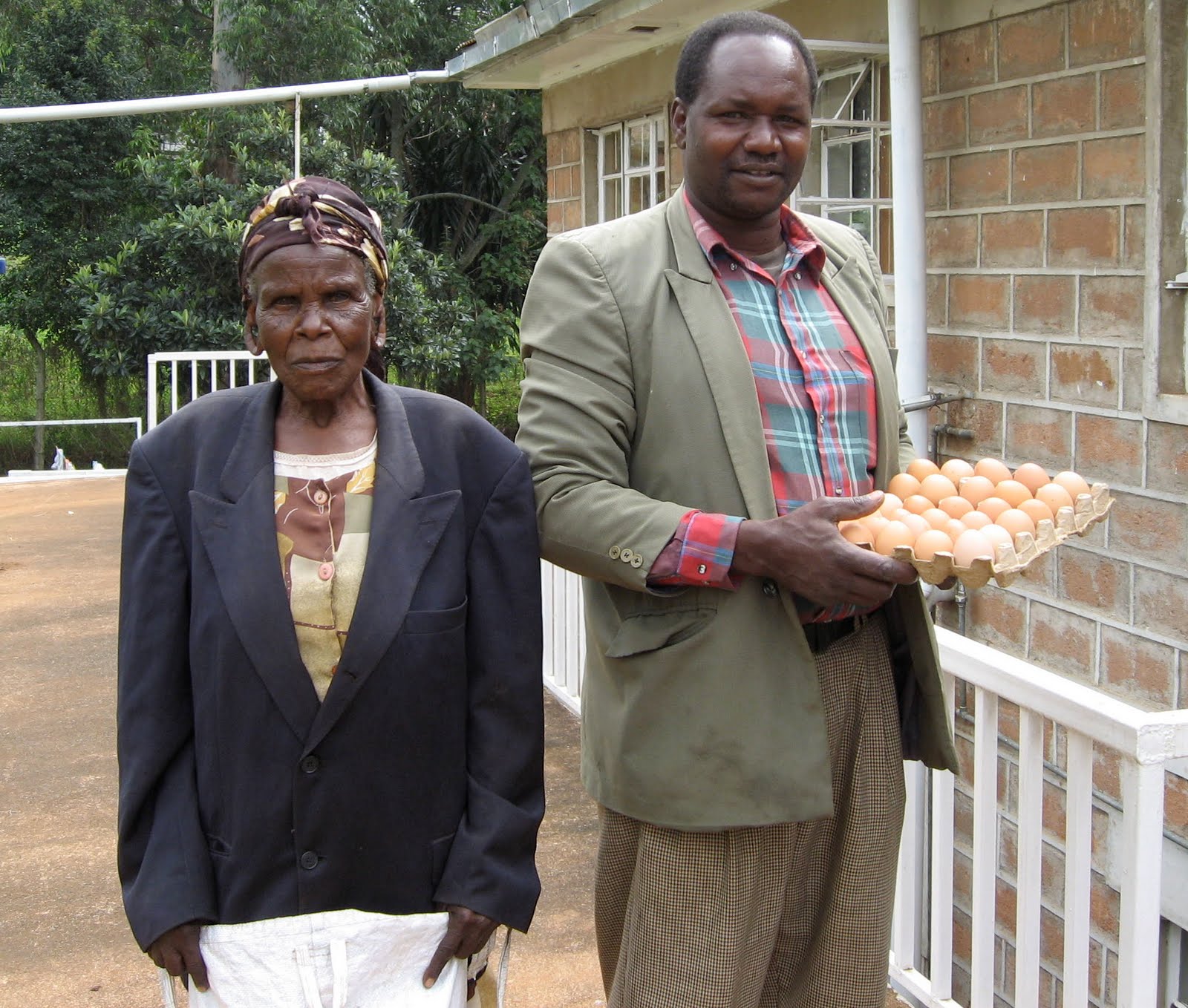
Elizabeth (left) comes a couple times a week, usually with bananas (about $0.25 for a bunch) and/or pineapple (about $0.50 each).  Joseph (right) manages a local orphanage and sells eggs to produce revenue.  A dozen eggs cost 120 shillings (about $1.50).


Shadrach brings cilantro, carrots, and beets (not sure if he's ever been able to convince anyone to buy the beets!).


Lilly (left) is most noted for her spinach, but she also brings squash and other veggies from time to time.  Caroline (right) is who I rely on most.  She works as a househelper for the Whites, but comes every Tuesday with pineapple, onions, tomatoes, green pepper, and big mangoes that can be hard to find locally.


Grace brings passion fruit, lettuce, spinach, butternut squash, and carrots.  She regularly tries to get me to buy a basket too, especially when we have visitors.


Most people here use fresh cow's milk since it's about 4 times cheaper than boxed milk.  John and I haven't quite been able to make the plunge.  The kids drink it and we use it for cooking, but we're not a fan of drinking it plain or with cereal.  The Faders and McLaughlins are hard-core missionaries and have made the switch.  

We get 2 liters of milk brought to our door every weekday (3 liters on Fridays).  Usually, your househelper arranges to have your milk brought to your house.  For some reason, we ended up with a milk merry-go-round.  Our househelper (Sammary) brings milk to the Faders, the Fader's househelper (Edna) brings milk to the McLaughlins, and we get our milk from Lily (pictured above).

Here you see Abi carrying the McLaughlin's milk container.  Note the "Bioclean: Heavy Duty Cleaner" on the label.  Hmmm....  If Maggie starts to grow some big, hairy moles we'll know why!

All of these folks were quite astonished when I told them that we never get food brought to our door in America.  They gladly obliged when I asked for their photo to tell all of you about them.  Several promptly asked for a copy of their picture!  :)

13.6.10

COTW - Mr. Jeram and Neurofibromatosis Type I


Let me introduce you to Mr. Jeram.  He developed a transportation empire in the Rift Valley during colonial days using scores of donkeys and oxen.  His wealth and generosity became famous, and his place of residence was given the name Kapjeram by the Kenyans. 
  

One of his many sons married the woman above in the blue sari and moved to England where he also became a wealthy businessman.  After he died, every year her children would ask what she would like for her birthday, and every year she would say, "I want to return to Kenya and sponsor an eye camp in honor of Jeram for the people he loved."  This past week her dream came true.  


On Friday, May 28th, two well-dressed Indian businessmen (one being the gentleman in the previous picture with children on his lap - a grandson of Jeram) came to the Eye Unit to meet with me without prior notice.  They wanted the Tenwek Eye Unit to staff their UK-based Jeram Foundation's inagural event because of its reputation in the community.  Much to my surprise, the event was scheduled for the following Saturday with members of Parliament to be in attendance and 25 descendants of Jeram coming from England, Uganda, Kisumu, Nairobi and Mombasa.  


The Eye Unit staff worked hard to make the necessary preparations (medications, tents, PA system, radio advertisements, 100’s of flyers to communities and schools . . . ).  On Saturday, we drove our bus and Land Cruiser 50 km into the bush to Kapjeram. 


We saw over 600 patients over the next 8 hours (we didn't get started till 10 am because the bus got stuck in the mud for a couple hours until a tractor arrived to pull it out).  Within an hour of starting, we began bussing surgical patients back to Tenwek where David Sawe, our ophthalmic clinical officer, started performing cataract surgeries that afternoon and evening.  


I took a quick break from screening to give an impromptu speech to the dignitaries, family and guests.  Unfortunately, I followed the eloquent Member of Parliament.  Among other things, I tried to express how the love God had shown us at Tenwek was the reason we now expressed love for them in our eye work.   


Many people had blinding eye conditions such as cataracts and glaucoma.  Below are some of the ladies with cataracts waiting for their pre-operative eye measurements back at Tenwek Eye Unit, getting a word of encouragement from one of the hospital chaplains.


By Saturday night, we had 72 patients crammed into 36 beds.  After a total of 6 round trips with our bus and Land Cruiser over the next few days, we had completed nearly 90 surgeries!  Despite its last minute feel, the eye screening was massive and flawlessly organized by our veteran eye staff, namely Richard Tonui.  We then worked several late nights to finish all the surgeries.  I am proud to be part of such a team! 


Unfortunately, we weren’t able to help everyone.  We had three kids like this little girl who was blind from meningitis.

One of the more interesting cases of the day, our CASE OF THE WEEK (COTW), was an 18 year old boy who was crippled and hiding his eye under his hat.  Per a relative, he began having eye problems at the age of 3.


On exam, his eyelids were like a "bag of worms."  His left eye still saw a bit, and it seemed odd that a tumor 15 years old hadn't completely blinded his eye and killed him by now.  We got a little more history and found that his mother also suffered from a similar disease.  Up close, he had some interesting nodules on the iris (colored part) of his good eye called Lisch nodules - small glial hamartomas.  This clinched the diagnosis of Neurofibromatosis (NF) Type I, part of the Phakomatoses family of diseases.  

His eyelid tumor certainly is from a neurofibroma, but an optic nerve glioma may also be growing behind his eye as they are also seen in NF-1.  He is likely crippled from neural and bony lesions associated with NF-1.  In fact, I was able to get in touch with a hospital that operated on his leg three years ago, and they had removed a neurofibroma from his knee.


For the real dorks in the crowd, I remember that NF-1 is on chromosome 17 because there are 17 letters in NEUROFIBROMATOSIS.  NF-2 is on chromosome 22.  Easy enough, ehh?  

The Phakomatoses are autosomal dominant with the exception of those that have a "W", Sturger-Weber (Encephalotrigeminal Angiomatosis) and Wyburn-Mason (Racemose Hemangiomatosis) as well as Ataxia-Telangiectasia.  This means that the patient has a 50% chance of passing his disease to each future child.  All of his siblings and mother should also be screened for NF-1 and its associated tumors, which are many.  The Jeram Foundation has agreed to sponsor him for a CT scan and then reconstructive surgery at Tenwek.  We thank God for sustaining the eye unit through this past week.  I pray that the gift of sight many received will enable them to also see the gift of life that God offers to them freely.

12.6.10

The World Cup From Kenya

Yesterday 9AM: We have finished our morning education conference with all the interns and residents. "Any announcements?" A quiet voice from the back: "Five o'clock at my place. Opening ceremonies." He has broken the ice, and now a bolder comment from another: "Maybe all the services can try to finish rounding just a bit earlier than usual today..." We all know what he's talking about.

1PM: An unprecedented event. My Paediatric team decides to take a short lunch in favor of rounding in the NICU early... so as to get done earlier. (Believe me, in a culture that evolved during scarcity of food, this does not happen often.)

5PM: I'm checking in at the ICU on a patient before heading home. There's a guy nurse sitting behind the desk. I ask, "You got the unlucky shift to be here while everyone else is flying to South Africa?" (using a euphemism I've been hearing often.) He smiles. "I'm just so happy to have this happen in Africa."

5:30PM: I head over to one of the Kenyan bachelor pad's in the hospital's neighborhood. We watch as South Africa gets the honor of scoring the first goal of the World Cup. We groan when Mexico ties it up near the end, and we agonize as South Africa hits a great shot off the post in the last two minutes of the game, thus ending it in a draw.

In case you somehow missed it (and in the US, you might have), South Africa is hosting the World Cup, and this is the first time Africa has hosted the competition. And they've never had the Olympics, or really any big international event. Kenya didn't even qualify, but three sub-saharan Africa teams did, South Africa, Ghana, and Nigeria (Whoops! Actually five, forgot Cameroon and Ivory Coast). South Africa is several countries away from here, and lives in a different economic bracket from the rest of their region. However, there is a surprising kinship that people here have with this experience, and it is an incredible source of transnational pride and excitement. And it is a definite perk of being here to be able to share this experience with them.

10.6.10

Floatin' Down the Chepkulo

Elise and I were on a bat cave adventure a couple Saturdays ago when I took a gander down the Chepkulo River and thought, "Shoot, that looks like a fantastic ride for an inner-tube."  I grabbed Jeremiah "Sticky" Galat, and we headed into Bomet to find our rides.  We eventually found our lucky tubes at Oil Lybia, our handy local gas station.  Now, these tubes required about an hour's worth of patching before they would hold air, but they looked tough otherwise.  We bought a few back-up patches and glue just in case we might spring a leak.

On Sunday, Sticky, Jason and I got geared up for this adventure and took off after church.  


Our point of entry -- the foot of the Tenwek Falls.

Our destination -- Bomet, deemed to be anywhere from a 1 to 3 hour float down the Chepkulo.


Despite its tropical appearance, the water was FREEZING cold.


Our initial plan of carrying sticks to push off of razor sharp rocks lasted approximately 1 minute as we hit the first set of rapids.


Eager spectators....Elise, Alyssa Pfister, & Dan Galat went to see us off.  Little did we know we would have other spectators along the way.  Saturday & Sunday are popular bathing days, so we took many bathers by surprise.  It soon became obvious that people were calling their friends after seeing us because after awhile we had people waiting for us.  When we came within their sight, they would start cheering for us.


Jason's descent down the first set of rapids...going...


...going...


gone!


Coming back up for air!


John's descent wasn't quite so successful.  For some reason, the heaviest guy got the smallest tube.  The poor tube didn't make it through the first set of rapids.


Damage control...


Successful repair.  This tube was saved as a back-up.


After about three hours we started to wonder if the river would actually take us to Bomet.  Some people we asked were convinced that Bomet was right around the corner.  Others said it was still a long ways away.  Fortunately, the latter were correct and we made it to Bomet soaked to the bone, shivering, and with very sore bottoms.  We made our way to the matatu (taxi) station and finally back to Tenwek.  We both took hot showers, ate some chili, and dressed in the warmest clothes that we brought!


Back home safe & sound, with only mild flesh wounds.


8.6.10

Hellos and Goodbyes

If you've been following our blog, you'll notice that this post is not an uncommon phenomenon. By this I mean that we've remarked quite a bit about "goodbye" to this person or that family. I suppose that life on the missions field is just a series of one goodbye after another. We say goodbyes to our families and friends back home, then travel halfway around the world and end up making new friends and saying goodbye to them all too frequently, as they leave on furloughs, or to return to normal life in the US.

This month we've had some difficult goodbyes here at Tenwek. Logan, Julie, and Liam Bankshave been with us since January (almost as long as the Faders and McLaughlins have been at Tenwek). Logan has worked with Jason, Eric, and Rachel at the hospital, and Julie and Liam were active participants of our baby playgroup on Mondays. We have all had a wonderful time getting to know them, and benefited from them in many ways: from Anna Fader learning ballet from Julie to Logan taking OB calls for Rachel and then from their family's generosity in leaving us with all their leftover food!! They're returning to Springfield, MO for a 5 year commitment to work in the family practice program. Then we hope to see them again on the missions field one day.
The other difficult goodbye is the Galat family. Dan, Heather, Jeremiah, Emma, Claire, and Levi have been at Tenwek for 18 months as part of the Post Residency Program, like us. They are returning to the US for hopefully only a year, and we really really hope to see them back here more permanently next summer. The whole family has been a blessing to us McCropders, and we will especially miss Jeremiah rapelling off our balcony, Emma scootering by, Claire greeting our kids with an enthusiastic smile and welcome, and Levi, well, Elise will really miss her first boyfriend from Kenya. :)

On the flip side, June is also a month of hellos. Rachel's mom Jean and her aunt Joan are here for the month, and another aunt and uncle arrive soon. Bob Lynn, our missions pastor from Knox, and his wife Ilene arrive in the next few weeks, as does Jess's sister Abby. We look forward to everyone's arrivals and would extend an invitation for all of you to visit, too. Stay tuned for more stories and pictures.

4.6.10

Happy Birthday and Happy Birthday and Happy Birthday

We McCropders like to organize our major life events into groups. If we're going to spend the rest of our lives together, then it's just not a good allocation of resources to have things like birthdays spread out over 12 months. Much better to lump them and then throw half as many parties. So, thank you to the mothers of Heather and Eric, who delivered them both on the same day (forceps and C-section, respectively), albeit 4 years apart: June 3. And I'm sure Jessica's mom would have LIKED to have Jess born on June 3 instead of June 8, but Jess must have realized that one day she would meet up with Heather and Eric and be secretly glad that she had her own personal birthday to celebrate.

Also of note in McCropder life events, Jess and John share their wedding anniversary with Jason, who has a birthday within 2 weeks of Maggie and Anna. Micah shares his birthday with Christmas, Abi with Thanksgiving, and Rachel, John, and Elise all have March birthdays. And the Faders found out that they were matched with Abi for her adoption on the same day Maggie was born. Neat, huh? :)

So all that to say, Happy Birthday Eric, and Heather, and an early Happy Birthday to Jess as well (who gets her own cake).

29.5.10

COTW: Retrospection and Introspection

I was on call overnight, but now it's a cool morning, with an almost autumn breeze, and I'm reminded of resurrection.

Mercy died yesterday morning, and that one was particularly hard. Because she was young. Because she has orphaned at least two little children. Because she spoke English and had been in the hospital for three weeks, so I kind of feel like she was a friend, after a manner. Because, in retrospect, I think I might have figured her out sooner if I had asked the right questions, and then maybe she'd still be here.

Now that it's done, I think that her heart failure had been distracting us. It was definitely present, but unusually hard to treat, and the overall picture just didn't quite fit right. Then, three days ago, she develops swelling in her thigh, we confirm that she has a clot in there, and all of a sudden I'm thinking that maybe that's been the problem all along. Pieces of clot from her leg veins breaking off and lodging in her lungs. We started her on treatment, but I guess we were too late. Or maybe it didn't matter. In any case, yesterday morning, walking back from the bathroom, she suddenly collapsed, and nothing we could do could bring her back.

It wasn't until the day before she died that she told us that she'd had this kind of leg problem before. She never thought it was relevant, and I never made a point of asking.

Her intern and I gathered with her very large family in the hospital hallway in the afternoon. We explained what we believe happened, and expressed our grief at not having been able to save her. We prayed together. Their gratitude in the face of this tragedy is overwhelming, and it is near to shaming me, as the back of my mind wonders if a better doctor, even here in this limited setting, would have sent Mercy home to mother her children.

And yet it wasn't until this morning that I was reminded of resurrection. Something about the cool morning hours, and I opened the bible to the end of Luke. The family and friends had lost. Their expectations for the future were crushed, as they suddenly lost a young life. Chapter 24 starts “But...” But it didn't end there. This death was different. It was reversed. Transformed. This death was different than all that had come before. And none since has ever been the same.

Resurrection for Mercy. Resurrection for me at the end of my days, whenever it will come. Resurrection from the smaller, everyday deaths that our lives bring to the lives around us. Resurrection of all our mornings and evenings.

“Brothers, we do not want you to be ignorant about those who fall asleep, or to grieve like the rest of men, who have no hope. We believe that Jesus died and rose again and so we believe that God will bring with Jesus those who have fallen asleep in him.” 1 Thessalonians 4:13-14

“We belong to the day.” 1 Thessalonians 5:8