21.1.24

Threads of Years Long Gone: Ministers, Babies, and Reasons for Reconsidering Hope

 (from Eric)

On Friday, the hospital inaugurated a new district health office. In addition to being a church hospital and a teaching hospital, Kibuye is the referral hospital for Kibuye Health District, a geographic area of over 200,000 people. Anyone sick in that area goes to one of 18 health centers in the district which refer necessary cases to the hospital. Of course, we also get cases from all over the country and neighboring countries because of specialized care here, but we are the primary hospital for this catchment area, and this health district is administered and supplied by the district health office.

Their office was insufficient and helping them build a better office just outside the hospital wall also liberated some valuable real estate within the hospital that the old office was taking up. So we partnered with them to build a new office building. The building is lovely, and governmental dignitaries were invited to cut the ribbon.

The guest of honor was Burundi's Minister of Health. Newly appointed to the presidential cabinet in the last few months, this was her first visit to Kibuye. Burundi's amazing traditional drummers pounded and danced out a welcoming rhythm as the Minister's vehicle arrived, and we formed a receiving line, of which I was about number eleven.

Burundi's Traditional Drummers with the new district health office

As the Minister proceeded down the line, I shook her hand and said "Welcome to Kibuye." Over the thrum of drums behind us, she said "I know you. I met you in Banga when you were learning Kirundi. You had babies with you."

A journalist caught the moment where the Minister tells us she remembers us

I couldn't believe it, to say the least. Banga? Banga is where our team spent three months in 2013 when we first arrived, fresh from French language school but wanting to get a small smart on Kirundi language study before moving to the hospital.
 
Future Kibuye kids at Banga.

It wasn't the easiest three months. In fact, the "green soup" that we ate every night for dinner has become a bit of team lore. The electricity and water were usually out, and thus staying healthy was quite a challenge. I remember one night walking outside to see the adjacent hillside aflame (apparently a "controlled" burn for farmers) and wondering where the fire would spread.

During meals, the nuns who ran the guesthouse and restaurant, in order to help out high-chair-less parents (and to amuse themselves), would take Toby (who was about 5 months old) around and greet the other patrons. Apparently one of those patrons was the future Minister of Health, who came to Banga for a malaria training event.

Mama Lea - Toby's favorite nun

Now the Minister is at Kibuye, cutting a ribbon and remembering our team fondly. The ceremony began, and the governor of our province gave some opening remarks. Bishop Deo did a wonderful job discussing the work of the Free Methodist Church's institutions at Kibuye and their involvement in health care, including some upcoming plans. Then the minister took the podium and gave a very favorable speech. She again mentioned to everyone meeting our team in 2013 and remarked on our love for their country. She said that she would like to take a tour of the hospital afterwards, and spend close to an hour being guided deftly by Dr. Gilbert our medical director. All in all, a very successful visit.

***

The collision of past and present filled me with gratitude. It was the gratitude of someone who had been living on the back side of a tapestry, where all the threads are knotted and seemingly disorganized as they do their best to get from here to there. Then, for just a moment, you're allowed to catch a glimpse of the other side of the tapestry, where a beautiful, complex image has been created by those same threads.

You see that there were a couple stitches way over there, and then the thread disappeared for so long that you thought it was gone, and then it resurfaces in just the right place. And that makes you reconsider the other threads. It gives you hope for the other long-invisible strands. Or maybe this one over here has always bothered you, and you wish it would be gone. But maybe it actually plays a role in a bigger picture. It's been a source of tension, but maybe it's like the musical tension of a passing note to a beautiful chord. Who knows?

No thread makes a tapestry. Rather it's all the threads together. It's the whole of all our lives and days and interactions, woven together by One whose perspective is so much bigger than ours that it's like how the heavens are higher than the earth. It's incredibly hopeful, and also incredibly humbling.

Is that what Banga was for? Probably not, or rather maybe one thing among many. Who knows? The point is that there are these moments where you see a bigger story and though you may not have much more of an idea of what's going on than you did before, you now have a reason to hope that there actually is a bigger story. And that changes everything with regards to how you look at the beautiful and the problematic that surround you even now.

Is that what the Minister's visit to Banga and now to Kibuye was for? Maybe a bit, but she is not just a character in our story any more than we are just characters in hers. Surely God has many plans for her life in so many other domains. And so we see that the big Kibuye tapestry is itself a piece within the tapestry of Burundi, within the tapestry of His kingdom throughout His creation.

It's too complex. It makes our heads swirl. No one could weave together such a complicated web of billions of people's lives into a single beautiful work of art. But if someone could... If someone is, then that One is most worthy of praise.

(On a more personal level, here's a song I wrote a while back on a similar theme: The Weaving of My Days, also on Spotify and other streaming sites)


17.1.24

I Bless the Rains Down in Africa

by Rachel 

If anyone knows anything about Africa, usually they can at least hum the above line from Toto.  It's a great song.  Most of my life I thought the line was "I MISS the rains down in Africa," which I think fits with the longing of the song, but anyway.  I've been thinking about that song a lot lately as Burundi has had a pretty epic rainy season this year.  

Now that we've been living here for 10 years, the dry and rainy seasons (instead of a classic summer/winter pattern seen in northern climates) have become second nature to us.  The rains usually stop in mid to late May, bring in the annual dry season.  Upsides of this would be massive amounts of solar energy for our powerpac, easy drying of clothes on the line, and reliably dry days and nights for outdoor activities.  Downsides would be massive amounts of red dust everywhere!   By September the rains usually return, maybe 3-4 times per week until May (with a one month pause in Dec/Jan).  Obviously if you are a subsistence farmer, these seasons are quite important for the growing of various crops.  In fact, if the rains are late (like a year ago), harvest comes late as well meaning that hunger and malnutrition increase until the harvest arrives.

This year, the rains were a welcome return by the first week of September.  We love the sound of rain on our metal roof, and all the dust washing away.  The profusion of green leaves, grass, etc is pretty amazing in this lush climate.  However, what was NOT normal this year was the volume of rain.  The rains came hard and fast and constant...in fact, there have been weeks where I don't think we saw the sun at all.  There is an aid website called Relief Web that publishes data on things like food security and humanitarian crises.  You can see the table below from the end of December featuring above average rainfall projected through February.  While not as severe as some parts of Kenya, rainfall has been 50-70% more than average this year.

We drove a Burundian friend to Gitega last month and asked him about the community and their thoughts on the rainfall.  He replied that when people see this volume of rain, they worry about famine.  Below are some pictures that Eric and I took on a recent walk around Kibuye.  Notice the brown stalks of corn, dead from flooding, and even the flooded rice patties in the valley.  Rain has also caused some significant erosion behind the hospital as part of the hillside washed away.

Flooding fields and dead corn plants

Erosion behind the hospital

Flooded rice fields

I love rain.  I think it brings green and life and beauty.  But if I was a subsistence farmer living in Burundi, and if my crops died I had no other way to feed my family, I would be worried right now.  Could you pray for our friends and neighbors, that God would provide the right amount of rain for crops to grow?  That they would have enough food to feed their families, even miraculously so?  It's quite possible that numbers will swell in our malnutrition program this spring as well.  You all contributed over $75,000 to that fund in the month of December, which is amazing!  If you'd still like to give, here is the link.

Burundi looked good in this report from November, with only a few regions being "stressed."  This might change in the next report.  Also, as you can see much of the region is in crisis, sometimes due to war in addition to natural factors.


23.12.23

On the Eve of Christmas

 (from Eric, adapted from our family Christmas newsletter)

Exodus 36:7: The materials were sufficient for them to do all the work. There was more than enough. 


I read this obscure verse this morning. It is describing how the people of Israel gave so much of their personal belongings to make the furnishings of the tabernacle that the craftsmen in charge told them to stop. “There was more than enough.”


Do you hear that provision? It hits my heart like a feast. We’ve known some times like that in 2023. We have seen our medical school flush again with graduates after several years of dryness. We have seen busy schedules align so that we can sign a new 5-year contract with our Burundian partners in good faith of what God will do in the future. We have seen patients healed and funds provided and small steps made towards better care given in the name of Jesus. We have celebrated together with our team what God has done in 10 years here. What have you experienced where it felt like “more than enough”?


But maybe those words sound less like a feast and more like a taunt. Where was the provision last week when we fought hard for a young man with kidney failure, only to have him die suddenly the day after (what we thought was) a successful discharge? Burundians’ crops are flooded this year, heralding a season of exceptional hunger. We didn’t see our daughter for 3 months while she started school in Kenya. Meanwhile, we’re covering extra classes for our boys because we don’t have enough teachers to help us this year. Where have you felt like “there was more than enough” just doesn’t measure up to reality?


Then I think about Christmas. I think about 400 years of biblical silence followed by a nearly unmarked birth in a stable in a small town. In fact, it was the most extravagant, overflowing, lavish gift ever, the epitome of “more than enough”. That was the reality, but in many ways, it didn’t feel like it.


Here on the equator, the sun rises year-round about 6 am. About 15 minutes before that, when it’s still dark, scores of birds wake and sing to greet the day that is not quite here yet.


The sky is dark, but the air is full of song.


It’s beautiful, and it’s every morning for us. It is glory mixed with darkness, but it lets us know that the day is at hand. It’s a good reminder for both the moments where we feel God’s provision as well as the times when it feels so absent.


The night of Jesus’s birth, angels sang God’s glory. The sky was dark. The air was full of song. This seems to be characteristic of God. Often in joy, often in sorrow, but always looking forward to his coming.


We pray grace to you this season to be able to hold on to this promise in both the ebbs and the flows that you experience.


30.11.23

VIPs

 By Alyssa

As one of the most developed hospitals in a small country, we get our share of VIPs, and there is always a tension at to how much time and energy to spend on them versus the rest of the patients. My sense is that this is a challenge in lots of places but especially for mission hospitals in developing countries where the goals of medical excellence, compassionate care for the poor, quality education for trainees, and financial sustainability can sometimes seem impossible to pursue simultaneously. 

Kibuye Hope Hospital's vision is to: 

"Develop a university hospital of excellence where the love of God is manifested to his creatures."

Our mission is:

"To glorify God through quality physical and spiritual care accessible to all and through the training of healthcare professionals and disciples of Jesus Christ."

I'd like to share about a few patients I saw yesterday who aren't particularly prominent by the world's standards but who I hope experienced the love of God at our hospital. I would love for them to walk away from this place after receiving quality healthcare by compassionate healthcare workers with the sense that they are seen and known as Very Important People in the eyes of our Heavenly Father.


1) Mama D (pictured above with one of our nurses, picture taken with permission). This mama is so faithful to care for her little girl through so many heartbreaking challenges over the last few months. She has been in and out of the hospital multiple times and has often stayed for weeks at a time due to complications from probable tetanus. Her mother faithfully keeps every appointment, feeds her and give her meds through an NG tube (and amazingly, the little girl is not losing weight or malnourished), and is attuned to every new symptom that means she needs to bring her back to the hospital. We had the chance to encourage Mama D yesterday that she is doing such a great job in caring for her daughter, and she just beamed. She and her husband display great faith in praying for their daughter and not despairing despite the myriad of challenges their little one faces. 

2) "Isaac" is a 13-year-old boy who came to his follow-up appointment in peds clinic yesterday for cyanotic congenital heart disease. When they checked his oxygen level in triage, they were so concerned that they sent him to the emergency room instead of clinic. But then they came to find me and I explained that his oxygen levels are always that low. Sure enough, Isaac entered my clinic walking and talking normally a few minutes later despite his oxygen saturation of 65%. Isaac is one of the oldest patients I have seen here with cyanotic congenital heart disease (probably Tetralogy of Fallot for the medical folks). He's actually still attending school and can walk short distances around the hill where he lives. It's difficult to decide what medicines to treat him with because the medical literature generally assumes patients with this condition had surgery to repair it as infants. He's currently taking three heart meds and seems to be relatively stable, so we refilled the prescriptions and gave him a follow-up appointment in three months. 

3) "Emmy" is the 7th child in her family and there were complications with her birth. She was resuscitated for a prolonged period of time and that resulted in neurologic complications. Now she is 2-years-old but doesn't walk or talk or even sit up on her own. This is unfortunately a very common story here. Her mom brought her to peds clinic to see if we could help with her development. Emmy smiles and seems aware of her environment but has very little muscle tone. We gave her a referral to a center nearby that provides physical therapy, but there's not a lot else we can do for her. We did explain that she is a beloved child of God, and her mom readily agreed! 

4) Mama A brought her son to the hospital because of a huge tumor in his eye. She heard that there was a center here that could treat this condition, so she traveled from quite far away with her son and his little brother. The boy has now been hospitalized in the malnutrition service for over a month. Unfortunately the cancer (retinoblastoma) was very advanced and already metastatic when they arrived. We have given chemotherapy with the goal of palliative care (to shrink the size of the tumor and decrease his pain), but the boy is still not well enough to eat or drink or talk. He will likely go home tomorrow to continue palliative care. I hope the mother leaves with the sense that she did everything she could for her child and that there is no shame or curse associated with the condition he has. I will miss greeting her and the little brother each day. 

5) "Arthur" is a 4-year-old boy with epilepsy who came to clinic for follow up. Thankfully his seizures are well controlled on treatment. He has only had one seizure in the last year. He has some developmental delay as well, but he is making good progress. His mother is pleased with how he's doing. We refilled the medication and gave him a follow-up appointment for early next year. 

We want to keep growing and improving in the level of care we can provide for all the patients at Kibuye Hope Hospital. And yet as some of these stories show, we can't always provide physical healing for them given the resources available in our setting. But no matter what medicines or treatments are available, we desire that the love of God be manifested to all the patients along with their family members. Our specific pediatric vision includes the phrase "welcoming children, families, staff, and students as Jesus welcomes us." Please pray that this vision will be realized more and more in this beautiful corner of the world.  


22.11.23

Making Virtual a Reality

While a good understanding of anatomy is important for the practice of medicine, it's foundational for the practice of surgery.  Knowing the relationships between structures can be the difference between curing the patient and causing irreparable harm.  Because of its foundational nature, in the U.S. anatomy and physiology is one of the courses taught early in medical school.  Around 90% of U.S. medical schools include cadaver dissection as a part of their curriculum.[1] Even as the pedagogy for medical education is transitioning to a flipped classroom model, the importance of in person time studying cadaveric anatomy is not lost on educators.  In fact, according to anatomy course directors, one of the most common weaknesses in anatomy curriculum was insufficient dissection time, a problem which was only exacerbated by COVID. [1] 

There are many factors that prevent us from maintaining and using an anatomy lab as a part of our medical curriculum here in Burundi.  Both the formaldehyde and refrigeration options for preserving cadavers are very expensive.  Then comes the practicalities of maintaining constant electrical supply or the safe handling and disposing of large quantities of hazardous chemicals.  All this says nothing of the cultural and ethical implications of obtaining cadavers on a regular basis...

So, what are we to do?  

Well, 11% of U.S. medical schools also utilize virtual software to enhance, and in some cases replace, the cadaver dissection portion of their anatomy courses.  In the post COVID era, a full 23% more plan to incorporate Virtual Reality in their anatomy curricula.  [1] While the data is a little old at this point, a 2015 meta-analysis of the educational effectiveness of 3D visualization technologies in teaching anatomy showed that it 1) improved factual knowledge, 2) improved spatial knowledge acquisition, and 3) improved user (aka student) satisfaction as compared to all teaching methods. [2]


Visiting resident Yves Yankunze having some one-on-one teaching time.  We had recently discussed hiatal hernias, so I was pointing out the relationship between the esophagus, vagus nerve, diaphragmatic hiatus and aorta/aortic hiatus.


Since I had the headset and anatomic models ready to go in our (mostly) unused OR 1, I was able to have an impromptu teaching session for the nurse anesthetist students rotating at our hospital.  It was a chance to show them the relationship between the upper airway, the trachea and the esophagus.  A critical understanding for successful and safe intubation of patients. 


When set up in the classroom, other residents are able to follow along with the teaching as I guide the student wearing the headset toward the relevant and important anatomy.

After a few back-and-forth emails, the medical director for The Standford Virtual Heart program graciously provided me with a copy of the software.  So after we finished our chapter on congenital heart defects, our residents had a chance to explore the defects and their associated flow patterns and murmurs in virtual reality.

For now, I'm focusing this virtual experience on our current batch of surgical residents.  Their need for recalling and understanding anatomy is the most pressing.  But the trial run has been well received and quite helpful.  I'm excited about the possibility of significantly expanding our use of VR into the anatomy course taught at Hope Africa University.  

Afterall, it's hard to build a solid house without a solid foundation...


[1] Shin M, Prasad A, Sabo G, Macnow ASR, Sheth NP, Cross MB, Premkumar A. Anatomy education in US Medical Schools: before, during, and beyond COVID-19. BMC Med Educ. 2022 Feb 16;22(1):103. doi: 10.1186/s12909-022-03177-1. PMID: 35172819; PMCID: PMC8851737.

[2] Yammine K, Violato C. A meta-analysis of the educational effectiveness of three-dimensional visualization technologies in teaching anatomy. Anat Sci Educ. 2015 Nov-Dec;8(6):525-38. doi: 10.1002/ase.1510. Epub 2014 Dec 31. PMID: 25557582.

29.10.23

Neonatology part 2

by Jenn Harling

In February I wrote a blog describing what our neonatal unit looked like in our new pediatric building into which we moved at the end of 2021.  I mentioned in that blog that I had attended a neonatal conference a few months prior (Oct 2022).  I had the lovely opportunity to attend that conference again this year.  This is not an ordinary neonatal conference, but rather one to bring together those who care for and treat neonates in Africa. I'll state the obvious in case it's needed - taking care of neonates in LMICs (Low and Middle Income Countries) in Africa is not the same as practicing neonatology in HICs (High Income Countries).  This conference focuses on educating and training as well as sharing up-to-date information regarding neonatal care around the world, and also (and possibly more importantly) innovative ways to treat neonates when all the technology and resources are not available.  

Not only is there a huge opportunity to learn, it's also a place to network and make connections as well aso talk to others who are also trying to find innovative solutions to challenges faced in a low-resource setting. I've met numerous people who are in similar settings and it is so helpful - "oh, do you have this challenge too? this is how we navigate this situation without _____ (insert resource that may not be available in LMICs like blood cultures, electrolytes, intubation, ventilators, IV pumps, arm boards, paging system, caffeine...). 

I have left this conference each year thinking "there is SO much to do at our hospital to improve the care we provide..." but then I looked back and realized we have already started the process!

Below are a few things that changed in our unit after attending last year's conference:

-Trying to keep a cadre of nurses in the unit who do not rotate out.

-Hand hygeine 

-Keeping a particular generalist doctor mostly in the unit when a specialist was not available to round.

-Updated feeding protocol with fortification of breastmilk

-Transfusion protocol to know when to transfuse neonates

-New neonatal ward manual in French being written

-more kangaroo mother care (skin to skin care), with hopes to increase even more this year

-humidification of oxygen

-patient tracking white board

-updated fluids management protocol

-hats for every baby in the unit

This year I hope to expand bubble CPAP and medical air and blenders amongst many other improvement projects. My hope is to write another blog next year to tell you all the things God has allowed us to accomplish! 
There is hand hygeine signage all over the unit now

There is a steady supply / stock of hand sanitizer in the pharmacy now.

Patient tracking board 

One of our nurses washing his hands before touching the baby on the warmer. 


4.10.23

COTW: Postpartum Complication

 by Rachel

Well, we often see strange and bizarre cases at Kibuye, that has not changed!  But it's been awhile since we've posted our old blog standby of Case of the Week.  FAIR WARNING that if you are squeamish about medical things, this might be a post to skip.  But for all the rest of you, I'm curious if you can figure out the problem.  Also, we could use some advice on how to best fix this patient, so contact me after if you have ideas.

This lady came to the maternity service about 4-5 days after a spontaneous vaginal delivery of her 3rd child at a different hospital.  She had no previous medical or surgical history (no previous C-sections).  She was transferred to us with a suspected small bowel obstruction, with some nausea and vomiting, but was passing gas and stool.  Bleeding was minimal.  She had not passed urine for several days.  She had a low grade fever but otherwise vital signs were normal.  Her belly was significantly tender and distended.  Hemoglobin was normal with a very mild leukocytosis.  

Now, this presentation is not terribly uncommon after C/S.  Many women are transferred to us with peritonitis after a C/S done at an outside hospital, and they end up with frank pus in the abdomen and usually a necrotic uterine incision that needs debridement.  This all causes an ileus, not an obstruction.  We see this at least once a month.  But, this lady had not had a C/S.  Also not uncommon is a diagnosis of uterine rupture after vaginal birth, due to trauma or fundal pressure given during second stage of labor.  But, this lady didn't seem to have the classic signs of uterine rupture.  No bleeding, no fluid wave in the belly, and a normal hemoglobin.

On ultrasound, nothing was visible due to a massive amount of gas in the pelvis.  So, we ordered an abdominal X-ray.  And saw this:


I know that it's not a great image (and remember we have no CT scans here) but that's a giant collection of air/gas in her bladder, and in real life we could see a very tiny amount of free air under the diaphragm.  So, we placed a Foley catheter and got out a large amount of gas and around 600cc of cloudy urine.  Strange.  She was started on antibiotics for a UTI and improved significantly within 24 hours of placing the Foley.  We discussed with surgery the need for an ex-lap, but given the patient's significant improvement decided to send her home with the foley for 7 days, and then have it removed at the first hospital.

She came back two weeks later.  After the Foley had been removed, her pain had returned and continued to increase.  She was unable to pass urine, and once we replaced the catheter, cloudy yellow urine came out, but the pain did not improve.  She was taken to the OR, where the surgeons found this:

You can see her urethra with the foley in place.  The small tubes on either side are her ureters.  But the bladder was just a necrotic pile of mush.  Best as we can figure, during her delivery her bladder had ruptured (??), but the uterus remained intact.  Given the late diagnosis, the bladder was not repaired immediately, and perhaps developed an infection, but regardless all bladder tissue died.  She's currently hospitalized with drains and a foley catheter, but there's no awesome urologist to send a case like this to, to create an artificial bladder.  Any ideas? 

29.9.23

We Never Stop Learning

(from Eric)

Roughly thirteen years ago this month, Rachel and Maggie and I visited Burundi for the first time. This was the first trip of our team to Burundi and the one that led to all the others, I guess. We were welcomed generously by the leadership of Hope Africa University. We spent five days in country, mostly in Bujumbura, only visiting Kibuye for a half-day.  We learned about the country and the work of HAU, in particular their medical school which was seeking faculty members like ourselves.

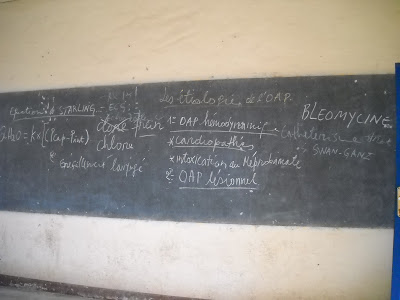
Walking around the main campus of HAU in Bujumbura, I ducked into a classroom, and I looked at the blackboard. Though I didn't speak French and didn't know then (as I do know) what the French acronym "OAP" meant, I caught a few words:

Bleomycin. Cardiopathy. Swan-Ganz catheter.


Why snap this photo? Well, without going into the medical details, I was both astonished and amused that in the middle of Bujumbura, on an old blackboard, students were being taught about relatively obscure treatments and invasive techniques that I was pretty such weren't available anywhere in the country. And years later, I can say that I was right: they're not available and possibly never were.

After years of medical school and residency in the US, and with about a year of African medicine (in Kenya) under my belt at that time, I had learned so much. We were looking forward to working in African medical education, and this blackboard struck me as the epitome of what we were going to better. We weren't going to teach archaic and inapplicable ideas to our students. We could do so much more.

***

Over the years, I have been surprised again and again by things I didn't understand. I remember the day years ago in the NICU at Kibuye when I realized that no one had any idea how to use the scale to weigh the babies. Weight gain in premature babies is truly a vital sign, fundamental to guiding what the doctor should do for the baby. I saw them randomly moving the weights of the balance around, and thought "what have I been doing for the past month?" (Obviously, the NICU has developed by leaps and bounds in the many years since I rounded there.)

Just yesterday, I was working on a small hospital project with some personnel and was again bowled over by my misplaced assumptions. In this case, I thought a certain person would certainly understand some particularly fundamental medical concepts. Nope. So I walked up and met with him for a while, trying to find out exactly where he was at, because it certainly wasn't what I had thought.

Fourteen years after moving to Africa, and I keep getting surprised at what I mis-guess or misunderstand. Each time, I learn a little more, but there is always something else that pulls the rug out from under me. Something else that I didn't understand and therefore I wasn't really engaging the situation correctly.

***

Today, I walked home from the hospital after some late afternoon teaching to our post-graduate interns on bleeding disorders. It had been fun. A new challenge to try and discuss a relatively complicated subject in an effective way, somehow reaching out across the void between me and them to connect.

I thought back to the Swan-Ganz catheter blackboard of 2010. Even now, I don't want to teach like that. I still believe we can do much, much better. But thirteen years later, I would say that sometimes there are reasons to teach things that are beyond the technology available around us. Sometimes students want to know, or maybe it's coming soon. Sometimes I find that a certain point may not be clinically relevant to them, but it can help illustrate a physiology concept in a useful way, so I try to use it to a different end. In other words, I think my approach to this question is more nuanced now.

I'm tempted to look back at my "one-year-in-African-medicine" self in 2010 and think that I didn't know anything then. But that's actually quite unfair. After years of training to become a physician attending, and a year in Kenya, I actually knew a lot. I had learned and learned and had my paradigms upturned and readjusted again and again. 

It's just that I didn't realize how many more times I would keep learning. I didn't know how beyond one mountain there would always be another mountain. How I would just continue to be surprised and made to feel like I was back in month one over and over again.

It would be folly not to take this recollection and flip it forward. I suppose I will continue to be surprised. I wonder what I will know in five years that I understand more incompletely now. I think I can legitimately say that I've learned a lot, about medicine, about a totally different environment, about how to go about effecting needed change. But I'm also learning just how much more I have to learn.

***

PS. on a somewhat related note, Glory Guy's father Bobby has a healthcare business podcast and interviewed me over the summer. Click here for about 15 minutes of us chatting about how experiences here have shaped my lens on healthcare.

24.9.23

Taken Away My Shame

by Rachel 

Every Monday I have OB-GYN clinic at the hospital. It usually runs from 9a-5p and I see sometimes over 40 patients. The pathology is variable, but the type of women that come to see me is also quite variable. Sometimes it’s a little hunched over old widow, wearing no shoes and a dirty wrap, coming to see me for her uterine prolapse. Sometimes it’s a fancy looking woman with well done hair and perfume, accompanied by her husband holding car keys and a giant stack of medical tests, seeking help for infertility. I see farmers and teachers, nurses and business women. They come from Kibuye, Gitega, Bujumbura, and even sometimes Tanzania. Young and old, rich and poor. All seeking the hope of healing in some way or another. That last piece can be hard to remember in the crush of the day, with a long line of patients and a large stack of charts waiting. Trying to get through the day, skipping lunch, going as quickly as I can...but trying to remember the humanity of each person and their own brokenness in some form or fashion. That they need hope. 

One such patient came to see me about nine months ago. She was actually a nurse, a maternity nurse no less, at a different hospital. Her first pregnancy had ended in disaster: she went into labor at term with a healthy baby but her baby's heartbeat had started to look distressed. They performed a C/S for her, but her baby died just after birth. This is sadly not an uncommon scenario, but for it to happen to someone whose profession is to deliver healthy babies...a double blow. There is a falsehood that I probably subscribe to at some level as well, that a better job or more financial resources somehow guarantees a certain outcome in health and in life. This is not always true. 

Well, she was pregnant again, now just 5 months after her first loss. I placed the ultrasound on her belly and we were both surprised to see not one but two heartbeats: twins. This is usually joyful news, but does cause a bit more apprehension for the obstetrician! Her risk of another loss due to miscarriage or fetal death was somewhat higher, so we made plans to follow the pregnancy more closely, having her come back for follow-up visits every 4-6 weeks. And I can say that the rest of the pregnancy was wholly unremarkable. I wasn't even the one to follow her for the most part, my generalist colleagues being fully capable to perform her ultrasounds and follow the babies' growth. Her C/S was scheduled at 37 weeks' gestation. I don't even do very many C/S any more, because there are so many well trained doctors working at Kibuye these days, but that morning I happened to walk into the OR before the day had even started, and she was already on the OR table, prepped and ready to go. So I scrubbed in, said a prayer, and began the surgery. 

First, a girl. I held her up over the drape for the mom to see her and announced, "Bukuru!" The traditional Kirundi name of an older twin. The baby girl screamed her lungs out, and the mom began sobbing. Then, a boy. "Butoyi!" The younger twin. I likewise help him over the drape and the mom sobbed harder. It was, like the pregnancy, an unremarkable C/S. But as I closed up the layers and dressed her incision, a song that we sometimes sing in church came to my mind. "My beautifier, you've taken away my shame, you've taken away my pain. You've made my life so beautiful." And I couldn't help but think about how this pregnancy HAD taken away shame for my patient. Shame of feeling like she had done something wrong, that despite her profession she couldn't save her first baby. Cultural shame of not yet being a mother. These two babies HAD taken away the pain of childlessness and the loss of her first baby. Maybe not completely, as cases like this are intense joy mixed with intense pain, but healing has begun. The loss of her first baby will always linger, but redemption is now happening. Life is being made more beautiful for the loss and the pain and the joy and the new life. And I'm glad that God allowed me to be a part of it.

21.8.23

Shopping

(by Michelle Wendler) 

Here's a glimpse into what shopping in one of the country's largest "malls" looks like.

You first need to navigate a 40 min drive from Kibuye to Gitega. The road is challenging in many ways, from livestock, to pedestrians, and many bikes. And everyone trying to avoid the many potholes and other cars and motorcycles on the road. 

Here are some pictures I've taken of people transporting along the roads:


Once arrived the "on foot" part of the adventure begins. There is no "parking lot" here. You can park along the road or in front of a little roadside shop and walk to the mall. Crossing the streets is always fun, with cars, bikes, pedestrians in a mishmash trying to avoid each other. Many horns honking, people yelling, frantic running when the right moment comes. If you are a white person, you can expect to hear many people yelling "muzungu!!" because it's so rare to see one here. I've actually never seen another muzungu in the market. 

Along the main road is the fabric district with many little shops selling bolts of African fabric and many people sewing using pedal sewing machines. 


Upon entering the mall there are many ground level little booths where people are selling many things, like shoes, beans, rice, metal objects, fabric, etc. Most of the clothing items are not new, but are second hand. The shoes are washed to look pretty good though. And the prices are right. A pair of kids shoes will cost around 20,000 fbu with is around $5. 


Once in a while you might have to dive out of the way of someone transporting fresh meat to the meat shop. Fresh meat is usually a freshly butchered cow skewered on a pole and being carried by two men as blood drips on the ground. 


If you are looking for clothing you climb stars to the second story of a two story building. I've often wondered the journey of each item of clothing. I've seen an item with a Marshalls clearance tag, then a thrift store tag. They ship these clothing items in large bundles tied in twine to Africa from all over the world. The 2nd hand items that couldn't find a home elsewhere are welcome here. Sometimes there are piles on the floor to look through, or neat piles folded on tables. Sometimes you can find shops that actually hang things with homemade hangers. 


Bartering is the name of the game. People will be yelling one price while the shop owner is trying to get a higher. I've found that I always need to go with a local who knows the actual price that things should cost...otherwise I'll pay 10x the correct amount. 

Another thing to get used to how they will try to draw you into their shops. Sometimes they will grab your hand and pull you in. But seeing kids and babies everywhere is something I enjoy. This is a culture that loves family and kids. The little ones will often stare at my because it might be the first time they will have seen a white person. 

The vegetable market is outdoor but covered and is situated along the street. I love the colors in this part of the market. Thankfully I don't have to come all this way to buy our perishable items because we pay a local to come and do a large purchase for our team once a week. Such a gift, especially with gas prices and availability being so problematic.