18.4.16

A cup of BUSOMA!

(By Caleb)

At the end of February we celebrated the opening of the new BUSOMA factory at Kibuye.  It turned out to be a lovely facility that we hope will serve the hospital, Church, and community for generations.  This factory has certainly been a product of teamwork starting back in the 1980s when Dr. Frank Ogden began researching a local solution for a high-protein flour to serve to malnourished patients.  Thus was born BUSOMA, a flour made of two parts corn, one part soy, and one part sorghum (BUrundi – SOrghum /SOy – MAise).  BUSOMA production has been a staple at Kibuye for over 25 years now.    

With the implementation of the Kibuye Hope Hospital Master Plan (our integrated plan for the next 20 years) we wanted to continue and even increase the production of BUSOMA.  The Friends of Hope Africa University pursued and obtained a grant opportunity through the Herman Miller Cares foundation for this new facility.  The grant also included funding to serve a cup of BUSOMA porridge each day to all the patients at the hospital and their caregivers, as well as all of the kids who come to our malnutrition clinic. 


The factory was designed around the process of making the BUSOMA flour.  Carlan Wendler sat down with Fidele, our BUSOMA manager, to figure out the details of the process in order to come up with an efficient design that will allow production to increase. The new facility also takes advantage of rain-water collection for grain washing, includes both covered and uncovered drying areas so grains can be dried in all weather, and greatly increases the sanitary conditions of the entire process. In mid-September, a few weeks after my family and I arrived in Burundi, I was given this design and construction began.  Through the efforts of our dedicated construction team, the factory was completed in less than 5 months.  It was a joy to be a part of something that has had such an impact at Kibuye and will continue to do so for years to come.    

Jason and our Medical Director, Dr. Wilson, cutting the ribbon

All were invited to tour the new facility

Dr. Gilbert offered a prayer of dedication and thanksgiving

In celebration all hospital employees and construction workers enjoyed a soda and a delicious meat-pie at the canteen!

In an effort to illustrate the process of Busoma production:

Grain is delivered by the trusty Busoma truck to the loading dock.

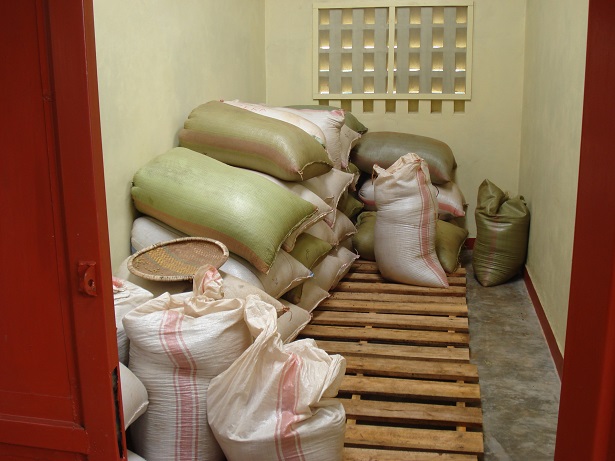
The grain is stored in tightly-sealed rooms to keep the vermin out!

The grain is sorted by hand to remove impurities.  Notice the rainwater collection tanks on the left and the Busoma truck in the loading dock on the right.  

John receiving careful instruction on how the grain is then washed with rainwater

The grain is then dried under the sun on nice days....

...and under a covered area on rainy days.

The grain is then roasted which produces a lovely aroma throughout the area.

The grains are mixed in the correct proportions and milled

The flour is then packed and sealed for distribution

The porridge being enjoyed by this young patient

12.4.16

New Album of Music for Free!

(from Eric)


It's been about a year in the making, but I finally finished a collection of Burundi-era songs.  I have shared a couple of them on the blog before, but there are a total of thirteen, now available for free download.


I hope these songs can give a few different glimpses into life here.  Today, I'll spotlight the first track, "Though the Mountains Give Way".  I wrote this song just weeks after arriving in Burundi, when we heard about the Westgate Mall terrorist attacks in Nairobi, where we had had lunch just six weeks prior.

At the time, we were living on that rural Banga hillside, where we spent three months getting an introduction to Burundian culture and Kirundi language.  I remember sitting on the veranda, looking across at the mountains on the other side of the valley.  I was reading Psalm 46.  "Therefore we will not fear though the earth gives way, though the mountains be moved into the heart of the sea."  The words came alive, and I trembled.  I could picture the distant mountain being uprooted, and felt the terror that accompanied the idea that the mountain where I'm sitting might be next.  "We will not fear?"

It came alive so vividly precisely because of the Westgate Mall attacks.  The revolutionary nature of faith.  The way that the reality of God so drastically changes our outlook on the world.

"I will not fear."  Mostly, I say it in order for it to be true, rather than because it already is.  But I do believe that there is good reason for it to be true, so I guess we will press always closer to the author and perfecter of such faith.

(Track #1.  Download it along with the others for free.)

6.4.16

Growing Pains

(from Eric)

Currently, there are a lot of patients at the hospital.  A lot.  Alyssa posted this on Facebook the other day:


84 patients on the pediatrics service.  A year ago, a heavy pediatrics service was 35 or 40.  The year before that it was 25.  Malaria season does make a big difference, but half of these 84 are either on the malnutrition service or the neonatology service, neither of which existed a couple years ago.  As Alyssa said, it is "another" record breaking day.  The record just keeps on getting broken.

She is not alone.  All over the hospital, there are more and more patients.  More people coming from farther away.  More hospitals transferring their cases to us.  (We used to only get transfers from health centers, but now it is just as often from another hospital.)  Less places that we can transfer them on to.  And this is challenging.

1.  Not enough doctors.  We are very blessed to currently have five specialist Americans working with five Burundian generalists.  That is a lot of doctors for a hospital of our size in Burundi.  However, it is taking its toll.  The patients keep coming, and there is no one else to shift the responsibility to.  We are set to hire a few more generalists, and there are a couple of Americans in language school in France, but they are not here yet!

2.  Not enough staff.  Alyssa rightly asked for prayers for perseverance and endurance for all the hospital staff.  Everyone, from registration to nursing to lab and administration is being asked to do the work of a hospital 40% smaller.  Again, more hiring is coming, but the process takes time.

3.  Not enough beds.  Alyssa has 84 patients in 31 beds.  Actually she has 84 patients, 84 mothers, and a score or so of the patients' siblings who came along for want of someone else to care for them.  So that is about 180 people in 31 beds.  Don't worry, they're small.  =)  We have broken ground on a new ward building.  It's exciting to watch the footings get poured, and to think about what that space will represent in terms of function and accommodation when it is finished.  Next year.

All this can feel simply broken and insufficient.  And it is.  But there is another side to it.  This is growth.  These are our growing pains.

The reality is that we have more usable space in the hospital than ever before, and we have way more doctors than a couple years ago.  Our staff is also growing.  The infrastructure of our facility in greatly improved.  Our water supply hasn't been this good in decades.  Maybe ever!  Our systems are also improving.  When things go wrong, there is more attention paid, and more desire to find a solution.  We are better organized, and our leadership skills are growing at every level.

We have moved significantly up the slope.  It's just that the demand has moved even faster up the slope.  I guess this is natural enough, and the fact that the demand is moving will probably be the strongest impetus to keep the growth going.  It's just painful, that's all.  Growing pains.

But if there is anything that we have all learned from Growing Pains, it's that great things can one day result if we can find the strength to persevere.  Like Leonardo DiCaprio winning an Oscar, for example.


19.3.16

International Women's Day


by Rachel

This post is a little late in coming, but March 8th was International Women's Day (thanks for the reminder, Facebook).  I actually had a patient that day wearing a traditional Burundian dress made out of fabric that featured the words "mars 8" and "la journee internationale des femmes."   I don't think that in the past, I would have paid all that much attention to a day celebrating women.  In my own life growing up, I didn't see that there was all that much gender inequality in the world.  I was able to get into the schools I wanted, the profession I wanted, the job I wanted.  I was able to choose marriage to someone I loved, decide when to have children and how many.  I knew (know) a lot of fantastic women doing a lot of amazing things, so I supposed a day celebrating women was fine.


Then I started living and working overseas, and the idea of International Women's Day has taken on a whole new meaning.  I wrote a post on March 8 expressing my feelings of the day:

March 8 = International Women's Day. Hooray! So glad that I chose to be an OB-GYN 12 yrs ago. At the time I had no idea how perfect this field is for impacting the lives of women around the globe. I am privileged to work with women who have had no advantages yet remain resilient and strong the in face of much adversity and heartache, and I pray that I am bringing hope into their worlds. I wait and work for the day when women won't have to worry about finding food to feed their families, they won't have to bury their children due to preventable diseases, and they won't have to fear childbirth as a likely cause of death. Today I celebrated by helping a woman get pregnant, preventing a woman from getting pregnant 
smile emoticonstopping a postpartum hemorrhage, diagnosing a tubal pregnancy, and delivering a healthy screaming baby. Some days I love this job.

As so often is the case, though, there are many ups and downs in this work.  Several days later I came home dejected and defeated.  The lady with the tubal pregnancy had gone home before her surgery because her husband refused to allow it.  He was too concerned with the potential decrease to her future fertility to understand that she could most likely die if left untreated.  Another lady requested a tubal ligation during her 5th C-section (this time for two dead babies) and the staff strongly advised against my performing it, since her husband wasn't there to give consent.  A third patient came in with a bad infection months after a C-section, and told me her husband had already left her because of the chronically draining pus.  And then later that day, I walked in to the OR to find Jason debriding burned skin off of a little 9 year old girl whose father had pushed her into a cooking fire because he was trying to beat her mother, and she was standing in the way.  

Oh, the stories that we see and hear.  It is amazing that these women will continue to get up and go back to their homes and keep living.  Keep caring for their families.  Keep toiling in their fields.  And even, sometimes, keep smiling.  And I'm realizing that International Women's Day isn't just a day to celebrate women, although we should.  And it's not even just a day to talk about equal opportunities in the workplace and increased salaries for working women.  It's a day to look around at the world, to see where women have been overlooked, abused, taken advantage of, beaten down, and to try to do something about that.  To try to ensure that they receive basic human rights.  To offer love and prayers and hope that it won't always be this way.  It's hard to fathom that somewhere between 1 in 16 and 1 in 20 women here in Burundi will die because of a complication of pregnancy and/or childbirth.  How is that even possible in 2016?  How are we allowing that to happen in this day and age?  I wish I had a good conclusion to these thoughts.  I do know that God sees every woman and her pain and heartache.  And I pray that He would give us the desire and the courage to see those women too, and to work for change both in our own lives and also globally.  Perhaps we will see that in our lifetime.

7.3.16

Depth of Mystery: A Tale of Two Patients

(from Eric)

A couple weeks ago, the morning report of overnight admissions informed me that we had admitted a 75-year old lady with malaria.  The severity of the illness had taken its toll on her.  Her blood pressure was low and she was quite agitated and "talking crazy" (to attempt a translation of the French).  These were all very bad signs.  Her husband had been admitted the same night, at the age of 82, also with bad malaria, but he was looking even worse.

They were placed in two different rooms, across the hall from each other.  The next day, the husband passed away.  In the other room, his now widow had regained her rightful mind, but had become acutely short of breath, and so was placed on one of our precious oxygen canisters.  Her children had not told her about her husband's death, afraid that it would cause her to lose hope.  I told the students that it reminded me of the story of King David and Bathsheba's first son, which remains incredibly realistic after 2500 years.

***

There is a third room in that hallway, one that I always jokingly refer to as the "Ward of Darkness", due to its utter lack of windows and our frequent power outages.  The same days that I was seeing this struggling, frail widow, a new lady came into the "Ward of Darkness".  She was thirty-one years old, and had delivered a baby three weeks before.  She started having trouble breathing, and the local health center referred her quickly to us.

Unlike most of our patients, she looked strong, well-fed, and healthy.  But something had gone wrong, and she was now floridly infected with something.  Her temperature soared and her blood pressure dropped.  We started her on antibiotics and lots of IV fluids.  The next day, we did some more tests, and broadened her medicines.  Nothing would bring her fever down.  Her newborn baby would lay on the bed, nursing from her mother, who didn't have the strength to rise and whose milk supply was rapidly diminishing.  Her husband stayed by her bedside and carried their newborn around.

We talked some more, and considered every diagnosis we could treat.  We treated her in the face of negative tests.  My student (also a mother of four) was worried for the baby.  We examined the baby, ran a couple tests on him, and Alyssa donated a tin of baby formula.  The next day, the mother died.

***

The widow survived.  She slowly got off her oxygen, and I remember her last day as she smiled at me, greeting me and shaking my hand with both of hers.

It was all very juxtaposed.  The young healthy mother, with a family and a newborn.  She falls away while this elderly widow beats the odds once again to go home.  Why would this happen?

But then again, this family had just lost a father, and though ancient by Burundian standards they might be, they were spared the tragedy of losing their mother in the same week.

***

These things are just utterly impossible to weigh out.  And yet I try.  I try to make some kind of sense of them by looking at them from different angles, trying to see how the light is outweighing the darkness, and my only conclusion is that I will never see deep enough into the mystery of the manifold world to be able to make a call one way or another.  Who knows?  Who knows what just happened here?  We tried.  There was great sorrow and there was some great joy and some moments of great beauty.  But what is the sum of it all?  Any pretense on my part to be empiric in one judgement or another would be foolish.  Who knows?

***

About a week later, we were in morning prayer for the hospital staff.  What this means normally is that I do my best to understand the rapid-fire Kirundi and consider it a success if I can grasp the Bible passage we are reading, and then I try and think about it on my own, since I don't have much chance of catching the speaker's conclusions.

We read from Isaiah chapter six.  It's a classic missionary motivation text.  Isaiah has a vision of the glory of God's throne room, and he hears God ask "Whom shall I send, and who will go for us?" and of course, Isaiah says "Here am I!  Send me."

But for the first time, I was struck by what immediately follows:  "Go, and say to this people:  'Keep on hearing, but do not understand; keep on seeing, but do not perceive.'  Make the heart of this people dull, and their ears heavy, and blind their eyes... until cities lie waste without inhabitant, and houses without people, and the land is a desolate waste."

It seems incredibly incongruous.  Was this what he was signing up for?  Why would he do that?  However, if Isaiah was surprised, he gives no indication of being so.  Maybe he had been surprised one too many times already.  Or, maybe he had seen the Lord, and what exactly he was going to be doing was not as important to him as the one that had commissioned him.

Don't misunderstand me.  I believe that God is doing a good work, better than we could dream.  Sometimes I can see it with my own eyes, and sometimes I have to cling to it, remembering evidences of past goodness.  Maybe I even have to cling to it in order to see it with my own eyes.

But I cannot grasp it.  I cannot anticipate it all.  My concepts of what is just and unjust will always continue to move me to action, but I also recognize their limits.

What are we doing?  Where are we going?  God knows.  If that was all we had, it would be enough.

4.3.16

Falls of Beauty, Flash of Terror

By John Cropsey

It was a beautiful Sunday morning after church when our escapade began last weekend.  A group of us from Kibuye decided it would be a perfect day to confirm the existence of a set of hot springs and a mysterious waterfall a few of our teammates had supposedly visited a couple months back an hour south of the southern most source of the Nile.

The journey there was an adventure all in itself as it took us nearly 3.5 hours of searching beautiful hills and valleys in our team 4x4 on two tracks.  Let’s just say the road leading to the falls was a bit difficult to pin down on a map and had some questionable bridges along the way.  The thought did enter my mind that perhaps one of our devious teammates had sent us on a wild goose chase.


After nearly giving up several times, we did finally arrive at our destination.  We decided to head straight for the falls, a 10 minute hike from the hot springs into the mountains by foot.  There was a brief shower we had to wait out and then the sun came beaming through fluffy white clouds and brilliant blue skies. 

Just around a bend in the valley, our eyes were spoiled silly by the sight of a beautiful 300 foot waterfall tucked away in the side of the valley.


It was a perfect day.  I had our three kids with another nine adults pitching in for Jessica’s absence. 

Happy Dad on an adventure with his kiddos.

That’s a better than a 3-1 adult-kid ratio, so what could possibly go wrong?


We enjoyed a picturesque picnic and a polar bear swim down at the foot of the falls.

That’s when our beautiful weather quickly changed.  An impressive tropical thunderstorm rolled over the mountain and we all huddled under the overhanging cliffs at the base of the falls as lightening flashed and the rains came down hard.  The shelter wasn’t great and we were all soaked to the bone by the cold, mountain rain,  but it didn't seem like a good idea to venture back out onto the bare face of the mountain given all the lightening.   As soon as the storm began to let up, one of our stellar interns, Lauren, wisely suggested we get going ASAP.  We agreed and began packing up our drenched picnic as the storm moved south.

Most of the team had now crossed the stream at the base of the waterfall and were headed up the edge of the gorge.  Mrs. Caitlin, Elise (my daughter) and I were still on a big, flat rock in the middle of the stream at the base of the falls where the picnic had taken place.  Caitlin was about to help Elise put her shoes on, and I had just finished closing up the picnic bags which also had our valuables inside (wallet, 4x4 keys, dry clothes for kids etc) when we heard it — a deep rumble like a freight train coming towards us up in the mountains.  We immediately knew our lives were in grave danger.  

I screamed “GET OUT!!!  GET OUT!!!”  As I peered back above my shoulder, I saw a roaring mass of water descending upon us from on high.  I won’t tell you what my next word was.  As there was no option for escape, I felt frozen as my mind futilely analyzed the best course of action.  In reality, it was less than a two second pause per a teammate who was watching this all take place before his eyes from the gorge's edge higher up.  

I snatched up Elise into my arms and jumped off our rock into the stream in what was looking to be a futile attempt to reach high ground before we were crushed by the power of a flash flood coming straight at us off a massive mountain.  I thought it was the end for us.

Waterfall just before storm.
Waterfall shortly after flash flood hit (note people down at stream between trees looking for us)
I’m not really sure when the torrent hit us.  All I remember is my brain telling my legs to sprint as fast as they could to save my daughter’s life, but instead of sprinting, all they did was slip and stumble with Elise’s head going under water again and again as I tried to keep us upright and make progress to the steep bank of the gorge as the flood waters whisked us away.  As Elise first recounted it, "Daddy pushed me off the rock and then kept dunking me under water."

Miraculously, we did make it to the bank.  I threw Elise up into the vegetation as high as I could and yelled at her “CLIMB, CLIMB, CLIMB!!!”  Climb she did, like a mountain goat.  As I attempted to get out myself, she scampered up the steep slope and didn’t stop.  As I crawled/climbed to the footpath via our "shortcut", all I could think about was, “Where are my boys”?  But by now Elise was continuing her rapid summit of the mountain and I had to stop her, so I could search for the boys.  I yelled “STOP ELISE!” over and over until she finally turned around and saw me yelling for her over the deafening roar of the falls.  

As I attempted to gather myself to find the boys, someone shouted to me from further down the path that the boys were safe.  I collapsed face down on the spot.  As I neared passing out with relief that the kids were safe, someone yelled up the path to me to come right away, “Katie is stuck in the river.  We need your help!”  My head was spinning and my hearing was going in and out, but I scrambled to my feet and struggled down the path back to the raging water’s edge.  

There was poor Katie, center stream, clinging to a boulder at the brink of being overtaken by the unpredictable torrent.  The pounding mists of the falls lashed at her relentlessly.  She was only about fifteen feet from us, but any attempt to enter the water would have been rewarded with certain disaster.  Gad, her valiant husband, began accosting nearby trees with his bare hands and a rock in order to try to reach her from the bank with a tree trunk.  While he did successfully bludgeon down several, they were not sufficient to attempt a safe rescue.   

We were helpless to save her.  So we prayed.  We prayed the flood waters would let up rather than intensify.  The other ladies maintained eye contact with Katie nearly the entire time and tried to keep us guys from attempting something foolish.  Note, my kids were appropriately "crying their brains out" (per Micah as he initially thought Daddy and Elise had died and now all feared for the life of Mrs. Caitlin).   Thanks to everyone who hugged, consoled and prayed with them as we sought a way to reach Caitlin.

The rains stopped, and we felt time might be on our side for the moment, but we couldn’t know for sure.  We had a contingency plan to attempt a rescue by bending down a branch of an overhanging tree with our body weight if things deteriorated rapidly.  

After thirty minutes of extreme intensity pouring over every possible way to rescue Caitlin, we felt the waters were letting up a bit.  One of our visitors, Hans Peter, convinced us to let him attempt a rescue by fording the stream about thirty feet up-stream from Katie using a vine hanging down from a tree as his safety cord.  It worked and he was able to bring Katie to the bank retracing the same route. 

At this point, everyone was out of immediate danger, but now we had to get to shelter.  That was complicated by the fact that the flash flood now lay between us and our vehicle, and the keys had been swept downstream as I had to let go of the picnic bags in order to have any attempt at survival.  In the mean time, we did successfully get a call out for help.  So the brothers Fader were on their way from Kibuye with warm clothes and the spare set of 4x4 keys.

Given there was a sharp bend in the river downstream in the valley, we decided to send out our two visiting eye docs on a recovery expedition, but with little to no hope.  Long story short, these eagle scouts not only found the 4x4 keys and my wallet, but several other Cropsey articles of clothing strung along bushes at the high water mark including Elise’s “favorite” shirt.

As the waters receded and another storm began to threaten, we successfully forded the once tiny stream using a human chain and booked it to the 4x4.  After being in the cold water, rain and wind, it felt so good to get inside as the rain began to fall again.

There was much rejoicing and thanksgiving as we headed for home and met up with the Fader brothers 15 minutes into the journey.  The adventure didn’t end quite so quick however as our rescuer’s vehicle broke down briefly on the way out and then we came upon the scene of a head-on accident between a motorcycle and a pick-up truck.  

We were so glad to arrive home just 30 minutes after nightfall.  Everyone was alive and well with a few of us nursing some nice cuts and bruises from our ride in the flash flood.  Our prayers had been answered.


1.3.16

Third Time's a Charm...I Think

by Jess Cropsey

If you are a regular reader of our blog, you’ll know that I’ve made several attempts to intentionally give our kids opportunities to interact with Burundian kids.  This is easier said than done believe it or not and the North American bubble that we often live in can be challenging to burst!  At the beginning of the school year, we tried taking our kids once a week to the local elementary school for a French or Kirundi class.  I wouldn’t say it was a home run success and it certainly didn’t foster relationships with other Burundians like we had hoped (either because interacting was just not part of the class and/or because our kids were all sitting together in the back row).  

Sometime in mid-December I starting mulling around the idea of a bilingual class (English-Kirundi) once a week that was comprised of our “bazungu” kids and Burundian kids.  After some thought and discussion, we decided to drop the weekly visits to the local school and give this a whirl.  We started in mid-January and have had about 6 classes so far.  The Burundian kids were chosen from the local community and I personally know each of their parents.  These kids all live right at Kibuye (with one exception), their parents work for the hospital or the school, and they all attend our local church.  We have roughly equal numbers of bazungu & barundi, with ages and genders matched to some degree.  Here are 6 of the 9 Burundian kids who are part of the class, enjoying a take-home balloon on that particular day.     


The primary purpose of the class is to encourage cross-cultural relationships in an environment that is a little less intimidating [at least for our kids], with some structure, but a limited number of kids.  The secondary purpose is for the kids to soak up as much of the second language as possible (English for the Burundians & Kirundi for our kids).  

I recruited Thérèse, the lady who has been helping teach Kirundi to our kids, to co-teach the class with me.  It’s a great opportunity for all of the kids to function in both a teacher and learner role as they help each other with language.  Here’s Micah & Bryce taking turns giving each other instructions about how to dress the doll.  


Playing a little Twister & Candy Land to practice our colors.


While I feel very unqualified to be doing this, it’s been fun and challenging to plan for this class and so far it has gone pretty well.  Outside the classroom we’ve had some discouraging moments of…
Me:  “Hey, that’s ____.  They’re in your bilingual class, remember?”  
Kid:  “Really?  She looks different here at church.”  
Me:  Sigh.

But we’ve also had some great moments of others seeing a particular kid while they’re out & about and saying, “Hey, that’s so-and-so!” followed by a greeting.  Or, "Hey they're playing that game [with the bricks and ball that we learned together in class]!".  Warms my heart and gives me hope to keep trying.  :)  

While I know there's no perfect solution, perhaps this third attempt is the closest yet in enabling our kids to develop relationships with kids from very different linguistic & cultural backgrounds.  Pray that we'll be able to love these kids well despite our limited ability to communicate and that they'll form a special bond with each other.  

22.2.16

COTW: 6 years old

By Alyssa (written Sunday, Feb 21)

One of my first patients when I began work in Burundi over two years ago was a little 4 year old girl named Jeanette. She was unable to walk due to severe joint pain and she needed a blood transfusion. We diagnosed her with sickle cell anemia. Near the end of that hospitalization she began to walk again and recovered from that painful crisis.


 I decided at that point that I would like to follow up with her regularly and explained this to her mother. This was asking a lot of her mother as there was no known concept of regular doctor visits unless you were sick, and she had to walk many miles to come with Jeanette’s little brother on her back and sometimes carrying Jeanette as well. But she came. I consulted with some hematology doctors in the US on what we could do for sickle cell patients here and we did our best for her (and for our many other patients with sickle cell) with prophylactic antibiotics, folic acid, and pain medications. But Jeanette frequently was re-hospitalized with malaria, serious infections, severe anemia, and painful crises. You might recognize the below picture from the composite pic in our blog heading above. This was taken when she was 5 years old. 

I didn’t see Jeanette for many months after that hospitalization and I wondered how she was doing. She came back last week. Her mother was very excited to see me and said Jeanette had been asking if she would see me. Their financial situation had worsened so they had been unable to make the trip for her regular visits, but now Jeanette was sick again so they came back. I printed the above picture and Jeanette and her mother were happy to have it. Rachel mentioned that she saw the little girl carrying it around with her around the hospital while on her mother's back. 


But this time Jeanette was very seriously ill with shortness of breath, evidence of sepsis, and malaria. We treated her with our strongest antibiotics, quinine for malaria, oxygen and a blood transfusion. But after a couple days she wasn’t improving and she was no longer able to talk or move the right side of her body. She still greeted me weakly with a left-handed handshake on Friday morning, but it was clear she had had a stroke - one of the many possible complications of sickle cell disease. She died Friday night. Yesterday morning her grief stricken mother asked if there was anything that could be done to help with the hospital bill. She didn’t want to leave without paying but another family member was hospitalized as well and there was no money left to pay Jeanette’s bill. Thankfully we have a Needy Patient Fund for just such a case and we were able to pay her bill from that. The mother was overwhelmed with gratitude and expressed over and over how thankful she was for all we had done for Jeanette. I never know quite how to respond to such conversations - the precious little girl died, after all, what did we really do to help her? 

The translation of Jeanette’s Kirundi name is “I believe God.” And the faith of her mother who chose that name for her was very evident. Even in the midst of her tears of grief, she believed. And in observing her faith, I was reminded of God’s presence as well - even in the valley of the shadow of death. God is indeed the refuge and strength, an ever present help in trouble, for the families of the four young patients we lost at the hospital this weekend and for us as well. This world is broken and it’s not supposed to be this way. But it won’t be this way forever. And God gives more grace. “Jesus loves the little children…” and I’m thankful to know them and love them, too, in His strength. 
I close with one of our team’s favorite quotes which we’ve certainly shared here before but is apropos now:


"What about when the boy is not healed? When, listened to or not listened to, the prayer goes unanswered? Who knows? Just keep praying, Jesus says. Remember the sleepy friend, the crooked judge. Even if the boy dies, keep on beating the path to God's door, because the one thing you can be sure of is that down the path you beat with even your most half-cocked and halting prayer the God you call upon will finally come, and even if he does not bring you the answer you want, he will bring you himself. And maybe at the secret heart of all our prayers that is what we are really praying for.”                                          -Frederick Buechner

20.2.16

On Thievery and Treasures on Earth

(from Eric)

Two weeks ago, I was feeling like I had begun to get back on my feet.  Things had been going fine, but re-entering life at the hospital and the university after nine months away definitely left me with the impression of needing to dig myself out a bit.  There is just no escaping the accumulation of things that are waiting for you after such a period of time.

But it was going well.  I had just given a lecture that I thought went off well.  And now I was heading down to join everyone for a Chinese New Year party, where Grace was making dumplings, which are certainly a rare treat here in Burundi.  Rare and yummy.  I got there a bit early, and so I sat down and opened my laptop up (I had it with me since I came right from the lecture).  I put the finishing touches on a first draft of a new educational program and was quite satisfied with how it was turning out.

We had some dumplings (I might have had more than "some"), and then as it was getting dusk, we walked out to the field next to the church.  Our schoolteacher had miraculously procured a bunch of Chinese paper lanterns, and so for the next fifteen minutes, we were helping the kids get them lit and watch them sail off into the quickly darkening equatorial sky.  Of course, there was the usual gaggle of young male onlookers, especially since we were doing something so conspicuously odd.

When we were done, we said goodnight to the observers, and headed home.  About three minutes later, as I was carrying a tired Toby in our front door, it hit me.

I had set my computer down to help with a lantern and left it there.

I sprinted back, searching with my flashlight.  The computer was gone, and so were the gaggle of young strangers.  A swift multi-person search into the nearby area ensued, the local police took some details, and our good Burundian friend (who thought he had recognized a couple of those guys passing by) headed out into the dark hills to try and ask around.

It was my 6-month old MacBook Pro.  It is password-protected, with no power cable, and about 20% battery life.  I can't imagine what a rural Burundian is going to do with it (especially since Macs are utterly unknown in this country).  I offered a substantial reward.  Many friends were searching the hills for signs of its whereabouts.  It was even announced in church.

Two weeks later, there is no sign of it.

Coping with this has been a multi-faceted experience.  First, there are the logistics.  It's a substantial financial hit.  But we'll live.  I thankfully had a back-up from three weeks prior, but still I had done a lot in those three weeks, and I am still annoyed by discovering yet another document that isn't on the back-up.  It will be several months before I can get a new computer (though I'm borrowing an extra).

It was hard for a couple days to walk around and wonder at the people I was seeing.  Was this unknown young man the guy who took my computer?  Does he know who did?  It's not a very fruitful lens for the world around us that we are called to sacrificially love and serve.

One of our teammates' first concerns was that, if they caught this guy, he wouldn't be subject to undue punishment.  It's not impossible that local village punishment could result in him never being able to physically take anything ever again.  So, we pray for our enemies.  We pray for their repentance.

In a certain sense, I don't really blame whoever took it.  These folks almost invariably live on the brink of poverty and even starvation.  I am obviously wealthy.  The rich white doctor can buy a new computer (and in fact, I can.)  They might be able to easily sell this for (if they knew it's worth) three years of the average Burundian GDP per capita.  I doubt he went out that night with an intention to steal.  He didn't break into anyone's house.  He just seized an opportunity afforded by my mistake and distraction.

On the other hand, it's stealing.  It's not good for him, any more than it is for me.  And if he would do it to me, he might also do it to others, and those other people might suffer a lot more from it.  I've thought about this in the very gracious response from my Burundian friends.  They have really exerted themselves to try and find this computer.  I think that is because they care about me and value the work I do.  But also I think they don't like the idea of someone in their neighborhood who is willing to steal valuable things from other people when the opportunity arises.

In the end, there is trust.  God, I believe you have called me here to do this work.  Why have it hampered in such an unjust way?  I don't know.  When we don't know, we are called to trust.  Called to consider the possibility that there could be a reason beyond what we can figure out.  At the very least, we are called to keep going despite the setback, trusting enough to release whatever hesitations and unforgiveness are in our hearts.

"Do not lay up for yourselves treasures on earth, where moth and rust destroy and where thieves break in and steal, but lay up for yourselves treasures in heaven, where neither moth nor rust destroys and where thieves do not break in and steal.  For where your treasure is, there you heart will be also."  Matthew 6:19-20 

6.2.16

Farewell, First Students!

by Rachel


About 25 months ago, we started work at Kibuye Hope Hospital for the first time.  Looking back, I’m pretty sure I didn’t have much of a clue what I was doing.  I didn’t know where to find things, how to get things done, who anyone was...and certainly not how to educate medical students in French.  But, despite that, one week after our start date at Kibuye, our first medical students arrived.  This was their very first clinical rotation.  Many didn’t know how to use a stethoscope, and when I asked if they had questions they wondered if I could teach them how to take a blood pressure.  I didn’t know how to say 50% of what I needed to say and when I’d try out a new medical term, they had no idea if it was a real word or not!  It was so, so basic.  I think those first three months we learned a lot from each other.  And at the end of their time with us, it was fun to see how much they had grown and learned.  I guess I had grown and learned a lot as well.


Fast forward two years, and this past week the same class was saying goodbye to Kibuye.  They came up once in 2015 as well (Eric and I were in the US though and missed seeing them) and now were spending their last 3 month block at Kibuye.  It was a pleasure to see students again and remember names.  It was nice to watch them care for patients in a competent manner and complete tasks they couldn’t have 2 years ago.  The longitudinal education we can provide here is actually really encouraging for me.  

The students threw us a goodbye/thank you party as they got ready to leave on Wednesday night.  They’re heading back to Bujumbura for the last 11 months before graduation, finishing classes and rotations, developing research projects, writing and defending theses, before hopefully graduating this December.  We enjoyed a delicious meal, kind speeches, lots of pictures, and several fun musical numbers performed by the class.  In my experience, Africans seem to do a good job “appreciating” people, and we felt very appreciated.


I am excited to see where this class goes in the next years.  It would be great to welcome some back to Kibuye as interns or doctors.  They will always have a special place in my heart as our very first HAU class.