18.2.13

Standing on Shoulders

by Rachel

Dan Fountain died last week at the age of 82.  Many of you have never heard that name before.  Dr. Fountain was a missionary surgeon who served for over 35 years in DR Congo with his family.  But perhaps just as significantly, after he returned to the US he spent his entire retirement teaching and training the next generation of missionaries and missionary doctors about community health, whole person care, and other important lessons he had gleaned from many years of service in Africa.  Eric and I heard him speak at a Louisville medical missions conference in 2003 and were struck by his insight and creative ways of thinking and teaching nationals.  Most of us McCropders listened to his DVD course on Whole Person Care as well, thanks to MedSend, an organization that pays our medical school educational debt (and an organization that he helped co-found).  And we have since heard him speak at a number of conferences, including a CMDA "deployment" conference in 2009 for young medical missionaries.  Dr. Fountain's life is certainly one that touched many people around the globe, and his legacy will live on through the thousands of people he helped to train.

Hearing about Dr. Fountain's death made me start thinking about what lies ahead for me.  At the age of 33, I have almost my entire career in front of me, and potentially a retirement as well.  I have been called to go to Burundi...a country I had barely heard of three years ago.  And yet already in the country there is a missions hospital and a medical school.  Someone started these places.  Someone planted seeds many many years ago.  Missionaries from all over the world have been working in Africa for hundreds of years, bringing the Gospel, bringing education, bringing health and hope and healing.  I can go to Burundi because of some of them.  Other missionaries have invested in young lives--teaching and encouraging youth, medical students, residents.  I can go to Burundi better equipped and better prepared because of some of them.  Our whole team stands on the shoulders of people who have sacrificed much to go before us.  Some of these people are unknown, and others (like John and Jason's parents) are quite close.

I remember at times like these that we are a body of believers; we are a community in Christ.  We do what God has called us to do not by ourselves, but because of and with those others who have also been faithful to the call--people who go, people who give, people who pray.  People who went before, people who are coming after.  Dan Fountain was one of those people who spent a lifetime investing not only in the NOW but in the future, and I pray that through my life, my career, and yes, my retirement, I can be one of those people too.

The McCropders at the 2009 CMDA conference...Dan Fountain is pictured at the left of the group

16.2.13

Looking Ahead and Looking Around


(from Heather)

This coming week, a team of nine engineers, architects and surveyors through EMI (Engineering Ministries International) is traveling to Kibuye Hospital in Burundi to carefully evaluate the current facilities (buildings, water, electricity, land).  In a few months, when this information is processed, another similar team can use this information on another trip to Kibuye to develop a comprehensive long-term (10-20 year) plan for how the hospital can develop into a 300-bed teaching institution.  This is a big step of planning for the future of the hospital.  

Evidently our children have caught the excitement for drawing up plans for Burundi.  Anna, Elise, and Abi recently took on the task of designing the schoolhouse for Aunt Sarah’s McCropder kid school.  Here is the schoolhouse design committee meeting:

Elise (wearing an “I ♥ USA” t-shirt while sitting here in France drawing plans for Burundi) created plans for a dream playground.

Anna mapped out a multi-room schoolhouse, the highlights of which include a reading corners for everyone, a rest time area, a time out corner, a large number of bookshelves, and a snack shelf.

A few days after this looking ahead to Burundi, the kids found themselves looking around here in the Alps.  On Thursday our school took a field trip to the nearby mountains to experience an important aspect of local culture:  skiing. 

 Others went sledding (Cropseys in the foreground, Maggie and Rachel in the middle of the picture)

or snowshoeing.  

All enjoyed the opportunity to look around at the beauty of creation.


He who forms the mountains, creates the wind, and reveals his thoughts to man, he who turns dawn to darkness, and treads the high places of the earth--the Lord God Almighty is his name.  Amos 4:13


For the Lord is the great God, the great King above all gods.  In his hand are the depths of the earth, and the mountain peaks belong to him.  Psalm 95:3-4

11.2.13

Beyond France

(from Eric:  Today's post comes from our special guest blogger Kathryn Wong.  She is a friend of ours from Michigan, and a blessing to our families, as she visits and studies with us for a few months.  She is also a great writer, and so we thought you might enjoy hearing from her as a different perspective on our lives here.  Read her own blog here.)

Here they are. Three families, three singles, and seven – soon to be eight – kids living in the Alps of Southeast France. Living in this land of baguettes, cheese, and wine, of majestic mountains and rich history. Living in a land that displays culture and cultivation at its finest.

But it doesn't take long to figure out that this year of living in France is really not at all about France. You walk down Le Chemin des Galibouds, what seems to be a very normal, peaceful, residential little French street until you arrive at the blue and green sign that reads: Centre Chrétien d'Enseignement du Français. Turn into this driveway, and you'll find a collection of connected, faded white, somewhat weathered buildings with dark brown roofs surrounding a small parking lot. And here in this place, people live with a purpose, for the most part with a purpose decidedly beyond France. People going to Mali, to Togo, to Chad, to Burundi.

Living with the focus beyond France manifests itself in a multitude of different ways. Hardly a day goes by when I don't observe something – different actions, words, gatherings – directed towards what is yet to come.

Aunt Sarah practices the alphabet with Abi each week. I watch them hard at work – jumping from letter to letter, Abi receiving stickers as a reward for her endeavors. A preparation for and a mere foreshadowing of what's to come. She is now learning who each of these little people are, and her role in the lives will be enormous.

Pastor Bob flies across the ocean to visit the McCropders. Why? To discuss Christianity in the context of French culture? No. To look forward. Ahead and into the future of life in Burundi. To wrestle with issues of how to present the gospel in a transformative way to the Burundians. Not a word of France is mentioned. Eleven adults, crammed into the Cropsey's apartment, focused on what is yet to come.

Not all McCropders are natural language learners. Some enjoy it, but not all. For many it's a struggle synonymous to scaling Mount Blanc (and indeed some may prefer that more physical challenge!) Yet they persist in le discours indirect, in mastering les pronoms compléments, in the mind-bending game of communicating correctly with the subjonctif, conditionnel, imparfait, passé composé... Why do they willingly subject themselves to the seemingly insurmountable difficulties of learning an entirely new language with all that it entails? To studying extensive, imaginary dialogues in their textbooks between rather petty, shallow French women celebrating their thirtieth birthdays. To essentially putting themselves back in the shoes of a child, just learning how to speak. Why? Because of what's to come.

On Sunday nights they gather as a team. This time crammed in the Fader's apartment, they enjoy the Galette des Rois – a French epiphany cake – whilst they listen to sermons and work on the aspects of their team covenant, articulating in words their mission statement for beyond France. They pray for and with each other. They're preparing themselves for life in Burundi by learning the language, but underneath the constant verb conjugations and new vocabulary, they're preparing themselves in many more ways than by simply learning the language.

A common refrain is, “It's on the container.” Yes, there is a piano that the McLaughlins packed...I don't have that book with me here, but I do think we put it on the container...Yes, yes that's on the container...No, we don't have that with us here, but it's on the container... They are even materially focused ahead. They will never use this furniture again. They will never use many of these bulky winter clothes again. They will not use these dishes, or these French coffee presses, or this silverware once the year is up. The future of their material lifestyles is packed up, sitting somewhere in Ann Arbor in a big metal container. Eyes are focused on what is yet to come.

The marketplace in Burundi burns to the ground. Attentions are riveted on this event. Something has happened hundreds of miles away, and according to google maps 6,000+ miles, that has powerfully impacted their future. There is a detachment from the place that they now live, from the current events of the locals; there is a deep connection with a place some of them have never been to before.

Lest you get the wrong impression, however, let me assure you it is by no means all detachment from France. Each Saturday many a McCropder hits the ski slopes, fully aware that this may very well be the last opportunity for winter sports that will present itself in decades. On Friday, the célibataire McCropders enjoyed a delicious, French raclette dinner at the McLaughlins. Crêpes and cheese and French bread abound in great quantities. McCropders help out with French Sunday school, they attend Friday night Old Testament Bible Studies with the French church, they're involved in the French youth group. As time and children allow, they travel, exploring the vast amounts of history and culture and legacy that surround them. And so they do embrace France and the great opportunity that a year in Europe presents.

And yet something brews within these walls that is much more than just learning a new language and living in a spectacular country.

Toujours, the McCropders look ahead.

7.2.13

A Few Words from our Children


With actual video footage to prove it, we affirm that the McCropder kids are learning to speak French.  Elise's vocabulary is expanding…

Let’s see if Abi and Maggie can try that…

Anna "loves French" and speaks in sentences which, despite grammatical errors, actually do make sense....

Micah even sings in French….

Voilà. 

2.2.13

Song for Sonship: If Not For Your Love

Coming off the last post, here is a song I wrote to try and express the same sentiments.  Again recorded on my phone, please forgive/enjoy the simplicity of the recording.  In light of what I wrote before, I hope that it bears no further background, though hopefully it fills out the ideas a bit.

The bridge is taken from Gerard Manley Hopkin's poem, That Nature is a Heraclitean Fire and of the comfort of the Resurrection, which you can read here.


Seize a few better things, then buttress them high with stones
and bury deep all else beneath
Where perhaps I maybe could believe
That these are not part of me

If my virtues will make you love me
Then I have no vested interest in honesty
So I lie, and tell myself that it’s true
For I fear the same of you
That you’d flee if you knew

If not for your love, 
then I would never bear the truth about myself

And I can’t even admit to myself
That this is what I do
For none could love the blackguard that’s making bold his plea
That how I am is really what you see
Just don’t dig too deep

And this means the death of pride
And means all my worth is lavished on me from outside
Staring into this dark space
Falling out of this chase
To rest an object of grace

And it’s left but ash
But in a flash, at a trumpet crash
I am all at once what Christ for he was what I am
And this jack, this joke, 
this poor potsherd, patch, matchwood, immortal diamond
Is immortal diamond

If not for your love, 
then I would never bear the truth about myself

31.1.13

Sonship

(from Eric)

I was surprised to discover that we haven't written about this.  But then I started the post, and realized how hard this is to encapsulate.  However, this has been quite impacting for our whole team, so here goes: 

Depending on what missions agency you work with, there are different prerequisite requirements, quite similar to entering medical school, actually.  They vary.  Sometimes they include cross-cultural training, and oftentimes bible school or seminary classes.  WHM has a somewhat unusual set-up in that the centerpiece of their training is a discipleship program called Sonship.  In my mind, this shows great wisdom on their part, for it speaks an opinion that, for surviving and thriving in the work we are settling into, we are not predominately needing more knowledge (about the Bible, about theology, about culture, etc).  Rather we (quite desperately) need a deeper and better daily application of that which we already know.

Every week or two, for the better part of a year, we would meet via Skype with a WHM Sonship "discipler" and almost daily we would work through introspective questions.  If you think back through our nomadic lives, you can picture us rendez-vous-ing in the strangest of circumstances.

One of the core quotes of Sonship goes something like this:  "I have good news for you!  You are much worse than you think you are!"  Pause...  "and the grace of God is so much greater than you ever dreamed it was."

There have been many transformative things taken from our Sonship program, but if I had to make one central, it is the unrelenting uncovering of the sin of our heart.  The basic argument goes like this:  Deep in my heart, I really want to be able to contribute something to my salvation or goodness (or I just don't believe that God could love me), and so I need to hide most of my sins and more or less publicize my virtues (which does take a bit of the virtue out of them).  In other words, if the grace of God is anything other than free, then we have no vested interest in honesty - in the church or in the world.  We rather have very good reasons to hide the truth about ourselves from everyone, including ourselves.

Thus we may be quick to judge others, but we can't even admit to ourselves that we are hiding our own sins, much less admit what they are.

Sonship is relentless is leading the way through this into repentance, and thus into a discovery of the greatness of the grace and love of our God.  Before Sonship, I would never have said it (or even thought it), but for me, it has been honestly a shift from "God's love is so great that he loves me, an imperfect person to be sure, but overall with a lot of positive qualities and a pretty decent asset to God's team" TO "God's love is so great that it extends to me, full of pride and self-conceit, unwilling to even acknowledge my own faults and persistently rejecting the grace of God in favor of some worthless alternative that leaves my pride looking sort of intact."

The point is this:  the awareness of my sin magnifies the love of God in my heart.  But it's a bit "chicken or egg", because I don't think I would ever admit my sin to myself if the great love of God was not there to call me out of it.

Applications?  Beaucoup.

We can be honest.  We can share our weakness, and it becomes consistent that God would use our weaknesses to glorify himself.  We need the gospel every day every bit as much as any person in Burundi that we would seek to serve, so the harmful "I-versus-them" dichotomy withers.  Our work, now in France, also in Burundi, is never the basis for our worth.  Whether we succeed or fail, our worth is that God has loved us with an everlasting love...

29.1.13

What Response a Fire Demands

(Carlan writing) On Sunday the marché centrale in Bujumbura, capital city of Burundi, burned to the ground in what appears to be an accidental conflagration. Conflicting reports have been received as to how many were killed directly by the blaze and how many have been injured. With the aid of Rwandan helicopters the Burundian military and emergency services (5 firetrucks total for a country the size of Maryland with almost 10 million citizens) seem to have gained control of the fire, avoiding further disaster as a nearby petrol station was threatened.

Though it may not make international headline news, the scale of this disaster is difficult to comprehend for those of us who have never lived in Bujumbura. Here is a quote from Rebecca Mosley, a Mennonite missionary in the capital that gives some sense of the immediate and ongoing impact this destruction of the commercial center of the city/nation will have:

"Up to a thousand households have lost their savings and income. There will be a direct humanitarian crisis for these people. Most businesses were run on credit and those creditors won't see their funds back, in most cases. This will also affect many banks that capitalized vendors in the market [and] the supply lines for most local products in Burundi [that] passed through the central market. Vendors who work in other locations lost their supply lines. Farmers from up-country will have to reorganize also to get their goods to market... All Bujumbura transport passes through the central market [and] will all have to be reorganized...There will almost certainly be a recession in Burundi, but it's hard to imagine how the situation here could get any worse, with high levels of inflation, devaluing currency, average daily wages not at all keeping pace with the most modest costs of living."

One of our friends has sponsored a Burundian Christian family who just lost their livelihood in the blaze and has forwarded us the father's response to their loss: "My little children ask what will happen to us, and I tell them that God is faithful, but will He be this time?"

It can feel trite or even false to recite those assurances of old when new tragedy strikes, but these are the very same times when Asaph and David, Isaiah and Habakkuk wrote (emphasis added):


Psalm 50:14,15 "Offer to God a sacrifice of thanksgiving, and perform your vows to the Most High, and call upon Me in the day of trouble; I will deliver you, and you shall glorify Me."

Psalm 52:8,9 "But I am like a green olive tree in the house of God. I trust in the steadfast love of God forever and ever. I will thank You forever, because You have done it. I will wait for Your name, for it is good, in the presence of the godly."

Isaiah 55:1 "Come, everyone who thirsts, come to the waters; and he who has no money, come, buy and eat! Come, buy wine and milk without money and without price."

Habakkuk 3:17,18 "Though the fig tree should not blossom, nor fruit be on the vines, the produce of the olive fail and the fields yield no food, the flock be cut off from the fold and there be no herd in the stall, yet I will rejoice in the LORD; I will take joy in the God of my salvation."

It is no small thing for God's people to pray, persistently and deliberately for Him to act. Would you join the McCropder team in praying and fasting for the people of Bujumbura and Burundi? Would you ask alongside us that somehow, in God's sovereignty, this tragedy might unite the nation, heal old wounds, and draw people to Christ? And if He moves you to some additional action of aid, please contact one of us for help in so doing.


23.1.13

The Impossible Loads of Africa

This has been circulating around, but if you haven't seen it, then our blog is delighted to bring it to you (click on the title:


French Culture: A Study of Comparisons

(by Eric)

I asked a question on facebook:  If I say "Swiss", you could follow with "cheese, chocolate, army knives, banks..."  If I say "French", what comes to mind?

The responses were interesting and varied.  The most frequent answer was probably "kiss", and I won't endeavor to provide a cultural exposition of that at this time.  Other notables included Braid, Onion Soup, Silk Pie, Fries, Revolution, Tips, Cuisine, Horn and Dip.

A few such answers make for a good comparison, or can use some background information.

pain perdu
1.  French Toast:  This was a very popular answer.  From what I have thus far seen, the American version of this is not so very different from the reality in France.  One might ask the question:  "They obviously don't call it 'French Toast', so what do they call it?  They don't call it 'le toast', right?"  Good question.  The French term for this is pain perdu or literally "lost bread", referring to how it is used for bread that have gone stale.  It's a fairly nice redemptive picture, actually.  Which brings us to...

2.  French Bread:  We picture a long, crusty white roll, thicker than a baguette, with a nice fluffy inside.  And though there are many varieties available, this is indeed the classic.  And indeed, one just calls it pain or "bread".  Just like that.  You walk into the store and ask for "two breads", and you can get two such delicious batons.  

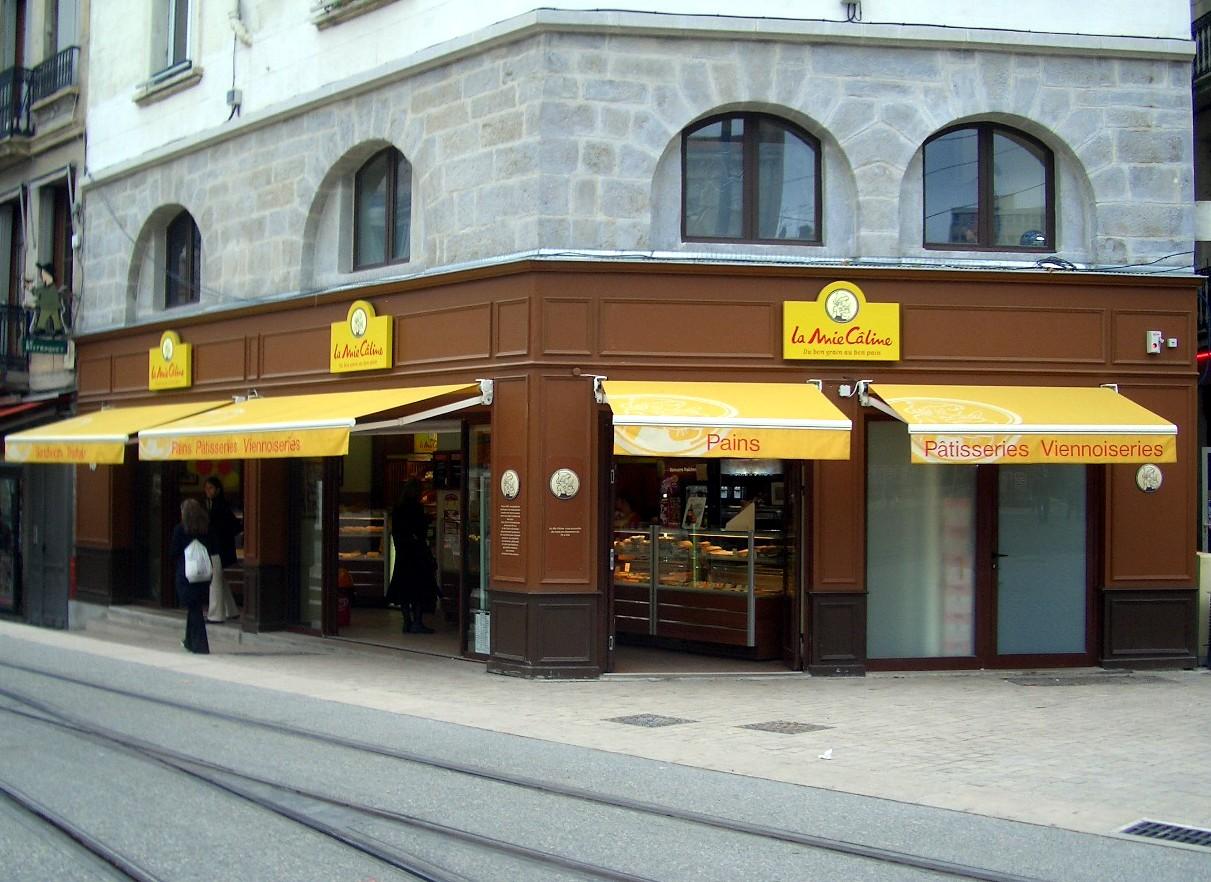
La Mie Caline, a popular bakery
The French are quite hardcore on their bread.  There are labor laws restricting which businesses are allowed to be open on Sundays, and bakeries are one of the exceptions (along with pharmacies and hospitals, but not usually grocery stores).  It is remarkable how delicious French Bread is on day 1, and how quickly it goes stale, so I guess I can't argue with them.

3.  French Mustard:  I enjoy mustard, and I like dijon in particular.  Some of you may know that Dijon is actually a city in France.  Thus we look here for the authentic.  And what we find is very good, and amazingly strong (!) dijon.  And it is used for many things.  It is a bit of a challenge to find mayonnaise that does not have dijon added to it.  And it seems to be a frequent favorite for a salad dressing ingredient.
the real deal


4.  French Press or French Roast:  I haven't yet figured out all the coffee lingo.  Generally speaking, you "take" a coffee at the end of a meal, and that is referring to a small cup of espresso without milk, +/- sugar.  Cafe au lait (coffee with milk) seems to be treated as an utterly different beverage, rather than a variation of the above, and is usually taken with breakfast, in a bowl (bol) not a cup (tasse).

5.  French Dressing:  Cards on the table, I have never much liked this stuff.  And I'm not sure what it is, and I'm pretty certain the French don't recognize it either.  Salad dressing here is nothing like American "French" dressing, but usually an extremely tasty vinaigrette, often with a hint of dijon, as mentioned above.  In my experience, salads are simpler, often just lettuce with dressing, but somehow amazingly good.

19.1.13

DTW to LYS

(from Heather)

The airline industry may be suffering economic hardships, but the McCropder team and community have done their part this winter to keep the industry afloat.  
 
In the last month, 6 McCropders, 12 visiting family members, and 3 special visitors made a total of 41 trans-Atlantic voyages. 

“But wait,” you say, “41 is an odd number… so someone has not made a return flight….”  That’s right.  We have gained a delightful addition to the community here.  We are so happy to have Miss Kathryn Wong in Albertville with us for four months! 


The kids ADORE Miss Kathryn.  And the adults are equally pleased to have her here helping with the kids, participating in life here, and studying French along with us.  Kathryn’s impressive French speaking abilities have landed her in a class with 5 McCropder adults, and she reports that she loves class, which is not surprising for those of you who know Kathryn.  Kathryn and her family are treasured friends of the McCropder families who hail from Ann Arbor, Michigan.

Kathryn is also a gifted writer who keeps a blog here to chronicle her adventures during this gap year (at an orphanage in Haiti last semester and at French school here in Albertville this semester) before she heads to college in the fall.  This girl tells a good story and documents with great pictures, as evidenced by her report of her downhill skiing adventure last weekend. 

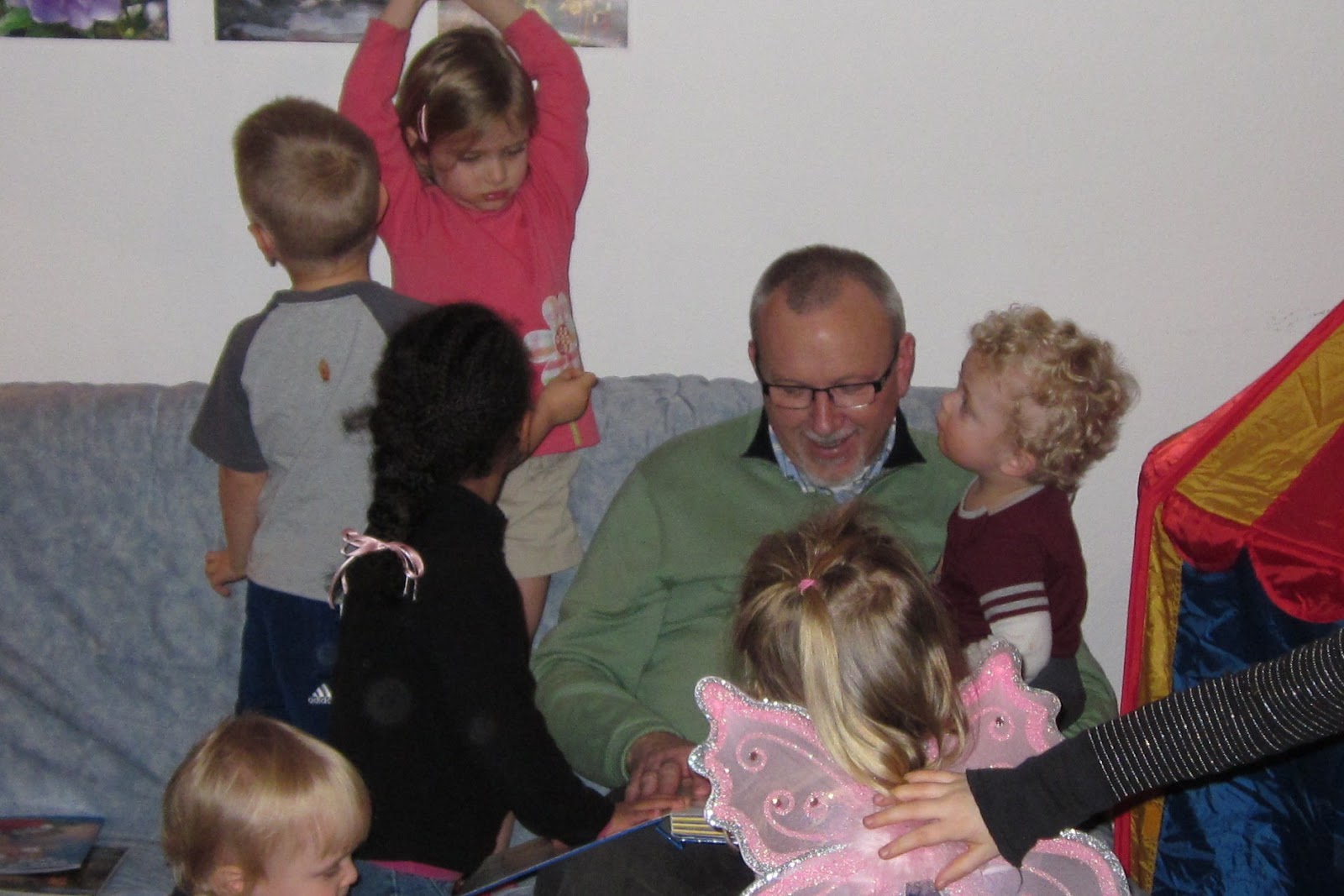
Ann Arbor also sent us another blessing recently as Pastor Bob and Ilene Lynn came for a visit last week.  The adults really appreciated good talks with the Lynns, and the kids appreciated their attention and story-reading as well.

We are so thankful for Kathryn and for the Lynns and for the love that they bring from our awesome home church in Ann Arbor.