13.9.18

Dry Season (music video)


by Logan

During last year's dry season I had a crazy idea: what if I took a time-lapse video of my walk across the field to the hospital?  If I took a photo every day, just one step further, perhaps it would tell the story of dry season.  You could watch the field grow more and more yellow and dusty as the season progressed, and then at the end, watch the return of green grass.


It actually worked out pretty well, and I was pleased with the result, except that it was completely silent.  I asked our musician teammate, Eric McLaughlin, if he had written any songs that would go well with the theme of dry season.  He recommended a song called Banga Hill, that he had written during their very first dry season in Burundi.  It talks about our need for God's grace to "rain" into our lives, washing away our sins and quenching all our thirsts.

Enjoy!


For I will pour out water on the thirsty land, and streams on the dry ground; I will pour out My Spirit on your offspring, and My blessing on your descendants. 
-Isaiah 44:3

Blessed are those who hunger and thirst for righteousness, for they shall be satisfied.
-Matthew 5:6

Now on the last day, the great day of the feast, Jesus stood and cried out, saying, "If anyone is thirsty, let him come to Me and drink.”
-John 7:37

Jesus answered and said to her, "Everyone who drinks of this water will thirst again; but whoever drinks of the water that I will give him shall never thirst; but the water that I will give him will become in him a well of water springing up to eternal life.”
-John 4:13-14

More of Eric's music can be found here.


10.9.18

Serge East Africa Retreat

(By Alyssa)

Most of the team recently attended the Serge East Africa retreat that occurs every four years.

Retreats provide an opportunity for us to get away from the hustle and bustle of life in Burundi and to reconnect with God, each other, and Serge friends doing similar work in the region. The theme of the week brought by speaker Greg Thompson was "Life in the Wilderness." In Exodus, God leads His people in the wilderness - not an easy place but the place where God was with them by day and by night. We had no trouble applying the imagery of wilderness to our lives in East Africa - places where we lack clarity & control, sometimes powerful and beautiful places but where we don't always understand what's happening. We identify with Martin Luther King, Jr. who said, "Always there's a wilderness before us." But wilderness doesn't have to be a place of despair. Instead it is a place of invitation by our Beloved Heavenly Father to be embraced, transformed, and consoled by Him alone which leads us to join Him in consoling and loving others. We appreciate your prayers for our team that these truths would sink deep into our lives and overflow to those around us.

And to update you on our ever-growing and transitioning team, check out this video that we shared at retreat - created by our oldest team kid Jonah Watts:


And a few more retreat pictures:
Our talented teammates leading worship 


Communion

Fun time with friends
Beach soccer
Running on the beach at sunrise

Beautiful creation drawing us to our Creator

8.9.18

Solar Power at Kibuye

(By Caleb) 

It has been a busy summer in Kibuye.  Among the many comings and goings, regional conferences, the arrival of new teammates, etc. we welcomed a whole new level of power to Kibuye hill….solar power.  

It takes a team to bring something like this to fruition.  It all began with a group of electricians and solar experts working for a non-profit called International Technical Electric and Construction (ITEC).   ITEC installed a solar system about 25km from us for a partner organization.  They visited our hospital while here and asked if we had ever considered solar power for Kibuye Hope Hospital.  It was not too long after this that we began receiving only an hour of power per day from the national grid and diesel was becoming extremely hard to find. If diesel became available at a gas station 30km away, we had to first get a special letter from our Provincial Governor to allow us to buy a very limited quantity and then race to the station before it was all gone.  Lines at gas stations could reach one hundred cars long.  We had to cut way back on the number of hours we could provide power to the hospital. This had dramatic effects on patient care: those who needed oxygen could not get it, premature babies were not able to be warmed in incubators, and essential surgeries could not be performed, etc. We were becoming hamstrung.  

Something had to be done. 

In September of 2016, ITEC came to Kibuye for a preliminary survey.  This group of gentlemen immediately impressed us. They were professional, very knowledgeable, and delightful to have around.  In the following months ITEC proposed a solution they call a Power Pac: a 40-foot container that they build out and pre-wire in their warehouse in Pennsylvania complete with batteries, inverters, and switchgear. The solar panels, distribution wire, and mounting equipment are shipped in a separate container.  Our team held many discussions about this solution and finally decided this was right for Kibuye.   

A design based on current need and future growth was decided upon: 122.5 kW of solar panels, 90 kW of battery inverters, 120,000 Ah of batteries, 176 kW generator and a new transformer dedicated to the hospital.   The design could also be easily expandable as the hospital grows.     

A preliminary planning sketch


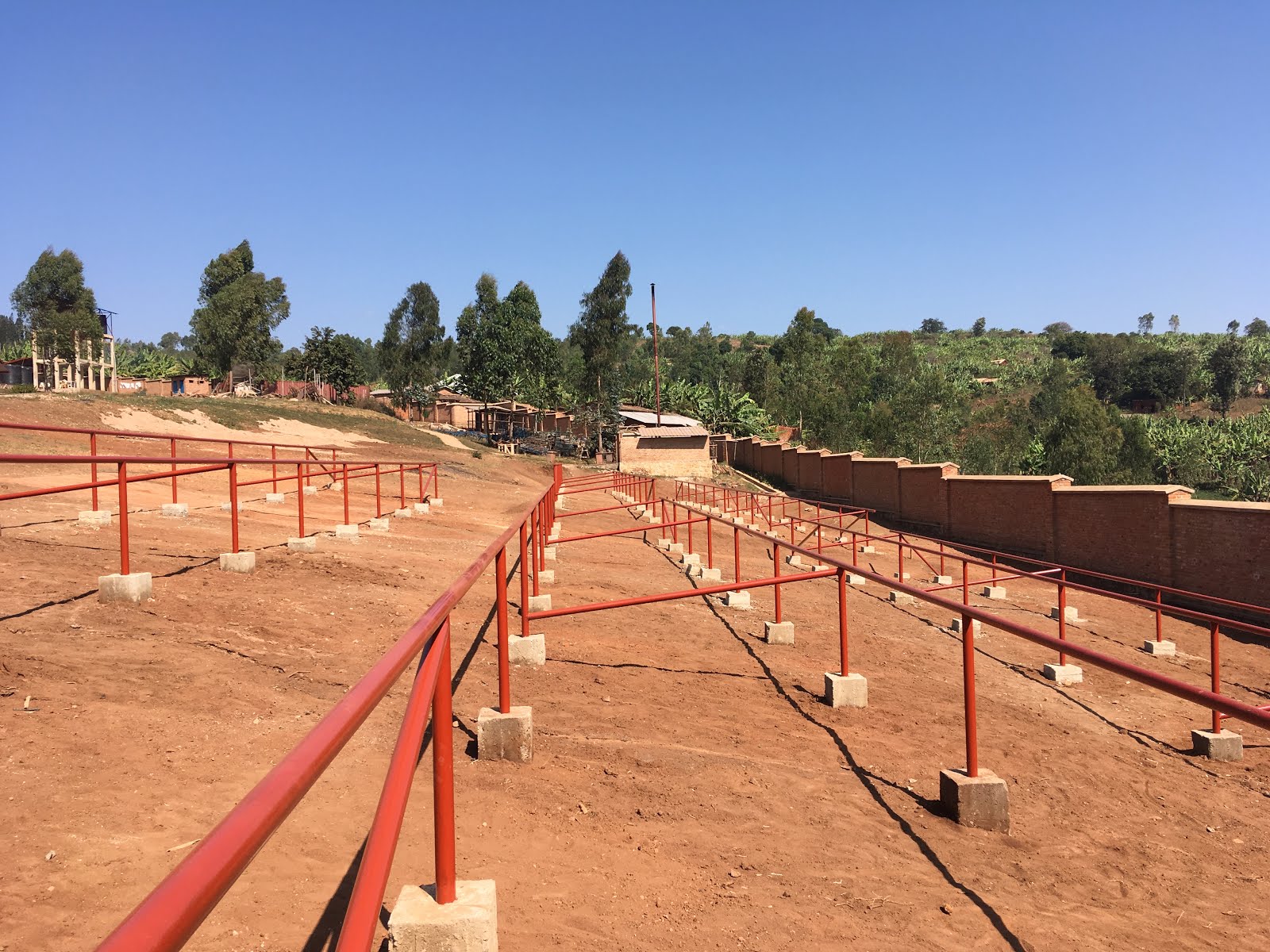
The piers for the Power Pac were poured and we waited for the right time to level the corn field to prepare for the solar array
Volunteers at ITEC spent countless man-hours throughout 2017 and early 2018 purchasing equipment, building and testing the Power Pac.  The two containers shipped from Pennsylvania in March of this year and came via New York City, Atlantic Ocean, Mediterranean Sea, Suez canal, changed ships in India, the port of Dar es Salaam and then finally by road to Burundi.  

To our great relief the containers arrived safely in early June 

Greg Sund diligently "supervising" the unloading of the solar panels

The Power Pac was set in place by two cranes, one of which must have been from the WW2 era. 


The container moving attracted lots of curious onlookers 

The team laying out the supports for the solar array under the watchful eye of Jack Myhre, our highly-skilled engineering intern


Digging postholes by hand


Dressed in his awesome pink bathrobe, our charismatic and resourceful welder puts the final touches on the array supports

Solar panel supports ready for the arrival of the ITEC team.

Power Pac and new generator covered and prepared. 

Work commences


Strong and willing hands.


Solar array going up panel by panel. 

First array installed


Always donning proper safety equipment, these men are pulling the supply wire to the hospital.


350 panel array complete!  


Inside the Power Pac 15 battery inverters hang on the right side...

....and the switchgear and battery bank on the left.  


Just a few of the 28 ITEC expert volunteers who came to install the Power Pac  


We have been enjoying seamless 24/7 power at the hospital for almost 4 weeks now.  The oxygen concentrator can satisfy the endless demand, incubators stay warm, operations can happen at all hours of the day or night, lab results never have to wait and x-rays can be taken when needed.   The impact of this work on the ability of Kibuye Hope Hospital to care for patients will surely be felt for years to come.    

We are very grateful to many for the their hand in this project: 

Funding: African Mission Healthcare Foundation and the Christian Broadcasting Network, Isaiah Mission Foundation, David Pyott Foundation, Brenden and Jenece Hanks and a number of other generous individuals.   

ITEC Volunteers: 28 men and women from North America who came and served this community with their skills and always did so with a smile.

Jack Myhre: Engineering Intern working at Kibuye for the summer did a vast majority of the site preparation planning and design.

 (NB:  A majority of these pictures came from the ITEC blog which chronicles the 5-week installation process) 


24.8.18

Party Animal

(by Greg)

A Burundian party is not like an American party.  I have learned this by now.  The first time I was invited to a Burundian party, for some reason, I expected nachos and music and a lot of laughter.  I think more than anything this reveals my own ethnocentrism.  Burundian parties begin with everyone sitting silently in a circle.  Often there will be a time of prayer, then Fantas, then the speeches begin.  After the speeches, things start to loosen up a bit.

Last night, a group of anesthetist students who have been working at Kibuye for the past two months held a party to say thank you to myself and the other Burundian anesthetists whom I work with.  They have been living for the past two months in a modest dormitory located just next to our house.  When I arrived at 6 PM, I was greeted by these 6 students dressed to the max.  One of them sat down next to me and explained that they have very little but what they have they wanted to offer to say thank you.  He then explained that what they have is their voices with which to sing and their prayers.  We then stood, and they began to sing, in Kirundi.  And it was beautiful.  They are incredibly gifted, incorporating harmony, crescendoing and de-crescendoing.  After three beautiful songs, one of the students read a passage of scripture, then gave a brief message about what it means to offer yourself as a living sacrifice to God.  

After that, the students went around and gave speeches of thanks for all that they had learned here at Kibuye and for our time and effort in teaching them.  Then it was my time to give a speech.  I tried my hardest to express my gratitude for their work and for the compassion they have demonstrated to our patients, highlighting the significance of modeling Christ-likeness to those who are suffering.  

And as always, there were Fantas.  But not only Fantas.  They also served delicious Beignets along with peanuts and cookies (which I brought).  After eating I told them I was really moved by their singing, and could they possibly repeat one of the songs they had sung so that I could record it, which they gladly did.  I have attached the recording below.  But then, things started … loosening up.  The singing got louder and louder, then the dancing.  Then, the samba line.  It was a room filled with joy, and it left me feeling massively grateful to God for calling me to this work.  

I hope you enjoy the recording.  


18.8.18

My Burundian Slumber Party

by Jess Cropsey

I’ve always thought that staying for a longer period of time (including an overnight) at a Burundian’s home would be a really interesting and enlightening experience, but it’s also something I haven’t pursued because the thought of doing it with my children seemed like more than I could handle.  Well, I finally plucked up the courage to make it happen and left the kids behind!  Readers, you may remember a post I did about a wonderful Burundian woman named Thérèse who has become my friend.  Given the history of our friendship and the proximity of her home (not too close and not too far), I asked if she would be willing to welcome me into her home for an overnight visit.  She was very surprised but also quite pleased.  


She asked me to arrive around 5:30PM, about an hour before dark.  (Later I was told that was so people wouldn’t know that I was spending the night there.)  It’s about a 30 minute walk, but John kindly gave me a ride most of the way.  Really, any excuse to ride on the motorcycle is a good one.  I requested an early drop-off at an isolated spot so I wouldn’t make a spectacle dismounting the motorcycle in my skirt!  


I brought a backpack with some bare essentials — a change of clothes, some purified drinking water, hand sanitizer, toilet paper, a cell phone, a notebook and pen for taking notes, and some food to offer as a gift to my hostess.  

We spent several hours in the evening cooking supper and I was reminded how time-consuming it is to prepare a meal.  It takes several hours to heat water and cook over a charcoal or wood stove — two hours just for the peas.  


She let me help from time to time and complimented me at how good I was at peeling potatoes.  :-)  While we cooked, we talked (mostly in French, but I learned some new Kirundi words too) and I asked a lot of questions.  During a lull time, she invited me in the living room to watch some TV (and no, most Burundians do not have a TV).      


Around 8:30, everything was ready and it was delicious -- meat (a special treat), potatoes, peas with a tomato-based sauce, and pâte (a dough cooked with manioc/cassava flour).  We ate with our fingers which proved difficult for me when I got to the peas!  We didn’t drink anything at dinner.  I wondered if this was intentional to avoid night-time trips to the outhouse at the back of her property.  

I discovered that when someone has a stranger or visitor spending the night in their home, you must inform the “chief” of the neighborhood (for security reasons).  Thérèse sent her niece to tell him and he came to the house later in the evening with two other assistants.  In fact, during my short stay, she had lots of people coming and going.  She's a busy lady!      

We slept in her son’s room (who happened to be away for the weekend).  Many Burundians use mats on the floor, but Thérèse has beds with mattresses.  We each had our own double bed, so it was quite spacious.  I admit it was difficult going to sleep in a different place.  

In the morning, she made chapatis (like a tortilla) and tea for breakfast.  More visitors came -- a brother-in-law with bananas from her land, three ladies whom she hires to farm her fields, the "chief" and his assistants collecting food for the poor in their area.  I wish I had more pictures to share, but I wanted to just be there.  Before I left, she told me that "it was a miracle" that I stayed at her house and she extended an invitation to come again (but next time with my kids).  I'm thankful for this woman and her tremendous generosity and patience with me as I slowly learn more about her culture.                

4.8.18

Origins - Discovering Our True Home

(by Scott)

When asked where I’m from, my answer goes something like this: Well, my dad was a church planter, so we moved around a lot when I was a kid. I was 11 when my family moved to a small town called Shippensburg in Pennsylvania, but most people from Shippensburg wouldn’t consider me from there. My husband and I own a home in Williamsburg, VA, but we currently live and work in Burundi, East Africa. This simple question of where I am from has a complicated answer as it does for most of our Third Culture Kids. 

B was born in Kenya, visits his parents’ “homes” in Michigan and Tennessee when his family returns to the States on Home Ministry Assignment but lives and attends school in Kibuye. M was born in Canada, currently lives and attends school in Kenya, visits Kibuye (the place she probably most associates with the familiarity of home) on school breaks, and occasionally travels to Canada for Home Assignment with her parents and three siblings. Bi was born in Ethiopia, was adopted into an American family, now lives and attends school in Kibuye but still returns to his American home (where grandparents live) for a time during the summers.

Even when an explanation of the physicality of our home is simple, home itself can feel complex. But when the explanation even of physical place where you are from becomes difficult to express, people feel a whole range of complicated longings and emotions. Last year, while watching a film with two of our middle school students, one of the main characters made a speech filled with expressions of national pride. One student remarked, “I wish I knew where I was from so I could make a speech like that.” This summer, my own daughter turned to me at a church picnic in America and said with panic in her voice, “Mommy, the boy next to me just asked where I’m from, and I don’t know what to tell him.” 

“Just tell him what’s in your heart,” I said. 

“But does he want to know where I’m from here or in Africa?” 

“It doesn’t matter what he wants to hear,” I said. “Just tell him what’s in your heart.”

Bearing witness to my student’s longing and parenting through this moment of confused unease for my own child made me think of my own complicated answer to the question of home. Why can I not just say what’s in my heart and follow my own advice? What prompts me to give a lengthy explanation each time someone asks (for me this has been going on since college when I moved out of my own parents’ house - well before a move to Burundi)? These questions lead to other questions: why do I struggle to feel at home in a place? what does it mean to be from somewhere? when are you allowed to say that you’re from a place? how do all those other people come to feel at home and accepted? should I just give the simple answer (“I live in Burundi, East Africa”) or is the complex answer the one that is about me being who I am? (and now that I am parenting a TCK and teaching TCKs) if I can’t figure out what the disjointedness of place means for my life and my idea of home, how can I help others? what are the spiritual lessons we can all learn together from the complexities of our definitions of home?

At present, I’m still asking many questions, but I am certain that the answer lies in Jesus. Home is about a person, not a place - of that much I am sure. Home is about always being accepted and loved no matter what you’ve done or left undone. Home, like love, “is an ever-fixed mark” (Shakespeare, Sonnet 116). But while this answer is true and comforting and fuller than any answer that geography can provide, it is no less complex or easy for our hearts to accept and express. 

22.7.18

Cooking With(out) Gas


by Julie Banks

Cooking in Kibuye is always an adventure!  As we have mentioned in previous blogs, Burundi has no fast food restaurants, frozen foods, or pre-packaged treats like applesauce or granola bars.  We make everything from scratch around here.  

All of our stoves use gas, which we purchase by the tank. With our stoves and ovens running for many hours a day, we go through gas relatively quickly.  For our family of four, a tank lasts about two months.  So what happens when we run out of gas?  Or what if there is a shortage in the entire country?


Well, we have been able to find out what that is like!  For several weeks our gas supplier in the larger town nearby has not had any gas.  Even after searching the capital city, we found out that there were no full gas tanks to purchase in the entire country.  Some of us had plenty of gas and have made adjustments to make it last longer.  Others of us were completely out of gas! 

No gas means no oven.  No oven means no bread.  No cookies, cakes, casseroles, or (gasp!) pizza!

My boys had a suggestion: cereal for every meal!  Sounds fun, but cereal is imported and milk is limited.  We divide it among our families every morning when it comes fresh from the cow of a nearby dairy farmer.  Normally, we boil it on the stove (using gas for 20 minutes), but I have been able to do that in the microwave. 

Since we do have to eat real food (sorry kids) we have gotten creative with cooking for our families.  We have enjoyed salads from the garden, fresh fruit such as papaya and passion fruit, and other raw foods that don't require cooking.  


Thankfully we have had relatively good power so that we could use electricity to cook some things.  Here is a glimpse of our creative no oven/no stove problem-solving:

Alyssa made a tasty garlic cheese biscuit in her microwave.


Jess used her microwave to boil eggs…


But the power cut out halfway through!


Susan makes tortillas (and other things) on an electric griddle.


Julie Theissen (who has only been here a few weeks) created this layered tex-mex dish complete with an avocado sauce in her crockpot.


Heather used her crockpot to make cinnamon raisin bread.


This cheese bread was also made in the crockpot!


George Foreman grills have been used to make calzones (since we can't make pizza!)


Potatoes on a Foreman grill are great too!


But without a crockpot or griddle, some of our families’ main resource for cooking has come from traditional Burundian outdoor grills with charcoal. 


This is how Burundians cook all the time, so our local friends have been key to our survival recently.  They have kept the fires going all day so that we can cook vegetables, soups, and even granola over an open fire.


This gas crisis doesn’t really affect most Burundians.  It is tremendously rare to have a gas stove.  So, we have taken the opportunity to venture into the village and eat more of what they eat… for example, goat brochettes cooked over an open flame!


Throughout this crisis, I have to say I have not heard one person (big or small) complain.  The team has risen to the challenge and some have even enjoyed this little adventure!  We know that this too shall pass.  

Many of the beautiful Burundians around us have probably never even used a gas stove, but they cook for their families everyday!


We remain thankful that God always provides.  And we hear that gas tanks are on their way...