12.3.22

Where there’s a will there’s a whey… and other really gouda cow puns 👌

By: Jenny 


    Our monthly learning experience days made their long-awaited return to KHA last month, starting with a day dedicated to cows. The day was broken up into a trip to a local farm, cheesemaking, research projects and read aloud time with some of our favorite cow themed books like “Click, Clack, Moo”. I hope you enjoy all the pictures and favorite memories of this dairy good day. (The puns are only going to increase throughout this post...you’ve been warned 😅 )

    All families were invited to visit a small farm down the road that is home to several dairy cows, pigs, guinea fowl and even a turkey!


     We were able to observe the milking process, pet a few of the ladies and even see a newborn calf… and by newborn, I mean she still had her umbilical cord attached! Many were sad to have just missed the birthing process the night before, now that would have been an udderly memorable field trip!


     Our trip to the farm was followed by several Cow themed activities including research projects, crafts and Cheese Making! The cheese making activity was taken up by Julie and Glory and included a lot of dancing around the kitchen with witty middle schoolers rattling off the most amoosing cow puns.


      The younger kids learned all sorts of fun facts about the care and keeping of cows. Did you know some cows have waterbeds in their stalls? I’m serious, waterbeds! We learned that many people are responsible for the health and well-being of dairy cows including, the farmer, handler, veterinarian and even a nutritionist. Cows eat a variety of grains and have a special salad that includes cotton. Students were surprised to learn just how much work and resources go into keeping the cows in a good mooood. The older students worked on researching different cow topics. “The Cow Comic” was born from this activity and I couldn’t be prouder of puns these kiddos produced.


    The day ended with a cow themed P.E. class which was thoroughly enjoyed by all. They played games like “don’t wake the cow”, wherein the kids lay on the floor while a lone “cow” tries to wake them up. The catch? All they can do to wake them up is moo. (It was quite entertaining)

      Just like that, our cow themed learning experience day came to a wrap. Thank you all for reading along and enjoying the day with us, I hope didn't butcher the jokes to much. (butcher, get it? ... Okay, I'm done now)


3.3.22

Kibuye Pediatrics

 By Alyssa 

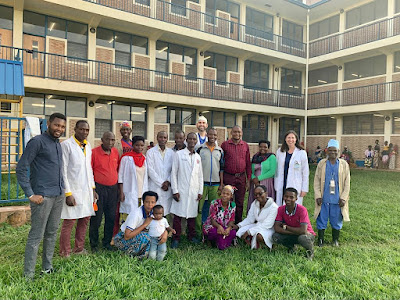
Pediatric team in front of our new building

So what's it like to be settled into the new peds building? We have now been in our new three-story pediatric building for 3 months, and it has made a huge difference for staff and patients. Last week we had 95 pediatric patients divided between the neonatology, inpatient malnutrition, and general pediatrics services. But since our new building includes 125 beds, we had plenty of space for everyone! Just a few months ago, that many patients would have meant mattresses on the floor or patients sharing beds. It makes such a difference having all the patients in one place, too. Before we had this building, our patients were spread out in four different buildings around the hospital campus, but now everyone is near which makes it easier to find help and supplies if a patient isn't doing well. 

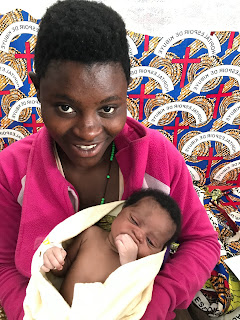
As an example, I was in clinic 2 weeks ago when I received the following text from a medical student (my translation from French): "Bonjour, Doctor. The baby we discussed this morning is doing very badly and has a very distended abdomen with vomiting. I believe it is an emergency for this baby." The post-call team had mentioned the admission of this baby in our morning report discussion, so I knew he had a surgical problem that needed urgent attention. I stopped by the OR on my way and asked our capable surgeons if they could move this case up.  They said they could operate on him next and began preparing the room. On arriving at the patient's bedside, I found the medical student, nursing student, and nurse all ready to help. The baby was definitely as sick as the med student said - which is an important skill for which I congratulated the student later - recognizing a baby that needs immediate attention. Because there were so many staff and students easily accessible in our new building, we were quickly able to stabilize the baby with fluids, NG tube, oxygen (in-wall oxygen in every patient room!), etc. as well as to talk with the mother to explain the situation and pray with her. And within minutes the baby was on his way to the operating room where our surgeons fixed the problem and saved his life. This baby had been to three different hospitals in rural Burundi before coming to Kibuye - delays which nearly resulted in his demise - but thanks to a team effort and quick thinking on the part of the medical student, he went home with his happy and grateful mother (picture below). I think the hospital motto explains well how God brought about healing in this case and so many others that we see each day, "Dukorera Imana ikiza itanga ubugingo." Loose translation: "We work with God; He heals and gives life."


So being able to quickly walk up or down the stairs to the centrally located nursing stations and find help is a huge benefit of the new building as is having enough beds for every patient. Another benefit is the lighting and ventilation that makes rounds and patient care so much more pleasant for everyone. Before, nurses would need to bring patients outside to look for IVs in the sunlight, but now they have well lit treatment rooms and procedural areas where it's much easier to place IVs quickly and sterilely. And in a land where most people can't afford diapers, having well-ventilated rooms and tile floors that are easy to clean certainly improves the olfactory experience on rounds! 


Twins - they can still share a bed! But everyone else gets their own!


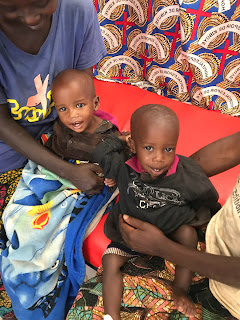
Aren't the patients seriously the cutest ever? Totally brings a smile on the long days when there are so many of them to see and so much work to do. 

But the patients would tell you that the best part of the new building is the playroom and the swing-set! As far as I know, this is the only hospital in Burundi with a play area for kids! The med students love bringing the children to play and sent me these pictures over the weekend. I love seeing their hearts of compassion for the patients even as they are learning more of the medical knowledge they need to care for them. 


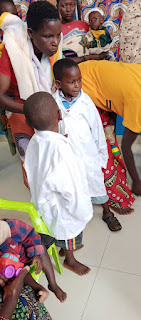
One of our teachers had little white coats made for the children to play with so they wouldn't be so frightened by our white coats - they seem to like them!


What these pictures of cute children don't convey is that we have challenging days, too, as we care for the littlest Kibuye patients. Sometimes they have really sad outcomes or come from difficult situations. Many have severe malnutrition and the families struggle to find enough food or to bring them to the hospital in time. Yesterday we saw 100 (!) children with sickle cell disease which meant a long and exhausting day even as we sought to show them the love of Jesus as we gave them their medications and taught them more about this difficult and painful diagnosis. And this week we said goodbye to another doctor (in the dark red shirt in the picture below). He received an exciting promotion in Bujumbura, but it's a sad loss for our team and means we are now even more short-staffed. 

I was encouraged this week as I read and reflected on 2 Corinthians 4: "Therefore, since through God's mercy we have this ministry, we do not lose heart." The whole chapter is brilliant and reminds me that though we do indeed face afflictions and human weakness, these point us to the "light of the gospel of the glory of Christ" and the "all surpassing power [that] belongs to God and not to us." One day we will fully experience the eternal weight of glory and all these transient struggles will be redeemed. Therefore, by God's mercy, we can persevere in heart, head, and hands each day as the Kibuye pediatric team while we wait for eternity. 


18.2.22

Math and Science and PE! Oh My!

By: Erica Ause

My second semester here in Kibuye is finished! This year was one of the most eventful of my life, with a lot of traveling, vaccines, quarantines, new team jobs, and of course, my main role as teacher to a 5th grade student. For this semester I had one student who has been such a joy to teach! Having such a small class, there is a lot of time for learning opportunities to extend the curriculum. This is an incredible gift to me as a teacher, and the students as well.

Now of course, we spend most of our time in the classroom with normal schedules and nothing extra exciting going on. However, every once in a while we have the time and the opportunity to have a little fun. Below are some of the extra interesting things that happen in our small school.

Math has proven to be one of the harder subjects to make interactive. Once you get into the older grades the concepts become more abstract. It no longer is practical to use physical objects when adding 1,456 and 239. But one of our favorite things to do was a flipped classroom. This where the student has some time to study the lesson in their textbook, and then teaches me the concept, while I listen, learn, and enjoy. It is always fun to hear how he chooses to explain the concept, and to learn how his brain works.

Science this year has been full of fun experiments!

We became chemists making reactions, seeing what happens, and trying to figure out why. Like in the video above.

We became culinarians, making ice cream using only juice, ice, and salt to learn about the states of matter. It was delicious.

My student then became an engineer and worked on a car design that traveled using only the air from balloons. His first 5 trials went 0 cm even though each one was an improvement of the last. On the sixth trial it finally went 407 cm! It was quite the learning experience.

He then turned environmental scientist studying and reporting on different forms of renewable energy. He took a deep look into our own solar energy system where the hospital and our homes get most of their energy. We got a tour from the team engineer and both learned A LOT about how solar power works! It was a fascinating project for both of us.

PE held all sorts of amazing adventures. They learned about teamwork by writing letters with their bodies, making decisions together, drawing pictures using strings attached to only one pen, and other team building games. They practiced throwing, catching, basketball, soccer, four square, and corn hole (a mid-west favorite for those of you who don't know it). It was always a special treat too when a younger sibling became an assistant teacher for the day. It is never a dull moment with these kids!

We don't only have fun within the classroom though. This year around halloween each child chose a character of a book or a character in history to dress as and write about.

The younger students chose a book character, wrote about them and the book they are in, dressed up as them, and presented their work to the school and many parents! We were so proud of their hard work and presentation skills!

The older kids chose a person from history and created a living wax museum to present what they had learned about who they chose. Once their "button" in the museum was pressed, they talked all about who their person was, and what they did in history. I was equally as impressed with their writing, memorization, and presentation skills, as I was with how still they stood when they were 'wax'! It was quite a fun day.

This past fall we participated in a 5K run for the AME Fund (African Medical Education Fund) which raises tuition for people specifically in Africa who would like to go to medical school. In the months leading up to the run, I lead the middle schoolers and some other teammates in training to get ready! It was a blast to get to share my love of running with them, and see their appreciation for it grow as it got easier and easier. And still to this day one of them continues to join me on my runs!

One last great aspect of teaching here is how often we get to be outside. With small classes and weather that is almost always perfect, going outside for a day or even just for a class period is such a fun way to throw something new into the week. And who doesn't love some fresh air!

13.2.22

To Sojourn


By Glory Guy 

    I am currently attempting to read the entire Bible in the months of January and February, which means I am experiencing it in an entirely different way. Rather than going deep, seeking meaning in every word and passage, I am going wide and attempting to see the overarching story that the Lord is telling. I often forget that the Bible is intended to be a story, the greatest fairytale ever told come true off the page, in all the days of life, and in the world over the past 2000 years. 

    Something I have noticed in my first couple days of reading is the repetition of a word I know the definition of in passing, but haven’t spent any time trying to understand; sojourn. It’s like it jumps off the page at me. Finally following my umpteenth time reading it, I googled it and found that it’s a Hebrew term. In a very unofficial glory paraphrase, it generally means a person residing in a community or place outside of their origin, who is dependent on the benevolent spirit of the community for their daily provision. I found camaraderie with Abraham in this term, because my daily life in Burundi often feels like that of a sojourner. In the Kibuye lifestyle, we rely on the greater community, and it is a greater dependence than I have ever experienced before.


   Though our dependence on the community shows up in many ways on both a large and small scale, one very literal example of its influence in daily life is the journey that our milk takes before it reaches my coffee cup in the morning. The milk comes from a member of our greater Kibuye community who sends it to our compound by way of bike. He delivers it at the gate where it is accepted by the guard, and a house helper picks it up on his way into our little housing compound in the morning. He goes from house to house with a greeting and a smile and delivers our two to three liters in a plastic jug. At our front door, our house helper receives it and boils it on the stove until the heat pasteurizes it. He returns the plastic jug to the previous man who waits at the door, and the milk circulates this way throughout the compound. This milk passes through the hands of approximately six people before I pull the pitcher out of the fridge and add it to my coffee on my way to school. If the cow stops milking, or if our friend that delivers is stuck in the rain or his tire gives out, or if our house helper is sick, there is no milk. The system is simple and effective and yet is totally reliant on the hands and feet of others. 

    Though this is an example that seems small, the need to rely on others is a constant thread in our lives in Kibuye. Very little is individual, we share our resources, chocolate brought from the States, a cup of flour, an extra tomato or two. We are reliant on one another, and without a conscious thought, my understanding of what it means to be dependent on the Lord has shifted drastically. To depend on the Lord is to literally lean on him for provision. I have discovered it is not my tendency to attempt to spiritually tidy myself in order to tiptoe into his presence but to literally sprint in, caked in dirt, and to fall at his feet. This is no “fainting” on the stage scenario either, where I land in gracefully in thinly veiled self-sufficiency. This is full-on falling and trusting that he will catch me, dirt and all. He does provide for my every need, and my awareness of that has grown over my five months here in Kibuye. He isn’t just grudgingly content to cover my iniquity, he is unfazed by my failing and receives me with kindness. 


5.2.22

The Only One

 by Rachel

    I've been back at work at Kibuye Hope Hospital for 4 weeks now, serving as the hospital's only OB-GYN.  Sometimes leaving a place and returning is the best way to gain perspective.  I was pleasantly surprised by the work that continued in my absence.  For example, there was a 2+ month gap when no specialty trained doctors were available to work on my service.  Normally this would have meant no ultrasounds and no scheduled surgeries, but my three generalist doctors stepped into that gap.  During those months, they continued to perform ultrasounds at a rate of over 200 per month, and Cesarian sections that needed to be scheduled were also done.  It's a really exciting thing to see all the training that we do pay off...a tangible result of our primary goals for being here.  

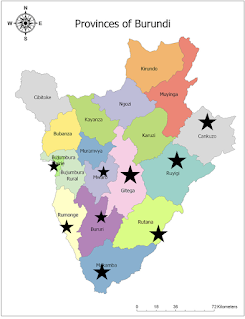
    I often get asked what my days look like as the only OB-GYN for a large chunk of the country (there are several dozen OB-GYNs in the country, but most are based in the capital city of Bujumbura).  On a recent clinic day, I kept track of the provinces in the country where women came from that day, and was surprised that I really did receive patients from half the provinces in the country!  If a general doctor from about half the country decides that a lady needs to see a gynecologist for some reason or another (fibroids, infertility, recurrent miscarriage, prolapse, etc), she will probably wind up on my clinic doorstep on Mondays, when I have no idea who will show up or how many women will want to see me.  

    On Tuesdays and Thursdays I perform scheduled surgeries....many scheduled C/S (we are trying to encourage showing up during a scheduled time instead of showing up in labor, when complication rates are higher for the woman and her baby).  But also hysterectomies and myomectomies (removal of fibroids), ovarian masses, cervical cancer, and a range of other random things.  Clinic and surgery and rounding in inpatients is all pretty normal and standard.  The harder thing is being the go-to hospital for half of the country's obstetrical emergencies.  

    What is it like to be the only specialty-trained OB-GYN for half of a country where birth rates average 6-7 per woman, in a country of 10 million people?  When I write it out like that, I'm somewhat surprised that I don't get MORE emergencies.  But what it means is that I never do the normal deliveries, the straightforward, healthy and happy outcomes.  I never do the primary Cesarian sections, with no scar tissue.  I'm almost never the first doctor someone sees for a chronic problem that has maybe been going on for years.  I do see the emergencies and the tragedies...women who have a pregnancy in their tube instead of their uterus and have already lost two liters of blood in their bellies while they wait to be transferred to Kibuye.  Women who developed a complication intra-op during their 5th Cesarian and get transferred to Kibuye before the skin is even closed so I can do a hysterectomy.  Women who developed such bad infections after surgery that their incision is open and pus is pouring out of them (sorry if that's too gross). I never know, when I hear the Land Cruiser ambulance chugging up past our house on the way up to the hospital, when it will be a call for me to run up urgently at any hour of the day to do surgery, because I'm always "on call" for those emergencies.

    But also, I get to see lives changed in a way I doubt I would if I was working elsewhere.  By the grace of God, although I have performed half a dozen hysterectomies to stop postpartum bleeding here since my return, all those ladies are alive and well and have returned home to their families.  That's not always the case, and I do not take that statistic lightly.  I also helped generalist doctors perform two surgeries on women with late-presentation ruptured tubal pregnancies, a diagnosis responsible for 10% of the world's maternal mortalities, and both did well.  I had a woman show up in my clinic this week who had lost 5 children because of preterm deliveries, and then she came to Kibuye about 5 years ago for a consultation.   We did a simple surgery called a cervical cerclage and she now has two living children, who I delivered at term.  She was returning this week to show me her 2 year old, who's doing well, and celebrate another pregnancy.  It's worth celebrating.  We've said it many times on the blog that here in Burundi the highs are higher and the lows are lower....when the lows come we lament and support each other, and when the highs come we celebrate together and rejoice in God's provision.  

    It's good to be back.  The work is hard but worth doing.  I'm grateful for all the people that helped out at the hospital in my absence, and I'm excited to continue training our Burundian staff and doctors in the days and years to come.