18.3.19

Pi Day

by Jess Cropsey

Our entertainment options are more limited here (which I actually love) -- play outside, watch a movie, ride a bike, read a book, play a game, do an arts/craft project, ...  There are no museums, playgrounds, libraries, shopping malls or amusement/water parks.  In fact, many of the moms and kids can go several months without ever getting into a vehicle.  So, we often go big when it comes to small holiday celebrations.  You know, to spice things up a little bit!

As a math educator, I couldn't pass up the opportunity to celebrate Pi Day on Thursday, March 14th (which also happens to be Albert Einstein's birthday).  My 6th-7th grade math class looked at the frequency in which digits appear in Pi.


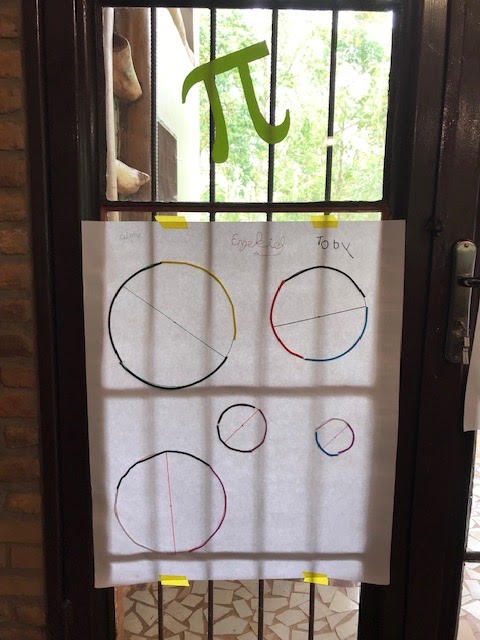
My 2nd grade class read Sir Cumference and the Dragon of Pi and then completed an exploration activity similar to the one by the young boy (named Radius) in the story.  They discovered that a little more than 3 pipe cleaners (cut to the size of the diameter of the circle) were needed to go all the way around a circle.


Both classes also contributed to a paper chain representing the first 100 digits of Pi, with each color representing a specific digit.


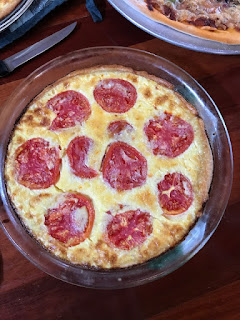
During the lunch hour, we had a school-wide party.  In groups, kids measured the circumference and diameter of some of the yummy food contributed by the moms (pizzas, a giant circle cookie, quiches, pies) as well as circular objects in the room.  


Of course, I made them record their data and do some number crunching to discover the relationship between the circumference and diameter of a variety of circles before they could eat!  Talk about motivation...


Math often gets a bad rap and many people have negative experiences with math class in school, so it was delightful to see all of the kids so excited about Pi Day.  While we were stuffing our faces with "pie", we listened to several students who had worked on memorizing the digits of pi.  The prize-winning student memorized the first 100 digits!  Incredible.


While these kids will never need to know more than the first 3 digits of pi, the lessons learned from setting a goal and seeking to achieve it, exercising their brain power, and wondering at the beauty & order of God's creation (even evident in mathematics) are all life-long.  


10.3.19

It's Electric!

Archimedes may or may not have harnessed the power of the sun to repel a Roman naval assault in 212 B.C., but the utility of solar power certainly has been well known since ancient times. The Romans used solar power to heat their famous baths and later Byzantine emperor Justinian included “sun rights” for particular buildings in the empire’s legal code. The modern harnessing of solar power began in 1839 when French scientist, Edmond Becquerel discovered a photovoltaic effect in an electrolytic cell. The electricity generation of the cell increased when exposed to light. Thankfully, the exploration into solar generated electricity did not end there. 

This week at our KHA learning experience day we examined the four sources of electricity used in Kibuye as well as other alternative energy sources. To start the day, Caleb led the kids through a tour of Kibuye’s “power plant.” Recently installed solar panels are the first and best option for electricity. You can read a detailed account about the solar project and the ITEC team in Caleb’s blog post from this past September (https://mccropders.blogspot.com/2018/09/solar-power-at-kibuye.html). Next, we looked at the inverters, multicluster, and the second best source of electricity: batteries. The excess electricity generated by the solar panels regularly charges the batteries. Finally, we looked at the last two sources, grid power and a diesel generator. Through the combination of these four sources, Caleb’s work, and ITEC’s technical support the hospital and residential area are supplied with near constant power. 

Upon our return to the school, the students put this power to use by researching other alternative energy sources online. Working in small groups, the students imagined that they were the marketing team for an energy company making a sales pitch to the city council of the new city of Kibuye. Their task was to develop a proposal that included the advantages to using a certain type of energy.  They communicated to the “city council” an understanding of how their type of energy works, as well as both pros and cons to their type of energy. The different types of power proposed included geothermal, biogas, and hydro-electric.
 

The tour of Kibuye’s power plant, researching alternative energy sources, and a reading of The Boy Who Harnessed the Windcombined to ignite the imaginations of our students to the benefits of uncommon solutions. Whether they harness the wind like William Kamkwamba or the power of the sun like Archimedes, we are excited to see how God will use the unconventional in their lives for His glory. 

7.3.19

COTW: Pott's Disease

(by Eric)

Continuity of patient care is a major reason why a lot of doctors choose to join my field of Family Medicine.  It is, on the other hand, a rather poor reason to go into missionary medicine in Africa, since the constraints of travel for most patients mean that they will not come back just for the sake of giving you good news.  Despite these travel constraints, I do have a number of patients that I've been treating now for a couple of years, and it's a great pleasure for them to come back and tell me how much better they are doing.

Yesterday, I saw a young mother that I had first met about a year ago.  She was in the emergency room with a gradual onset of paralysis of both her legs.  It was one of those rare medical moments where I could walk in and make the diagnosis in literally a matter of seconds.  I took a quick look at her back and saw this:
The similar back of a patient from Google.  I didn't get a photo of my lady.
This kind of a bump in your spine in Africa means that you have tuberculosis of the spine.  The bump even has a special name: a gibbus.  One of the vertebrae gets crushed in an angulated way, resulting in a spine that pinches the spinal cord.  It causes a lot of pain, and when it is severe enough, it causes paralysis of everything below that level of the spinal cord.

Tuberculosis of the spine is called Pott's disease.  It's an ancient disease, with old skeletons of Egyptians mummies showing the same deformity.  Percivall Pott was a brilliant British surgeon from the 1700's who lived in the era where the pinnacle of legacy was to have some terrible disease bear your name.  The treatment is standard tuberculosis therapy, which is thankfully available for free to our patients thanks to the government and foreign aid programs, but they need to continue the treatment for a full year instead of the standard six months.

I've been on a bit of a rant recently with my students regarding Pott's disease, because I have seen about six of these cases in the last two months, most of which have gone undiagnosed for a long time, for lack of someone who both looked at their back and understood what that bump means.

We started this lady on this treatment, along with some steroids.  She lives pretty close to Kibuye, so despite her obvious mobility problems, I saw her several more times.  The next time she was walking with a cane, and the next time with no cane, but still with considerable back pain.  We worked through those issues one at a time, and she steadily improved.

Yesterday, she came back for a last time to tell me that she is finishing her year of tuberculosis treatment today.  The bump is still there on her back, but the pain is minimal.  She can farm at her home with no significant difficulty.  There wasn't much to do from a medical standpoint, but I wanted to savor the moment with her.

I asked her how long she had the problem before she was put on treatment.  She had increasing back pain for three years before she was diagnosed.  I asked her if she had thought she would ever walk again.  She covered her mouth with her hand and let out the characteristic "Yooooo!" of Burundians.  Everyone was convinced that she would never walk again.  I told her that she has a lot to thank God for.  She agreed.  I told her that I also have a lot to thank God for, because of her.  And I thanked her for giving me a reason to rejoice.

***

It's not everyday that I get to be a part of a paralyzed person getting to walk again.  The surgeons do this on a fairly regular basis, but less so for me.  In Luke 7, Jesus mentions lame people walking again as a sign to John the Baptist of God's kingdom coming.  It is not the totality of the good news that Jesus brings, but it's part of it, and yesterday we understood together that God has been good to us.

Most of the time, we don't see the end of the story.  I often feel like some kind of Johnny Appleseed, wandering throughout the population scattering seeds, hoping that some of them take root and grow as intended, but not often getting enough chance to retrace my steps to know if it's actually the case.  So yesterday was a good reminder.

Of course, the Bible has lots of good seed imagery as well.  Here's the one that keeps coming to mind:

Those who sow with tears
will reap with songs of joy.
Those who go out weeping,
carrying seed to sow, 
will return with songs of joy,
carrying sheaves with them.
(Psalm 126:5-6)

2.3.19

A Big Deal

(by Greg)

Something happened recently at Kibuye, and it occurs to me that while there has likely been passing mention of it here and there, we have yet to celebrate it here on our blog.  It is a big deal.  Our team settled here in Kibuye with the goal to replace themselves with competent and compassionate African specialists.  In summary, the team goal is to work themselves out of a job.  While this may seem easy enough to a person reading this from the US, it is in fact an enormous challenge.  Burundi has not had in recent years residency programs to train specialists.  This translates into a country with far too few specialist physicians in all fields.  On top of that, for those few specialists, there is a great deal of pressure to remain in the capital, Bujumbura.  A small percentage of our graduating medical students are able to get into residency programs in other African countries.  But the next questions is, would any of them return to to work in rural Burundi?  

A few months ago, two of our former medical students who had gone abroad for specialty training  returned to work full time at Kibuye.  That means that for the first time since this hospital opened in the 1930s, we have hired our very first Burundian specialists.  It has been a great joy to work alongside Dr. Alliance Niyukuri, our newest general surgeon, and Dr. Tony Van Mugisha, our second ophthalmologist.  To take the enormity of this news one step further, Dr. Tony was born at Kibuye!

It is difficult to express in words how important this was for our team, and for the future of the hospital.  Both of these men are outstanding physicians, who are able to connect with our patients in a way that none of us are able to.  They are compassionate, intelligent, diligent and an absolute pleasure to work alongside day after day.  It has also been a joy to welcome Alliance’s family, his wife Cynthia and his two daughters to live alongside our team.  


While we hope and pray that this trend continues, and that in the coming years we are able to welcome more African specialists from various fields, for now we are simply celebrating God’s faithfulness.  He has done and is doing a good work here at Kibuye.  Some days I forget that this is true, but then I look across the drape in the OR and see Alliance operating, and I am reminded of just how good He is.  

 Dr. Alliance

Dr. Tony

20.2.19

Energy & Water Conservation Tips, Fader-Style

by Jess Cropsey

America truly is the land of plenty.  There are so many basic resources that we just take for granted because they’re always there — food, water, electricity, fuel, etc.  In Burundi, we encounter shortages in these areas on a pretty regular basis, and that’s even when we have the financial resources to buy them, a luxury many Burundians do not have.  

In recent weeks, there has been another fuel crisis in the country and we’ve had to restrict travel to essential trips only, coordinate trips with each other more than we already do, and use the most fuel-efficient vehicles for those trips.  While there is certainly inconvenience that comes with these choices, it’s so much easier to be grateful for the resources that we DO have when we see how much others DON’T have.

The Fader brothers (Jason and Caleb) are masters in the art of using resources wisely.  During a team business meeting, we were discussing the new solar power system at the hospital and how we can make lifestyle adjustments to maximize battery life and deal with power shortages when it’s rainy or nighttime.  As an off-hand comment, Caleb said, “You know, defrost your cheese wheel in the fridge instead of the counter so that the fridge doesn’t have to work as hard to stay cool.”  Two things struck me about this comment.  One, he said this like it was obvious, but I have to admit that I never would have thought of that as an energy-saving move.  Two, I found it interesting that he used cheese instead of meat as his example, but more on that later.  Unfortunately, many of us on the team don’t naturally think like conservationists simply because we’ve never HAD to (until we moved to Africa)!  

The Faders are slowly transforming me into a conservationist, but I still have a long way to go.  Here are some nuggets of conservationist wisdom that I’ve gained from them over the last 10 years.    
  • Your fridge and freezer function most efficiently when full (because the already-cold or frozen items keep each other cold or frozen), so use water bottles to fill the space when needed.
  • Keep a bucket in your shower to collect run-off and use the excess water to flush the toilets or water your plants.  Jason says that he never flushes the toilet with the handle anymore thanks to this tip.
  • Minimize your meat intake.  Per earthsave.org, “it takes 2,500 gallons of water, 12 pounds of grain, 35 pounds of topsoil and the energy equivalent of one gallon of gasoline to produce one pound of feedlot beef”.  Yikes.  
  • Pull something relatively “clean” from your dirty clothes pile to blow your (or your kid’s) nose to reduce the amount of toilet paper that you use.
  • And of course, something that is now a regular bathroom routine… “If it’s yellow, let it mellow.  If it’s brown, flush it down.”  (We’re still trying to teach our kids that this rule doesn’t apply when you’re visiting someone else’s house in the USA.)    
While thinking about this blog, I thought that surely there must be so many more habits that are so natural to the Faders that they don’t even notice them.  After pressing for more info, this is what I I discovered:
  • To conserve cooking gas, Heather never cooks only one thing in her oven.  If she’s going to bake something, she’ll fill it up as much as possible (and yes, cookies are actually the filler sometimes).  She only uses her oven twice a week (and that's not because she's eating out).  
  • She sorts laundry not by color, but by dirtiness.  The less dirty load gets a quick wash and the other stuff (like a surgeon’s bloody scrubs or kids’ muddy clothes) gets a normal wash.
  • Leftover drinking water after a meal is not poured down the sink, but instead used to soak laundry.
  • She admits to still wearing clothes from her high school days.  Of course, not many of us could do that even if we wanted to!  
  • She routinely erases post-it notes to re-use them (can’t replace those in Burundi!).
Really, there are so many gems here that I could go on and on, but I think you get the picture.  The Dutch-missionary combo is a pretty good way to ensure maximum thriftiness.  

Thankful for these teammates who have pushed me to think about how my lifestyle choices impact our world.  If you want to see how many planets we’d need if everyone lived like you, check out https://www.footprintnetwork.org.     

17.2.19

The Talking McLaughlins, Here and There

(by Eric)

During our time in the US, we did a good bit of speaking here and there, on various subjects.  Some of those sessions have been posted online (and some will be posted, but not yet).  Here are some links, if you are interested in listening more:

1.  Knox Presbyterian Church:  "The Already But Not Yet Kingdom".  Though I've preached at a lot of African churches, this is the only time to date that I've preached at a US church.  The text is John the Baptist and his doubts while in prison; the theme is our struggle to find hope in first fruits rather than finished work.

2.  StoryPrint.  My friend Wes Burtner runs a podcast about life stories of people in/from the Nashville area.  He interviewed me and the podcast is available here (Episode 003).  This 90-minute interview spans a lot of topics, including vocation.

3.  Louisville GMHC:  Rachel and I moderated the Marriage & Missions panel, including the Kims, the Chupps, and the Vaughans.  Our friends had some great perspectives to share.  There are pauses for small group discussion periods, but it should be easy enough to skip over those parts.

4.  Louisville GMHC:  I did a different breakout session entitled Walking With Those in Need Without Losing Heart.  The material for this talk was culled from four chapters of my upcoming book (more on that later!).

3.2.19

Refrigerators and Doors

by Rachel

A long time ago, before any of us moved to Burundi, we packed a container of "essential things" for life here.  Because we were unsure of what sorts of things would be available here, it was deemed a good idea to order appliances in the US that were wired for 220 volt electricity, so that we could have high quality appliances that would last for a long time, but that would also work well in our new environment.  Stoves, fridges, washing machines, and microwaves were loaded up in the container that arrived here December of 2013, several months before our houses were completed.

Where do you want your light switches?
Building a house was an adventure that was...occasionally...somewhat fun.  But mostly overwhelming and confusing.  Our house was the first to be built.  From almost day one, there were unanticipated issues.  Eric and I will never forget standing on a slope looking down at our newly poured foundations, then looking at the "blueprints," and then looking back at the foundations, wondering if there were perhaps new plans for our house that we didn't know about.  In fact, there were not, but every room except two had been mis-measured (by up to 2 meters).  We rolled with it.  We would occasionally get asked what kind of trusses we wanted (I didn't know what a truss was) or where we wanted our windows, and then Eric would rush off to figured out where to put windows and the workers would remove rows of already laid bricks in order to accommodate said requests.  So, yes.  An adventure to be sure, and we are so grateful that for the past 4 years, our teammate Caleb has helped the process run a little smoother every time.


The kitchen under construction
So, the day came in 2014 to move in our appliances in preparation for our move in, how exciting!  Sadly, there was an issue.  We had already been asked as to the width of our doorframes (um, standard size please?) and when the refrigerator was brought to the kitchen door, the fridge was about 10cm too wide.  Apparently Burundi standard size doors are not large enough to accommodate American "standard size" appliances.  Even after removing the kitchen door from the frame and the fridge door.  Finally, the security bars on the kitchen window were sawed off, the fridge was hauled in, and the bars were re-welded on.  We vowed to never remove the fridge again.

Trying to repair the fridge for the first time

I won't go into all the details, but the fridge has had a lot of issues.  It was repaired (while remaining in the kitchen) at least twice, and then we got an email on Christmas Day saying it seemed to have died for good.  Bummer.  Surprisingly, there is a Canadian Muslim refrigerator repair man now living in Bujumbura, who came up recently to try and repair the fridge.  Although he was not successful, he thinks that he will be able to fix it in his workshop in Bujumbura.  

We tossed around the idea of sawing the bars off the window again, but this time, Caleb came up with a new idea: why not widen the doorframe permanently?  I must admit, I was a bit skeptical.  The walls are solid brick and concrete.  I envisioned sledgehammers and half of my kitchen wall crumbling down.  But Caleb was very confident in our new plan.  So, on Wednesday, three very competent Burundian workers showed up at my front doorstep.  They promptly got to work with their little chisels and hammers (no sledgehammers, though) and removed 15 cm of wall.  Wouldn't you know it, the fridge fit out perfectly!  By the end of the day, a new frame was fitted, the concrete was poured, and other than the lack of paint, you could hardly tell work had been done at all.


It fits!
Now our fridge is on its way down to Bujumbura, hopefully to be repaired, and when it returns, I look forward to sliding it right in the kitchen door, with no chisels, saws, or hammer required.
Farewell, fridge...
As I was typing this up, Eric reminded me that actually we have had similar problems in America, so as "exotic" as this problem seems, we did have to move a queen box spring into our bedroom in Ypsilanti MI through the window...because it wouldn't fit up the stairs.  All's well that ends well....
The box spring in the Ypsi upstairs bedroom

28.1.19

KHA Learning Experience - Amazi

The majority of the human body consists of this substance and the majority of the earth’s surface is also covered with this substance. It is the only substance to naturally occur in all three states (liquid, solid, gas) on earth. Over 42 billion tons of this substance was gathered together in China and the shift in mass on earth’s surface caused the earth’s rotation to slow by almost 0.06 microseconds a day, and the poles to shift by nearly two centimeters. What is this versatile, ubiquitous, and powerful substance? I am sure most of you have already guessed it. It’s water. 

Where does your water come from? What do you use water for and is it important to conserve water? These questions and more were explored at our most recent KHA learning experience day where we focused on water as resource.
(A field trip to our well)

Americans, on average, will use almost 400 liters of water a day. Europeans generally use less than half of that amount. However, most people around the world consume only 10-20 liters a day. This is a shocking statistic; however, many people around Kibuye will collect water at the stream or a community tap and carry it back to their house. On our walk from the well in the valley up to the water storage tanks above the hospital, we imagined carrying 25 to 40 pounds of water that distance. The walk alone, with nothing to carry, was enough to wear out some of us and it was much easier to consider ways of conserving water.

On our nature walk, the kids collected water samples from a community tap supplied by the same well that supplies our faucets at home, from a stream in fields where some laundry was being done, from a puddle, and finally from a rain water collection tank at the school.

(DIY Water Filters)

Once we were back inside, the water samples arranged around the building for the students to examine by look and smell. Microscopes were used to get an up-close view of the water. Unfortunately (or perhaps fortunately), we did not see much floating around in the water when inspected through the microscope. Each water sample had its own unique scent, although, the rainwater had the most distinct smell. We never reached a consensus on exactly what the rainwater smelled like, but the scent of rubber cement received more than one vote.
(Examining water samples)


After some water games and story time, we finished our water day in the waterlogged mud of a rice field. Each of the kids had the opportunity to kick their shoes off, squish the mud (and other stuff) between their toes, and learn how to cultivate rice. Amazingly, rice is grown in one small patch until it begins to mature. At this point it is individually removed and replanted, one at a time. 


12.1.19

Nativity Play (video)


by Julie Banks

We took down our Christmas tree today. For me it’s always kind of a sad day. It’s the end of a season I love. But as I look back over the Christmas holidays here at Kibuye, it was really a special time, and we had so much fun not only with our families, but also in the local community.

This is the third year in a row that the children rehearsed and performed the story of Jesus’s birth. In the Western world it is very common for children to dress up and do a Nativity Play. But that is not the case here in Burundi. This is a new experience for our Burundian neighbors. For many who saw our kids' Christmas production, it might be their first time watching the Bible come alive in this way. They smile, they laugh, they whisper to each other each time a new character comes on, which really adds a fun dynamic to the performance.


This year we even added a set, or backdrop, to the production. The kids, working with our teammate Lauren Chudnovsky, who is an artist, painted 4 different scenes, and Jonah Watts built a moveable stand for it. Each scene looked amazing!


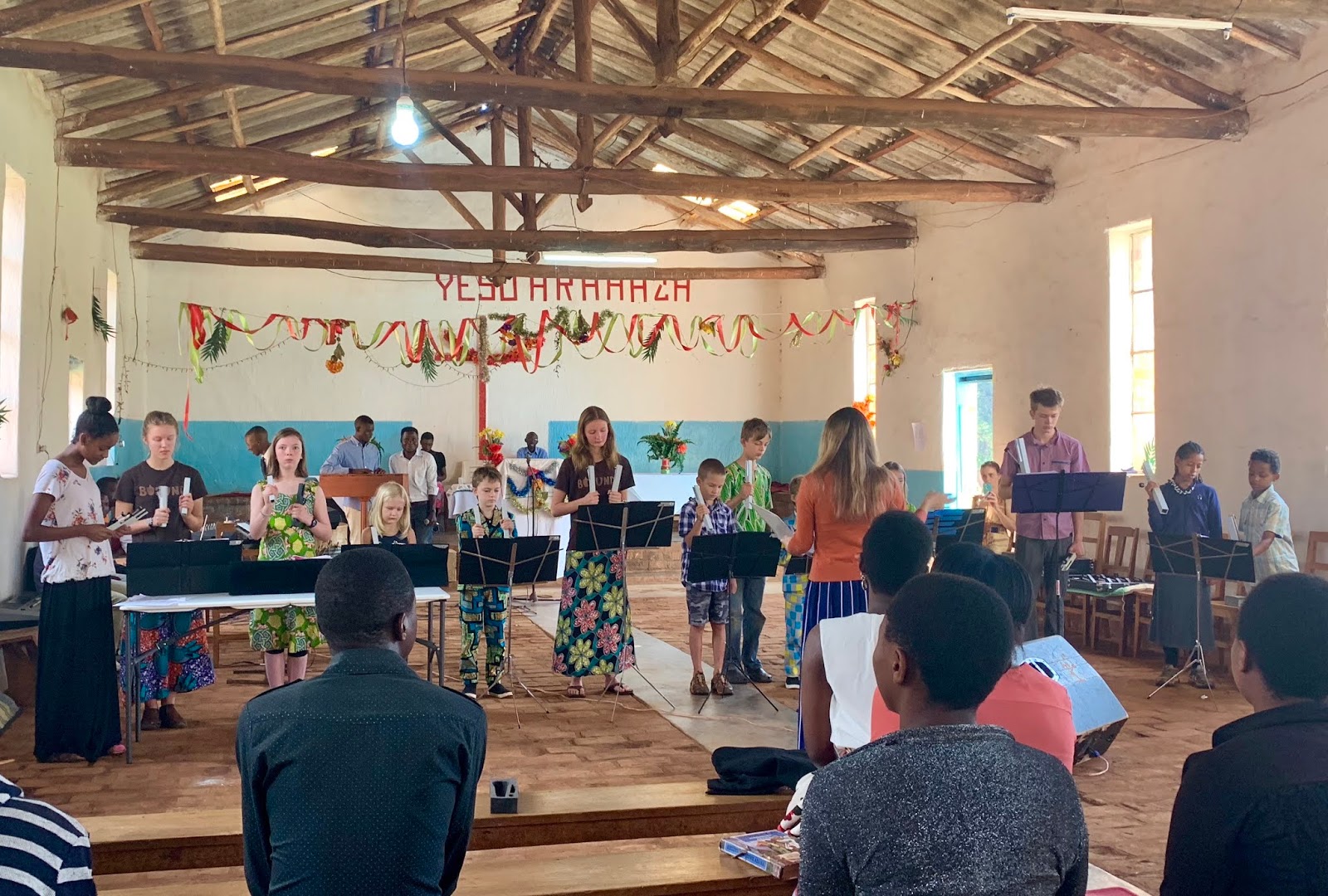
In addition to the Nativity, the kids also put together a chime performance. Michelle Wendler arranged a version of “Carol of the Bells” which she taught to the children during their music classes at Kibuye Hope Academy. The children performed the chimes and the Nativity in two locations at the hospital, as well as at the local school and the local church.


One of the places we performed was at the outpatient malnutrition clinic. These are children who had previously been admitted to the hospital for severe malnutrition. After they are released from the hospital, they are allowed to come back twice a week to be weighted, and receive a sack of Busoma (a nutrient-rich porridge) and a hard-boiled egg.

As the performance ended, I asked one of the chaplains to translate for me as I shared the good news of the Gospel with the children and their mothers. Christmas is not just a story - it happened! And it happened for a reason. God sent his son as a gift to us so we could be forgiven, and all we have to do is receive the gift.

As the pastor translated what I was saying, I noticed a majority of the group stood up. The pastor leaned over and whispered to me that he had asked who would like to respond to this good news, and who needs prayer. There were so many standing! Kibuye Hope Hospital is filled with people in need, not only for physical healing, but also for spiritual healing.


And that right there made it all worth it. All the rehearsals and costumes and sets. It wasn’t just a performance. We shared Jesus’s story. A story of grace, love, and forgiveness.

Please continue to pray not only for our team here at Kibuye, but also for the three chaplains who have a huge job at the hospital. The needs are massive. Physically and spiritually. We pray that everything we do is wrapped in truth and grace. Even a performance like this, that is new to their culture and can be a bit of a spectacle, we pray that the light of the Gospel would shine through all we do here.


Cast:

Madeline and Zeke as Mary and Joseph


Alma, Ella, and Seija as the Angels


Anna was the Kirundi narrator, Piper was the French narrator


Micah Watts and Abi Fader as the Shepherds


Liam Banks, Biniyam, and Kaden as the Three Wise Men


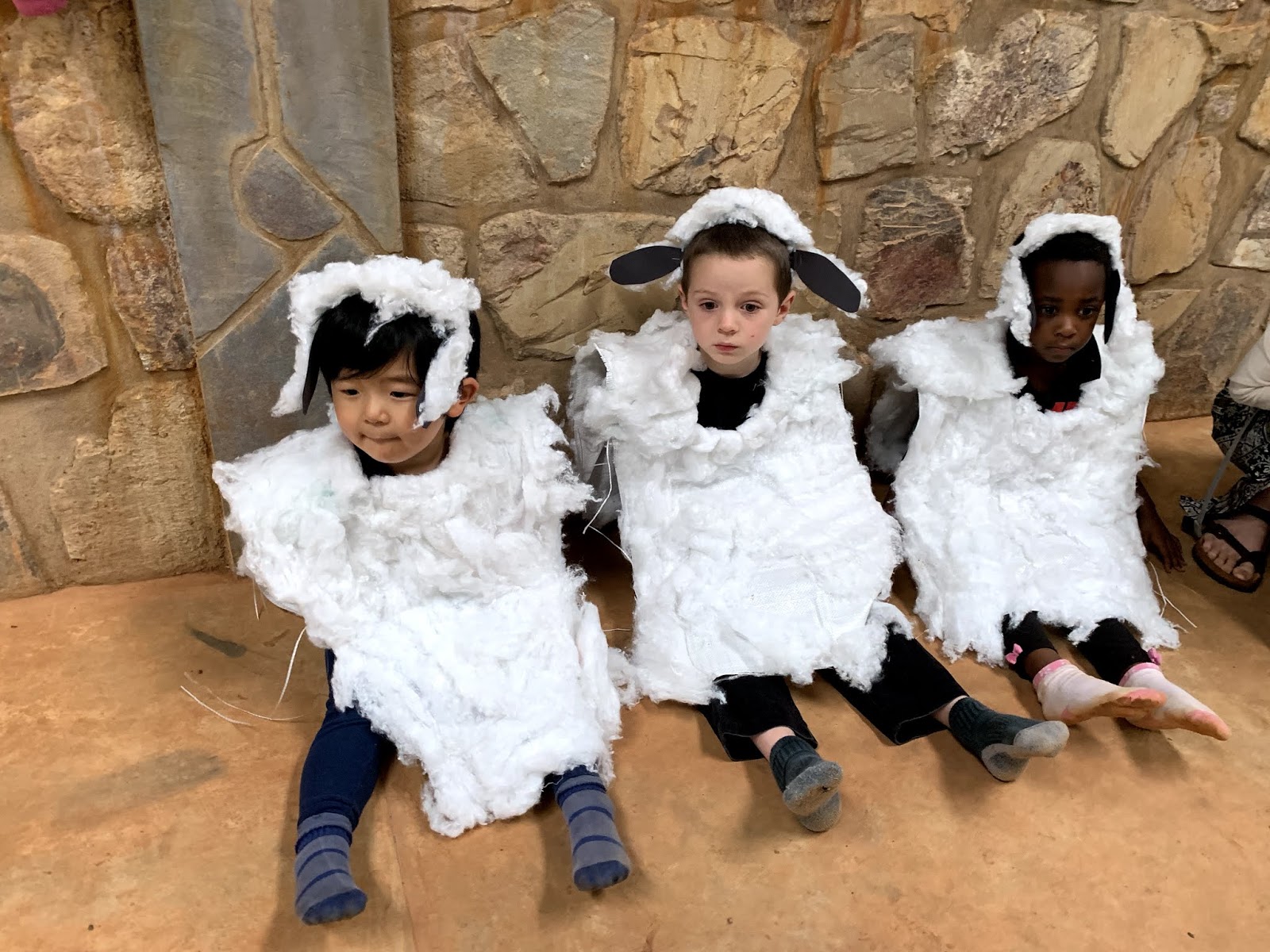
Toby John, Liam Fader, and Tracy (Dr. Alliance's daughter) as the Sheep


10.1.19

Two Graces for the First Day Back

(from Eric)

Our family returned back to Burundi last week, and Rachel and I restarted work in the hospital on Monday.  I had been seeing my hospitalized patients for a couple days, but yesterday was my first day in clinic.

The day starts out with Alyssa sharing at hospital devotions.  She leads the hospital staff through a small gratitude exercise, passing out sheets of a yellow legal pad for us to write down those innumerable gifts that God has given us that we are so apt to forget.  We close with a prayer and a few announcements, and the day starts.

The medical student who is working with me (and serving as Kirundi translator) walks with me to my clinic office, where an old man is waiting outside the door with his clinic sheet.  She exchanges a few words with him, and tells me "I think he has Parkinson's Disease, or something like that."  I start with surprise and then recovering, ask them to come inside.  Sure enough, this old man has come all the way from Tanzania because of a tremor which seems consistent with Parkinson's.  I have not yet found any real treatment options for Parkinson's in Burundi, and I doubt his rural outpost of Tanzania has better options.

I grab a bottle of Sinemet out of my office drawer, and I say to my student in French, "I don't make a habit of bringing medicines from the United States, mostly because we want to support Burundian supply chains.  But, you see, my grandmother passed away a couple months ago.  She was a wonderful and lovely woman.  My grandfather asked me to go through the medications she left behind, to see if any would be useful for Burundi.  The only one that seemed useful to bring back was this medicine for Parkinson's.  This bottle won't last forever, but I hope it will help him feel better for a while."  Turning to the man, I continue,  "I don't see that many patients with Parkinson's, and I wondered whether I would find any before the medicine expired, but lo and behold, you are my first patient back, and it's precisely what you need."

My student gives me a look that says, "Do you want me to tell the patient all that?"  Yes, I do.  I watch my patient's face light up with joy and profound gratitude on hearing the story of his medication bottle, and I think about the beauty and the probability of this moment.

A couple patients later, I see a 50-year old woman with heart failure.  She is a village lady that I diagnosed a couple years ago.  "She's only taking this one medicine now?" I ask.  "How is she doing?"  My student and the woman chat for a few sentences.  "She says that she feels very well.  Before, she couldn't even walk, and everyone told her that she would never get better.  Now she thanks God because she is even able to work in her fields, though she does get tired sometimes."

I smile at my student.  These cases can seem so rare sometimes.  I pick up my folded sheet of yellow legal paper from the morning hospital devotions.  "Did you hear what Dr. Alyssa said this morning?"  My student nods.  I say, "I'm going to write this lady down on my paper."

***

The thing is, since returning to Burundi, my most frequent prayer has been that I would be able to see God's hand at work in my life and in the world around me, day by day.  Kicking off my first clinic day with these two stories seems to be Grace to me in the form of an answered prayer.

Many other days are just discouraging.  Today was much more that way.  My patients are mostly sick and none of them seem like they're getting better.  Is God at work?  Do I just need eyes to see it?  Walking home through the gate, there is a vivacious chatter of a flock of weaver birds who have taken refuge in one of our tall eucalyptus trees.


It's a thing of beauty and of joy.  But is it really just a tree and some animals?  Or are these small wonders windows that peek into God's work in the world and his glory?  On one hand, I'm not interested in rose-colored glasses, but I need not exchange them for blinders either.

I think the answer to such questions always requires some kind of faith, in the end.  Either faith that it's just a coincidence or faith that it's something more.  Either faith that it's just a bird, or faith that it's a glimpse of the light of the world.  I'm not talking about faith as some arbitrary choice.  We reason and we discern, but there does seem to be some irreducible element of choice that remains.  How will we see the world?

I really do hope to see the world with gratitude for all that God does.  And at least for today, it seems like a reasonable approach.

***

(for those interested in slogging through this question with the great Blaise Pascal, here is a quote that is most rewarding is you can persevere through the tangle of double negatives:

“The prophecies, the very miracles and proofs of our religion, are not of such a nature that they can be said to be absolutely convincing. But they are also of such a kind that it cannot be said that it is unreasonable to believe them. Thus there is both evidence and obscurity to enlighten some and confuse others. But the evidence is such that it surpasses, or at least equals, the evidence to the contrary, so that it is not reason which can determine men not to follow it, and thus it can only be lust or malice of heart. And by this means there is sufficient evidence to condemn, and insufficient to convince; so that it appears in those who follow it that it is grace, and not reason, which makes them follow it; and in those who shun it, that it is lust, not reason, which makes them shun it.”)